
Adversarial patterns and infrared frames fail when surrounding cameras use gait analysis, multi-angle stitching, or visible light sensors.
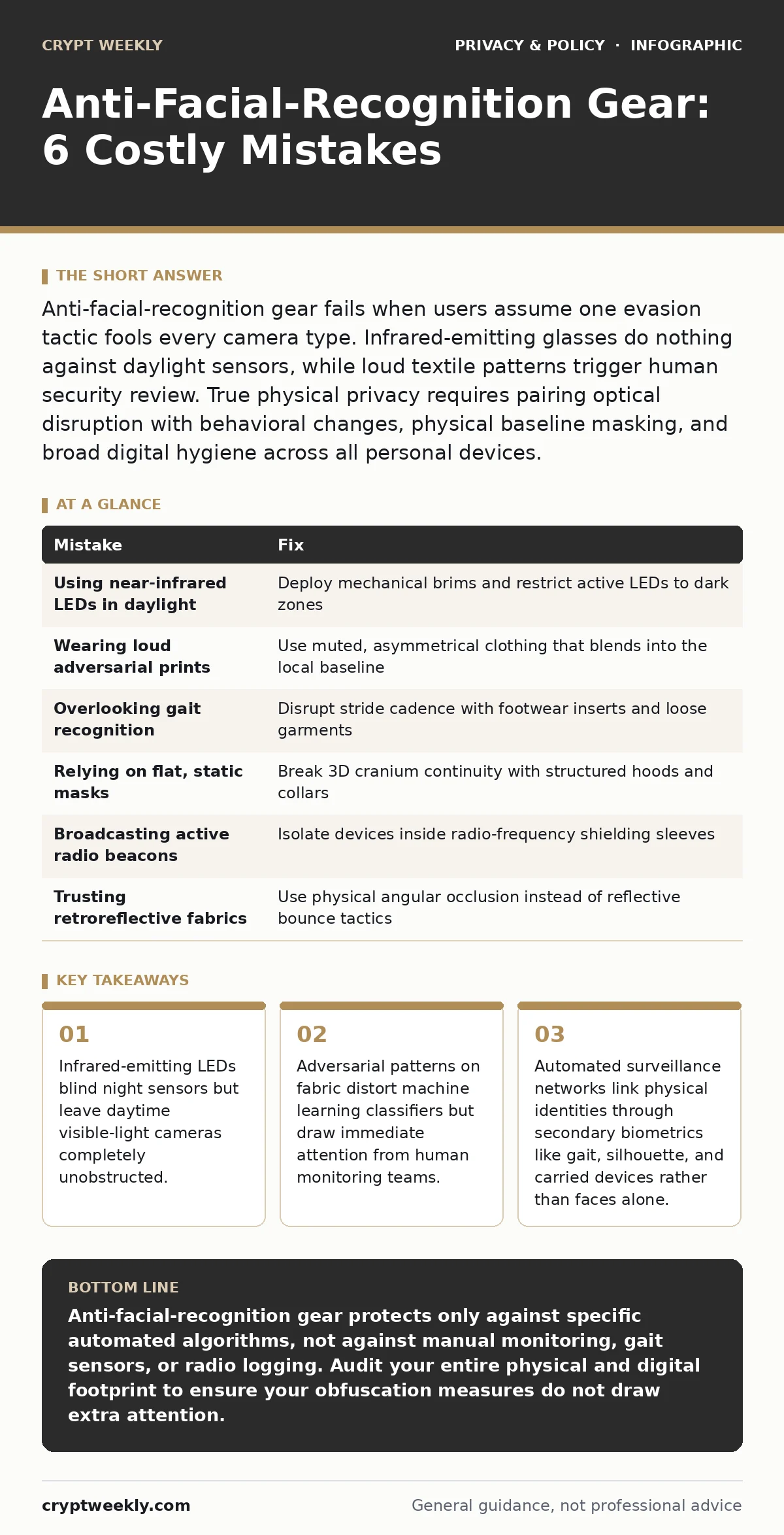
Anti-facial-recognition gear fails when users assume one evasion tactic fools every camera type. Infrared-emitting glasses do nothing against daylight sensors, while loud textile patterns trigger human security review. True physical privacy requires pairing optical disruption with behavioral changes, physical baseline masking, and broad digital hygiene across all personal devices.
Mistake 1: Relying on Near-Infrared LEDs in Daylight
Why it hurts:
Near-infrared light-emitting diodes (NIR LEDs) mounted to eyeglass frames blast light invisible to human eyes to saturate camera sensors. Daylight and indoor fluorescent bulbs flood the environment with broad-spectrum ambient light, overpowering tiny battery-powered diodes. Most daylight surveillance relies on visible-spectrum sensors with physical infrared-cut filters, which block incoming infrared wavelengths entirely. Your battery drains quickly while daytime cameras capture an unhindered, high-contrast image of your facial features.
The fix:
Treat active illumination devices strictly as night-use gear against monochromatic security feeds. Combine optical disruption with low-tech physical barriers, such as wide-brimmed hats or downward head angles, to obstruct overhead lenses. Optical disruption only degrades automated alignment; it never prevents direct human observation.
Mistake 2: Wearing Adversarial Prints That Flag Human Operators
Why it hurts:
Adversarial fashion uses algorithmic designs to trick convolutional neural networks (CNNs)—mathematical engines trained to detect faces and bodies—into seeing false shapes. A fabric pattern designed to register as three different faces confuses an automated detector, but human monitoring teams spot bizarre geometry instantly. Once an operator sees you wearing a garish optical distortion poncho, they switch their feed to manual tracking. Automated evasion fails the moment it induces human scrutiny.
The fix:
Select muted, irregular textures and asymmetrical cuts rather than high-contrast synthetic prints designed solely against specific open-source neural datasets. If your threat model involves mass automated sweeps, blend your clothing profile into local social baselines. You can complement physical evasion by handling your digital footprint; read our guide on removing your data from people-search sites to keep commercial scrapers from matching visual captures back to your home address.
Mistake 3: Ignoring Gait Analysis and Body Morphology
Why it hurts:
Modern tracking platforms use multimodal tracking, combining facial detection with gait recognition and volumetric silhouette modeling. Gait recognition systems measure the distance between steps, cadence, knee angles, and hip rotation over successive frames. Obscuring your cheekbones and nasal bridge leaves your walking cadence completely exposed. A multi-lens surveillance cluster links your masked face to an unmasked profile recorded two blocks earlier simply by cross-referencing how your limbs swing.
The fix:
Alter your physical movement profile alongside your headwear. Place small orthotic lifts of unequal height inside your footwear, carry a heavy bag on alternating sides, or adopt looser silhouettes that obscure limb joints. Physical privacy fails if your lower body remains an open biometric beacon to modern predictive analytics engines.
Mistake 4: Wearing Static Masks Against Dynamic Face Reconstruction
Why it hurts:
Retroreflective patches and static hyper-face masks attempt to confuse facial-landmark detection, which maps points like eye corners and jawlines. Modern surveillance clusters do not rely on isolated still photographs; they capture high-frame-rate video feeds across overlapping visual fields. Dynamic software algorithms stitch 3-frame sequences from 4 different angles, building a 3D structural model of your cranium that mathematically discards flat or static artifacts. Your static mask gets filtered out as visual noise.
The fix:
Disrupt the continuity of physical landmarks continuously using asymmetrical structural alterations rather than flat graphics. Combine deep hooded outerwear, structured collars that obscure the jaw angle, and tinted protective eyewear that breaks ocular symmetry. Pair these techniques with digital discipline; consult our advice on hiding your location on X (Twitter) to ensure external network telemetry does not undermine your visual obfuscation efforts.
Mistake 5: Carrying Active Radio Beacons Alongside Visual Camouflage
Why it hurts:
Visual camouflage is pointless when your pocket continuously broadcasts your unique hardware address. Cellular towers, local wireless networks, and Bluetooth proximity sniffers log your phone's media access control (MAC) address as you move past physical checkpoints. Automated physical security engines match timestamped radio handshakes directly to unknown visual subjects on camera. Even if your anti-surveillance glasses turn your face into an unreadable visual smear, your device announces your identity to the exact same tracking log.
The fix:
Isolate your radio-frequency profile before deploying optical disruption gear. Place your primary hardware in a certified signal-blocking radio frequency attenuation sleeve, or power devices completely down before entering monitored spaces. Visual obfuscation works only when severed from the ambient digital exhaust of modern handheld operating systems.
See also: Hiding your location on X: containment and recovery steps
Mistake 6: Assuming Retroreflective Materials Defeat All Lens Formats
Why it hurts:
Retroreflective glass-bead fabric bounces incoming light back along the vector of origin to overexpose a camera image. Security systems operating with off-axis illumination—where the light emitter sits several feet away from the receiving camera lens—bypass this effect entirely. Light bounced by retroreflective materials misses the off-axis lens, rendering the fabric as ordinary gray cloth. The camera captures your facial structure under plain environmental lighting without experiencing sensor blinding.
The fix:
Rely on geometric occlusion rather than dynamic reflection. Rigid structural brims, high wraps, and physical distance create shadow fields that do not depend on sensor positioning or flash angles. Physical space management protects against a broader range of focal lengths and sensor architectures than dynamic reflective treatments ever manage.
Summary of Anti-Recognition Mistakes and Fixes
| Mistake | Fix |
|---|---|
| Using near-infrared LEDs in daylight | Deploy mechanical brims and restrict active LEDs to dark zones |
| Wearing loud adversarial prints | Use muted, asymmetrical clothing that blends into the local baseline |
| Overlooking gait recognition | Disrupt stride cadence with footwear inserts and loose garments |
| Relying on flat, static masks | Break 3D cranium continuity with structured hoods and collars |
| Broadcasting active radio beacons | Isolate devices inside radio-frequency shielding sleeves |
| Trusting retroreflective fabrics | Use physical angular occlusion instead of reflective bounce tactics |
Practical Deployment Checklist
- Inspect your route for daylight visible-light cameras and off-axis lighting systems.
- Place asymmetrical orthotic inserts in your shoes to disrupt gait recognition patterns.
- Pack mobile devices in verified signal-attenuating pouches.
- Select muted outer garments that avoid human operator suspicion.
- Align headwear to physically block overhead sensor fields of view.
Key takeaways
- Infrared-emitting LEDs blind night sensors but leave daytime visible-light cameras completely unobstructed.
- Adversarial patterns on fabric distort machine learning classifiers but draw immediate attention from human monitoring teams.
- Automated surveillance networks link physical identities through secondary biometrics like gait, silhouette, and carried devices rather than faces alone.
Anti-facial-recognition gear protects only against specific automated algorithms, not against manual monitoring, gait sensors, or radio logging. Audit your entire physical and digital footprint to ensure your obfuscation measures do not draw extra attention.
Frequently asked questions
Do anti-facial-recognition glasses protect against thermal imaging sensors?
No, anti-facial-recognition glasses disrupt visible and near-infrared spectrums, not long-wave thermal emissions. Thermal sensors map heat signatures across skin tissue, which requires specialized insulating barriers to mask.
Why do adversarial patterns fail against newer surveillance networks?
Adversarial patterns target specific mathematical shortcuts inside older neural network models. Newer surveillance platforms use diverse training sets and multi-camera spatial fusion, allowing them to classify distorted subjects easily or flag them for human review.
Can ambient makeup designs bypass modern automated facial recognition?
High-contrast asymmetrical makeup can disrupt basic facial landmarking algorithms in laboratory settings. Real-world surveillance systems rely on multi-angle feeds, walking gait, and depth sensing that render surface-level makeup largely ineffective.
Will wearing anti-surveillance clothing attract legal penalties?
Jurisdictions regulate public face coverings differently, with some prohibiting public disguise during demonstrations or transit. Check municipal and regional regulations regarding masked identities in public areas before deploying disruptive face gear.
How this guide was produced: written by the Crypt Weekly editorial team with AI assistance, checked against the public references listed below, and reviewed when the facts change. See our editorial policy or report an error.