
Clearing your personal records from broker sites stops automated harvesting temporarily, but public government registries regenerate the profiles continuously.
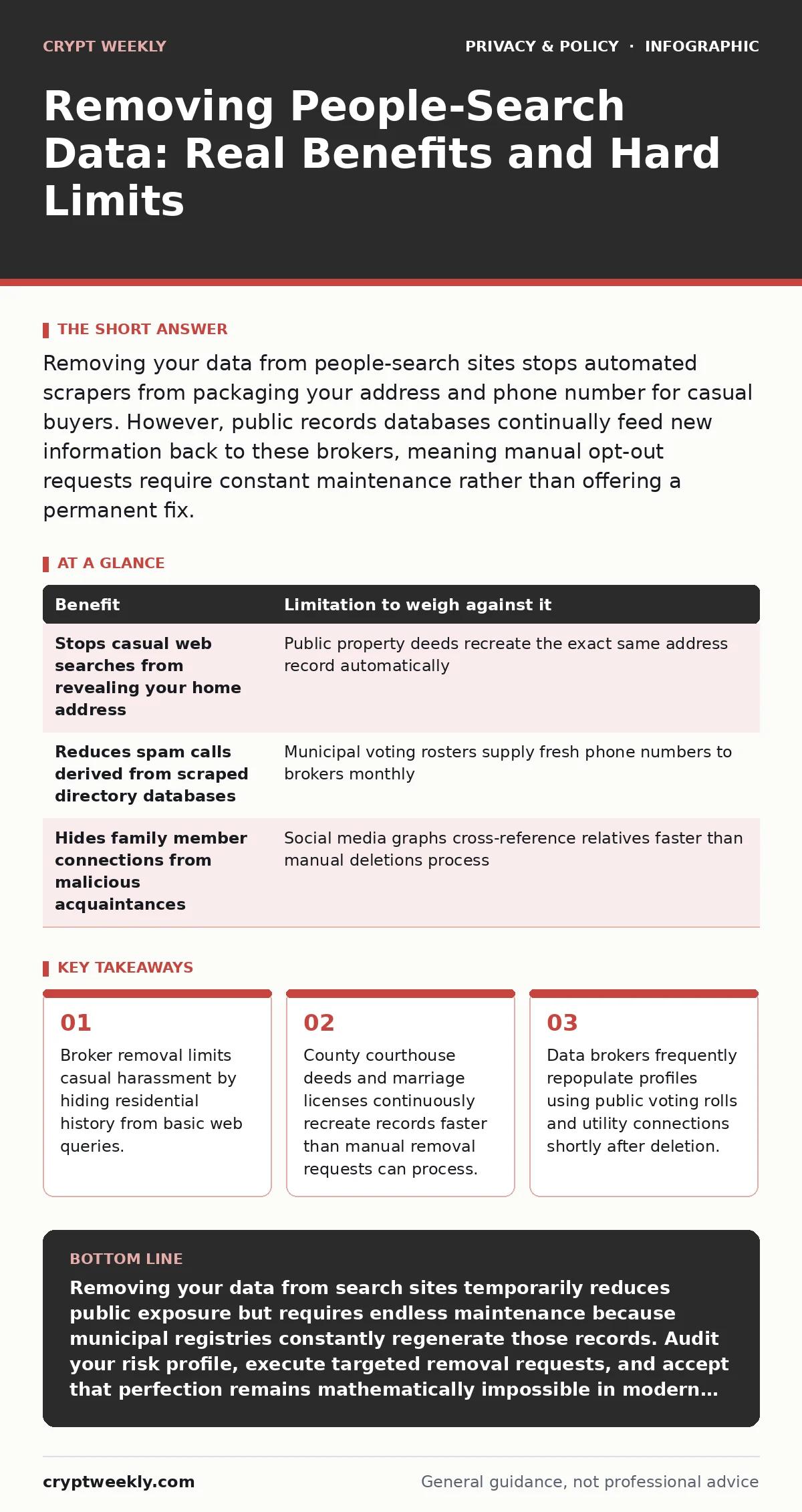
Removing your data from people-search sites stops automated scrapers from packaging your address and phone number for casual buyers. However, public records databases continually feed new information back to these brokers, meaning manual opt-out requests require constant maintenance rather than offering a permanent fix.
How People-Search Brokers Harvest Information
Data brokers scrape municipal registries, property deeds, and court dockets to assemble detailed dossiers on private citizens. These commercial databases monetize public records by organizing fragmented municipal filings into searchable profiles containing current addresses, relative networks, and estimated household income. Automated collection scripts pull updates directly from government servers every single day without human intervention.
Municipal transparency laws force local governments to publish these filings openly for public accountability. Commercial entities exploit these open archives to build secondary databases that operate entirely outside your direct control. Understanding this collection pipeline clarifies why simple deletion requests rarely result in permanent removal from the web.
The Concrete Benefits of Manual Opt-Out Requests
Removing these dossiers eliminates the easiest vector for local stalkers and malicious actors seeking your physical location. Hiding phone numbers and street addresses behind opt-out portals reduces nuisance phone calls, unsolicited marketing mail, and basic neighborhood surveillance. 3 distinct advantages emerge when you successfully scrub your primary profiles from top-tier broker networks.
- Reduced exposure to automated phishing campaigns targeting specific residential areas
- Elimination of direct-dial phone numbers from public aggregation directories
- Lowered visibility for casual acquaintances attempting to find your current home
Hidden Limitations and the Resubmission Cycle
County clerk offices regularly publish updated property transfers and voter registration lists directly to public servers. Data brokers scrape these municipal updates continuously, meaning successful removal requests often expire the moment a new public document links your name to an address.
Real privacy requires looking past simple broker removals, just as analyzing browser fingerprinting reveals how commercial trackers identify hardware configurations without relying on traditional storage methods. Similarly, reviewing municipal records compares to evaluating anonymization techniques that strip identifiable fields from datasets without guaranteeing absolute unlinkability.
Comparing Removal Advantages Against Maintenance Costs
Weighing the tactical advantages against the recurring operational friction requires a clear breakdown of expected outcomes.
| Benefit | Limitation to weigh against it |
|---|---|
| Stops casual web searches from revealing your home address | Public property deeds recreate the exact same address record automatically |
| Reduces spam calls derived from scraped directory databases | Municipal voting rosters supply fresh phone numbers to brokers monthly |
| Hides family member connections from malicious acquaintances | Social media graphs cross-reference relatives faster than manual deletions process |
When Opting Out Is Worth Your Time
Protecting your physical safety after a local relocation makes manual removal efforts worthwhile. Imagine moving to a new neighborhood to escape a hostile living situation, where scrubbing your public registry footprint prevents immediate location tracking by unwanted parties. 3 steps define this defensive workflow: auditing high-risk broker platforms, submitting formal removal requests, and setting recurring calendar alerts to check for profile regeneration.
- Audit the top 5 largest data broker platforms manually every quarter
- Submit formal opt-out forms using a dedicated email address and VoIP phone number
- Monitor search engine results for cached personal snippets after successful removals
When Removing Data Fails to Protect You
Pursuing complete digital erasure becomes pointless if you maintain active professional social media profiles with your home city listed openly. Publicly accessible networking sites defeat the purpose of scrubbing secondary databases because corporate marketing databases cross-reference social graphs instantly.
Suppose you maintain an active online storefront or professional registry under your legal name, tying every government filing directly back to your active digital identity. In these cases, spending hours chasing down every independent broker yields negligible security improvements because your professional footprint remains permanently exposed.
Maintaining Privacy Beyond Broker Removal
Sustaining operational security demands continuous vigilance against digital leakage, much like mitigating ISP tracking requires encrypted tunnels rather than relying on basic browser settings or default configurations. Data brokers represent only one commercial layer in a massive ecosystem of corporate surveillance. Combining periodic broker scrubbing with disciplined sharing habits creates a manageable barrier against casual data aggregation.
- Audit all public social media accounts for exposed residential locations
- Restrict real estate ownership records through legal LLC structures where local laws permit
- Use separate email identities for all government and municipal interactions
Key takeaways
- Broker removal limits casual harassment by hiding residential history from basic web queries.
- County courthouse deeds and marriage licenses continuously recreate records faster than manual removal requests can process.
- Data brokers frequently repopulate profiles using public voting rolls and utility connections shortly after deletion.
Removing your data from search sites temporarily reduces public exposure but requires endless maintenance because municipal registries constantly regenerate those records. Audit your risk profile, execute targeted removal requests, and accept that perfection remains mathematically impossible in modern data ecosystems.
Frequently asked questions
How often do data-broker profiles regenerate after a successful removal request?
Profiles frequently reappear within a few months because automated scrapers continuously ingest newly updated municipal property deeds, court filings, and voting registries.
Do paid automated removal services offer permanent protection against data brokers?
Automated services do not offer permanent protection because they simply repeat the same manual opt-out process on a recurring subscription schedule whenever new public records appear.
Does removing your data from people-search sites hide you from law enforcement databases?
People-search removals have zero impact on law enforcement access because police databases rely on restricted government networks rather than commercial broker sites.
Can I use a fake name on government documents to prevent data broker collection?
Using false information on legal filings like property deeds or voter registration forms constitutes fraud and creates severe legal complications.
How this guide was produced: written by the Crypt Weekly editorial team with AI assistance, checked against the public references listed below, and reviewed when the facts change. See our editorial policy or report an error.