Smart city sensors collect massive data streams that create new attack surfaces, requiring strict identity controls and continuous monitoring to prevent systemic urban failure.
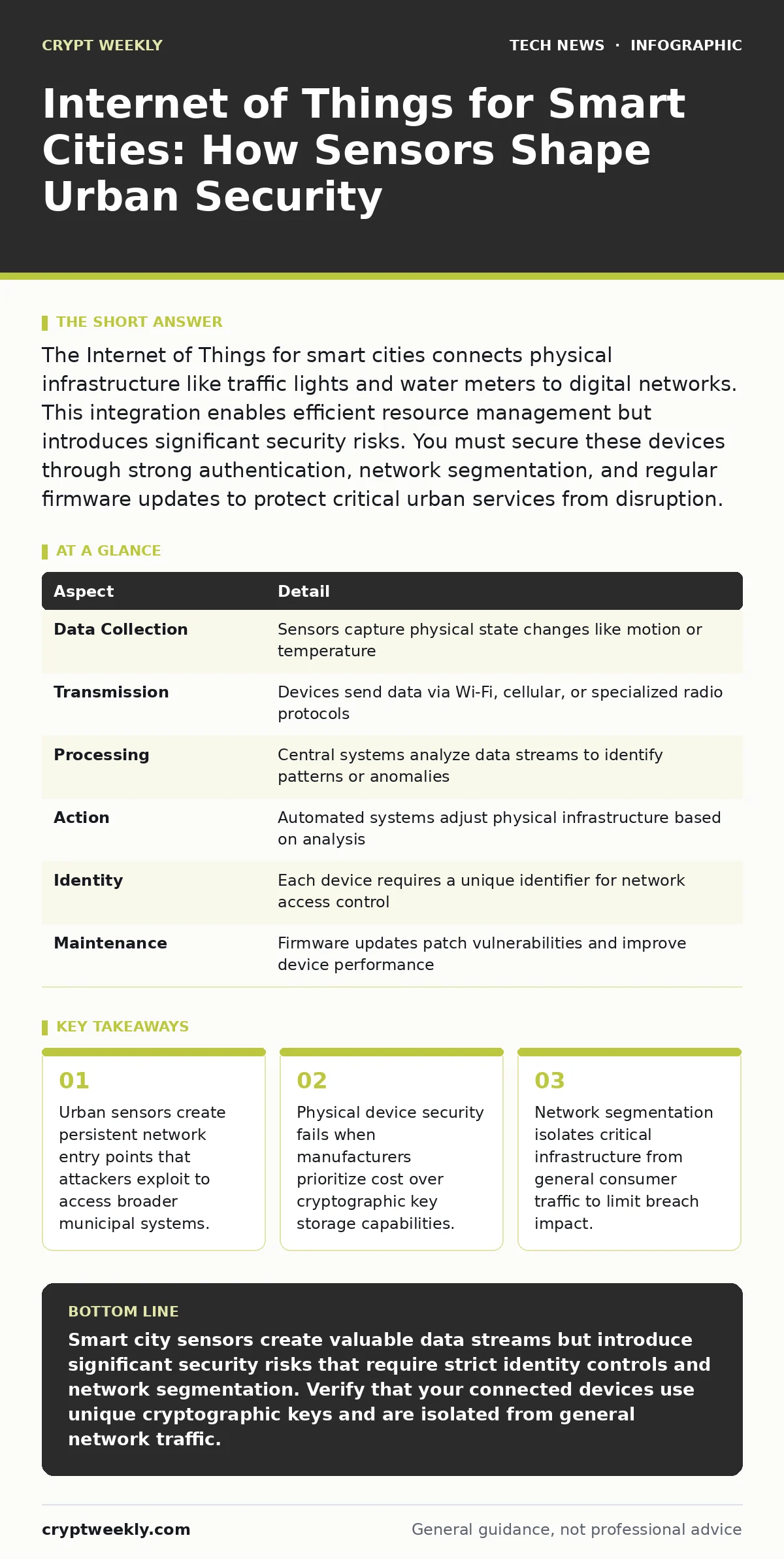
The Internet of Things for smart cities connects physical infrastructure like traffic lights and water meters to digital networks. This integration enables efficient resource management but introduces significant security risks. You must secure these devices through strong authentication, network segmentation, and regular firmware updates to protect critical urban services from disruption.
Understanding the Internet of Things for Smart Cities
Imagine a city where traffic lights adjust timing based on real-time vehicle flow, water mains detect leaks before they burst, and streetlights dim when no pedestrians are present. This vision relies on the Internet of Things for smart cities, which embeds sensors and controllers into physical infrastructure. These devices collect environmental data and transmit it to central systems for analysis and automated response.
The core mechanism involves small, low-power computers attached to physical objects. These devices measure variables such as temperature, motion, or pressure. They send this data over wireless or wired networks to cloud platforms or local servers. Software algorithms process the incoming information and trigger actions, such as opening a valve or changing a signal. This loop of sensing, transmitting, and acting creates a responsive urban environment.
| Aspect | Detail |
|---|---|
| Data Collection | Sensors capture physical state changes like motion or temperature |
| Transmission | Devices send data via Wi-Fi, cellular, or specialized radio protocols |
| Processing | Central systems analyze data streams to identify patterns or anomalies |
| Action | Automated systems adjust physical infrastructure based on analysis |
| Identity | Each device requires a unique identifier for network access control |
| Maintenance | Firmware updates patch vulnerabilities and improve device performance |
How Urban Sensor Networks Operate
You might assume these devices simply send data to a server. The reality is more complex. Each sensor must establish a secure connection to the network. It presents digital credentials to prove its identity. The network verifies these credentials before allowing data transmission. This process relies on public key cryptography to ensure that only authorized devices can join the network.
The devices often operate on constrained power sources, such as batteries or energy harvesting from sunlight. They use low-power wide-area networks to communicate over long distances with minimal energy consumption. This efficiency comes at a cost. These networks often have limited bandwidth and higher latency compared to standard Wi-Fi. Security protocols must be lightweight to avoid draining batteries or clogging the network with excessive handshake data.
Who Is Affected by Connected Infrastructure
You are affected by these systems whether you own a device or not. Municipalities operate the infrastructure, but citizens experience the outcomes. A breach in traffic control systems can cause gridlock, delaying emergency vehicles. A compromise in water quality sensors can lead to undetected contamination. The impact extends beyond inconvenience to public health and safety.
Service providers who install and maintain these networks face liability. They must ensure devices meet security standards. If a vendor sells a device with hardcoded passwords, the entire city network becomes vulnerable. Manufacturers bear responsibility for the lifecycle of their products. This includes providing security patches for years after deployment. You, as a citizen, have little control over these underlying technical decisions.
What People Usually Get Wrong
Many assume that because these devices are small and simple, they are not worth attacking. This view ignores the value of the data they collect and the access they provide. A single compromised streetlight can serve as a foothold for attackers to move laterally into the municipal network. Attackers use this initial access to reach more valuable targets, such as financial records or personal data.
Another common error is believing that physical security replaces digital security. Locking a sensor in a cabinet does not prevent remote exploitation. Attackers can send malicious commands over the air interface. They do not need physical access to manipulate the device. You must treat every connected device as a potential entry point, regardless of its physical location or perceived importance.
Securing the Urban Digital Layer
You must implement strict identity management for every device. Each sensor needs a unique cryptographic key. This prevents an attacker from cloning a device or impersonating a legitimate sensor. Public key infrastructure provides the framework for issuing and managing these keys. Without unique identities, it is impossible to detect which device is sending malicious data.
Network segmentation is critical. You should isolate critical infrastructure devices from general-purpose networks. Traffic lights and water controls should reside on a separate network segment from public Wi-Fi or office computers. This limits the blast radius of a breach. If an attacker compromises a public-facing system, they cannot easily jump to the critical control network. This architectural choice reduces the risk of systemic failure.
The Hidden Cost of Convenience
The drive for efficiency often overlooks security requirements during the design phase. Engineers prioritize battery life and data throughput. Security adds overhead, consuming power and bandwidth. This trade-off leads to devices with weak authentication or unencrypted communication. You inherit these vulnerabilities when the city deploys the hardware.
Maintenance is another hidden cost. Devices must be updated to fix security flaws. This requires a reliable update mechanism and a process for verifying the integrity of new firmware. If the manufacturer stops supporting the device, you are left with an unpatched vulnerability. You must plan for the entire lifecycle, including decommissioning. Retiring devices securely ensures that their keys and data do not remain accessible after they are removed from service.
What To Do About Urban Security
You should advocate for security standards in procurement. Municipalities must require vendors to demonstrate secure development practices. This includes using secure boot processes and storing cryptographic keys in hardware security modules. You can influence policy by understanding the technical requirements. Asking about update mechanisms and identity management during vendor evaluations pushes for better security outcomes.
Individuals can also take steps to protect their own connected devices. If you have a smart home system that interfaces with city services, ensure it is on a separate network. Use strong, unique passwords for your accounts. Monitor your device logs for unusual activity. While you cannot secure the entire city, you can secure your own entry points. This reduces the risk of your devices being used as part of a larger attack against urban infrastructure.
Key takeaways
- Urban sensors create persistent network entry points that attackers exploit to access broader municipal systems.
- Physical device security fails when manufacturers prioritize cost over cryptographic key storage capabilities.
- Network segmentation isolates critical infrastructure from general consumer traffic to limit breach impact.
- Regular firmware audits prevent exploitation of known vulnerabilities in legacy connected devices.
Smart city sensors create valuable data streams but introduce significant security risks that require strict identity controls and network segmentation. Verify that your connected devices use unique cryptographic keys and are isolated from general network traffic.
Frequently asked questions
How do smart city devices get their security updates?
Devices receive updates over-the-air from the manufacturer's servers. The update package is digitally signed to ensure it has not been tampered with. The device verifies the signature before installing the new firmware to prevent malicious code execution.
Can an attacker control traffic lights remotely?
Yes, if the traffic control system has unpatched vulnerabilities or weak authentication. Attackers can send malicious commands to manipulate signal timing. This can cause accidents or gridlock. Proper network segmentation and strict access controls mitigate this risk.
What happens if a smart city sensor is stolen?
The thief gains physical access to the device hardware. They may attempt to extract cryptographic keys or modify the firmware. Secure hardware design protects keys from extraction. The network should detect the missing device and revoke its credentials to prevent unauthorized use.
Do smart cities use IPv6 for their sensors?
Many smart city deployments use IPv6 because it provides a vast address space. This allows every sensor to have a unique global IP address. IPv6 security features, such as IPsec, can provide built-in encryption and authentication. Understanding IPv6 security helps in configuring these devices correctly.
How this guide was produced: written by the Crypt Weekly editorial team with AI assistance, checked against the public references listed below, and reviewed when the facts change. See our editorial policy or report an error.