Public key cryptography uses two different keys where one locks data and only the other can open it, removing the need to share secrets.
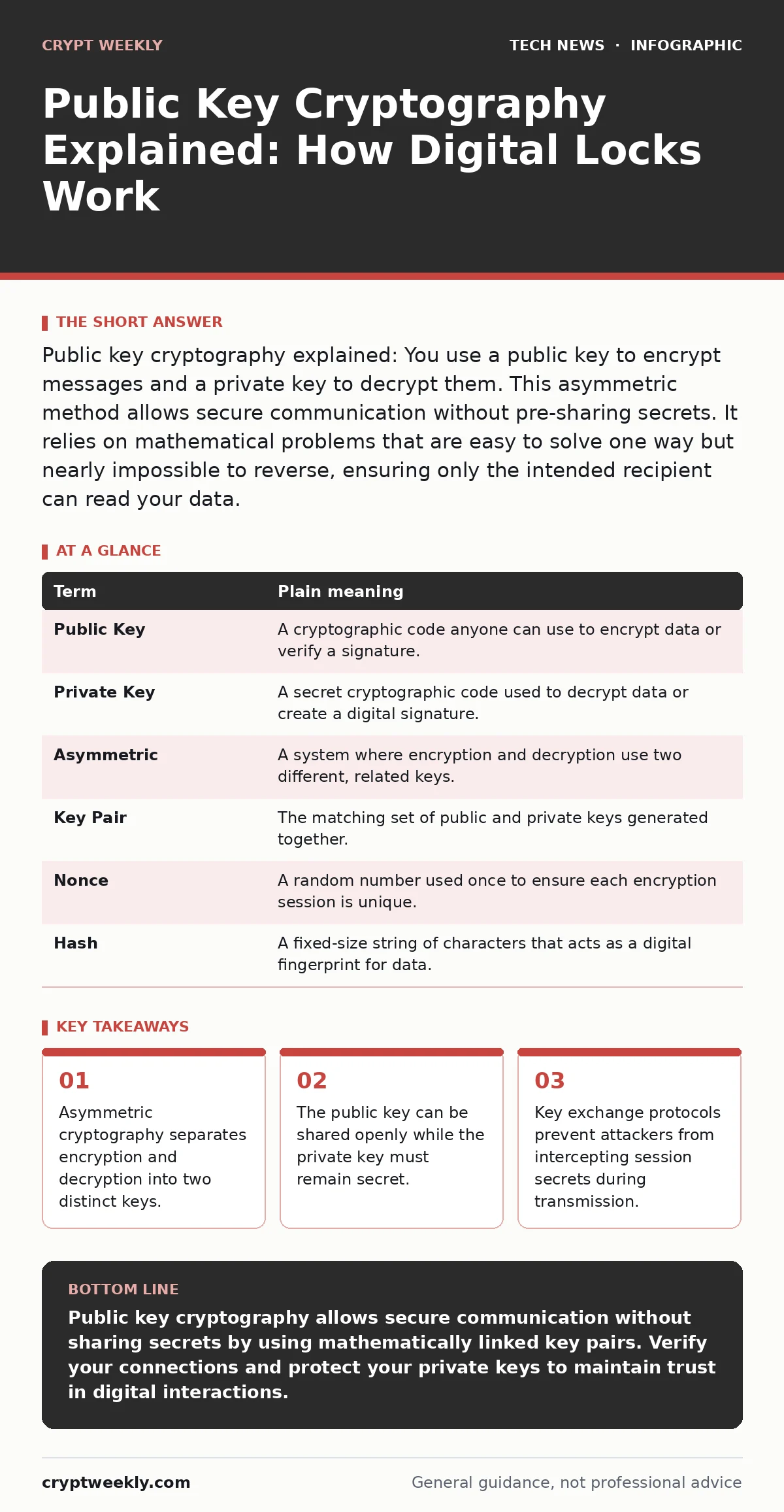
Public key cryptography explained: You use a public key to encrypt messages and a private key to decrypt them. This asymmetric method allows secure communication without pre-sharing secrets. It relies on mathematical problems that are easy to solve one way but nearly impossible to reverse, ensuring only the intended recipient can read your data.
Public Key Cryptography Explained
Imagine you want to send a locked box to a friend who lives far away. You do not have a shared key, and mailing a key through the post office is risky because someone could steal it. Instead, your friend sends you an open padlock. You place your message in the box, snap their padlock onto it, and mail it back. Only your friend has the key that opens that specific padlock. No one else can open the box, even if they intercept it. This is the core concept of public key cryptography.
In this system, the open padlock is the public key. You can give copies of this key to anyone. The key that opens the padlock is the private key. You never share this key with anyone. The security comes from the fact that having the public key does not help an attacker figure out the private key. The mathematical relationship between the two is one-way.
Key Terms in Asymmetric Encryption
Understanding the vocabulary helps you grasp why this method works better than older symmetric methods. Symmetric encryption uses the same key for locking and unlocking, which requires a secure way to share that key first. Asymmetric encryption solves that distribution problem.
| Term | Plain meaning |
|---|---|
| Public Key | A cryptographic code anyone can use to encrypt data or verify a signature. |
| Private Key | A secret cryptographic code used to decrypt data or create a digital signature. |
| Asymmetric | A system where encryption and decryption use two different, related keys. |
| Key Pair | The matching set of public and private keys generated together. |
| Nonce | A random number used once to ensure each encryption session is unique. |
| Hash | A fixed-size string of characters that acts as a digital fingerprint for data. |
The Math Behind the Lock
The security of public key cryptography explained relies on mathematical difficulty. The system uses large prime numbers to generate the key pair. Multiplying two large prime numbers is fast and easy for a computer. However, taking the result and working backward to find the original two primes is extremely difficult. This is called integer factorization.
Computers today are powerful, but they cannot easily factor large numbers. If you use a key with 2048 bits or more, the number of possible combinations is so vast that even the most powerful supercomputers would take longer than the age of the universe to break it. This asymmetry in computational difficulty is what protects your data.
Why You Need This for TLS
When you visit a secure website, your browser uses public key cryptography to establish a safe connection. This process is part of the TLS handshake. The server sends its public key to your browser. Your browser uses that public key to encrypt a session key. Only the server can decrypt that session key using its private key.
Once both sides have the session key, they switch to symmetric encryption for the rest of the conversation. Symmetric encryption is faster for large amounts of data. Public key cryptography is only used at the start to securely exchange the session key. This hybrid approach gives you both security and speed.
Digital Signatures and Trust
Public key cryptography also allows you to prove who you are. This is called a digital signature. To sign a document, you use your private key to create a unique code. Anyone can verify that signature using your public key. If the verification works, they know the document came from you and has not been altered.
This mechanism is central to certificate management. A certificate authority verifies your identity and signs your public key. When someone sees your certificate, they trust that your public key really belongs to you because the authority signed it. Without this chain of trust, an attacker could pretend to be a website and steal your login credentials.
See also: Encrypted Messaging Misconceptions That Leave You Exposed
Practical Steps to Verify Security
You can apply these concepts to your daily digital life. Understanding how keys work helps you spot weak points in your security setup. Here are three steps to check your current practices.
- Check the lock icon in your browser address bar to ensure the site has a valid certificate. Click it to see which certificate authority issued it.
- Review your SSH keys if you connect to remote servers. Ensure you are using Ed25519 or RSA keys with sufficient length, not older, weaker algorithms.
- Verify that your email provider supports end-to-end encryption. This ensures that only you and the recipient can read the message content.
Hidden Costs of Key Management
Managing keys is not just about generating them. You must store them securely and rotate them regularly. If a private key is compromised, you must generate a new pair and distribute the new public key. This process can be slow and disruptive.
For organizations, this leads to complex network monitoring requirements. You need to track where keys are used and ensure they are not stored in plain text. For personal devices, tools like FileVault handle key management automatically for disk encryption. You do not need to worry about the keys, but you must remember your recovery password. Losing that password means losing access to your data forever.
Emerging Threats and Standards
New computing models threaten traditional cryptography. Quantum computers could one day solve integer factorization quickly. If that happens, current public key systems will break. Researchers are developing post-quantum cryptography to address this.
Until then, stick to established standards. Do not use custom encryption algorithms. Use well-tested libraries that implement IPv6 security features and standard protocols. The transition to new standards will take time. For now, proper key management and strong key lengths are your best defense.
Key takeaways
- Asymmetric cryptography separates encryption and decryption into two distinct keys.
- The public key can be shared openly while the private key must remain secret.
- Key exchange protocols prevent attackers from intercepting session secrets during transmission.
Public key cryptography allows secure communication without sharing secrets by using mathematically linked key pairs. Verify your connections and protect your private keys to maintain trust in digital interactions.
Frequently asked questions
Can I create my own public key cryptography system?
You should not create your own cryptographic system. Use established libraries and protocols that have been tested by experts. Custom implementations often have hidden flaws that attackers can exploit.
What happens if I lose my private key?
If you lose your private key, you cannot decrypt data encrypted with the corresponding public key. You must generate a new key pair and update your public key with anyone who needs to send you secure messages.
Is public key cryptography slower than symmetric encryption?
Yes, public key operations are computationally intensive and slower. This is why systems use public keys only for key exchange or signing, then switch to symmetric encryption for actual data transfer.
Do I need a certificate authority for personal use?
You do not need a certificate authority if you exchange keys directly with trusted contacts. However, CAs provide trust for large-scale interactions like websites, ensuring you are communicating with the correct entity.
How this guide was produced: written by the Crypt Weekly editorial team with AI assistance, checked against the public references listed below, and reviewed when the facts change. See our editorial policy or report an error.