
RSA encryption remains secure because factoring massive numbers takes more energy than computers can manage.
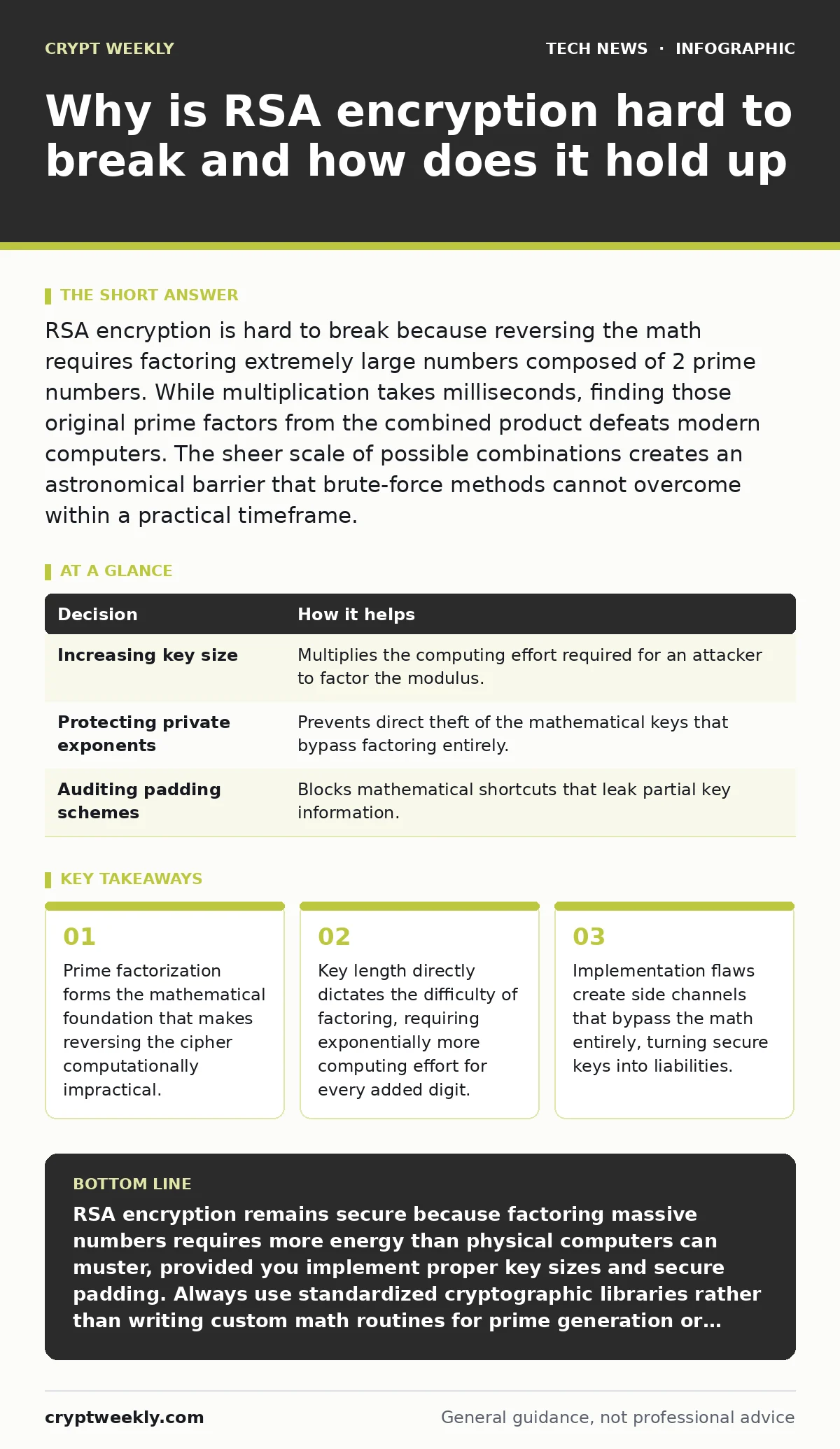
RSA encryption is hard to break because reversing the math requires factoring extremely large numbers composed of 2 prime numbers. While multiplication takes milliseconds, finding those original prime factors from the combined product defeats modern computers. The sheer scale of possible combinations creates an astronomical barrier that brute-force methods cannot overcome within a practical timeframe.
Why is RSA encryption hard to break and how does the math work
RSA encryption is hard to break because it relies on the asymmetry of prime multiplication versus prime factorization. Multiplying 2 massive prime numbers together takes a fraction of a second, but starting with the resulting product and finding the original primes requires testing countless possibilities. This mathematical one-way street forms the core of public key cryptography. Without knowing the original prime factors, an attacker faces a search space so vast that standard silicon processors will fail before exhausting the options.
Prime numbers serve as the atoms of arithmetic, and combining them creates a composite number with unique properties. When you multiply 2 large primes, you generate a public modulus used to lock data. Only someone holding the private exponent, derived directly from the hidden original primes, can easily reverse the operation. The difficulty scales exponentially as you increase the size of the primes, making larger keys dramatically harder to factor than smaller ones.
| Decision | How it helps |
|---|---|
| Increasing key size | Multiplies the computing effort required for an attacker to factor the modulus. |
| Protecting private exponents | Prevents direct theft of the mathematical keys that bypass factoring entirely. |
| Auditing padding schemes | Blocks mathematical shortcuts that leak partial key information. |
The role of key length in computational difficulty
Key length dictates the number of bits in the public modulus, directly controlling how long factoring takes. Small keys invite automated attacks because the number of combinations falls within the processing capacity of standard hardware. Doubling the key size does not merely double the security; it exponentially increases the number of operations an attacker must perform to find the factors. This scaling property gives defenders a massive advantage, provided they select key sizes that outpace current hardware advancements.
Choosing the right key size requires balancing performance overhead against security margins. Larger keys demand more CPU cycles for both encryption and decryption, slowing down connections and draining device batteries. Organizations often pair this system with symmetric algorithms to handle bulk data efficiently, using the asymmetric layer only for initial key exchange. Ignoring these performance trade-offs leads developers to shorten keys improperly, creating severe vulnerabilities.
Hidden costs and edge cases in prime generation
Generating secure primes requires true randomness, and predictable random number generators create catastrophic weaknesses. If a flawed generator repeats sequences or draws from a limited pool of values, an attacker can anticipate the primes without factoring the modulus at all. This flaw bypasses the underlying math entirely, proving that a secure algorithm cannot protect against weak input material.
Hardware failure during the generation phase can also produce weak keys that look random on the surface but share common factors with other keys on the network. When 2 independent systems generate overlapping primes, a mathematical shortcut allows anyone to compute the private key using a simple greatest common divisor calculation. Maintaining proper domain name system hygiene and secure provisioning pipelines helps catch these duplicate keys before deployment.
Side channel attacks that bypass the math
Side channel attacks bypass the hard mathematics of RSA by measuring physical properties like power consumption, electromagnetic radiation, or execution time during decryption. A processor uses varying amounts of electricity depending on whether it processes a binary zero or a one, leaking clues about the private key. Observers with sensitive equipment can record these tiny fluctuations over thousands of operations and reconstruct the secret exponent without solving a single factoring equation.
Defending against physical monitoring requires writing constant-time code that takes the exact same duration and burns the exact same power regardless of the key data. Standard software libraries implement these protections automatically, but custom implementations often fail. This vulnerability demonstrates that abstract mathematical security means little if the physical hardware leaks implementation details to a local observer.
See also: Anonymization of Data: How to Strip Identity Without Breaking Utility · What Is Virtual Machines: How Software Isolation Works
What goes wrong when padding schemes fail
Early implementations of RSA suffered from textbook attacks where mathematical relationships between plaintexts allowed attackers to decrypt messages without knowing the private key. To fix this, security engineers wrap plaintexts in randomized padding schemes before encryption. These schemes inject structured randomness into the input data, ensuring that encrypting the same message twice yields completely different ciphertexts and destroying the algebraic structures attackers exploit.
Using outdated padding schemes or rolling your own custom formatting introduces severe vulnerabilities that let malicious actors forge signatures or decrypt traffic. Modern systems rely on standardized, heavily reviewed padding modes that randomize input data and verify structure before processing. Neglecting these standards turns a mathematically sound cipher into a trivial puzzle.
Key takeaways
- Prime factorization forms the mathematical foundation that makes reversing the cipher computationally impractical.
- Key length directly dictates the difficulty of factoring, requiring exponentially more computing effort for every added digit.
- Implementation flaws create side channels that bypass the math entirely, turning secure keys into liabilities.
RSA encryption remains secure because factoring massive numbers requires more energy than physical computers can muster, provided you implement proper key sizes and secure padding. Always use standardized cryptographic libraries rather than writing custom math routines for prime generation or padding.
Frequently asked questions
Can quantum computers break RSA encryption easily?
Quantum computers threaten RSA because a theoretical algorithm running on a sufficiently large qubit processor can solve prime factorization exponentially faster than classical hardware. Current quantum machines lack the stability and scale required for this task, but security architects are already preparing post-quantum alternatives.
Why do we still use RSA if keys must be so large?
We still use RSA because its asymmetric properties solve the fundamental problem of securely establishing a shared secret over an untrusted channel without prior contact. While symmetric ciphers are faster, they require both parties to share a key in advance.
What happens if a private key is exposed?
An exposed private key allows an attacker to decrypt all past and future traffic encrypted with the corresponding public key and forge digital signatures. Revoking the associated certificate immediately is the only way to halt further abuse.
How often should RSA keys be rotated?
RSA keys should be rotated on a regular schedule determined by risk assessments and compliance requirements, typically every year or after any suspected infrastructure compromise. Frequent rotation limits the blast radius if a key ever leaks unnoticed.
How this guide was produced: written by the Crypt Weekly editorial team with AI assistance, checked against the public references listed below, and reviewed when the facts change. See our editorial policy or report an error.