Public key cryptography separates the ability to lock data from the ability to unlock it, removing the need to share secrets over insecure channels.
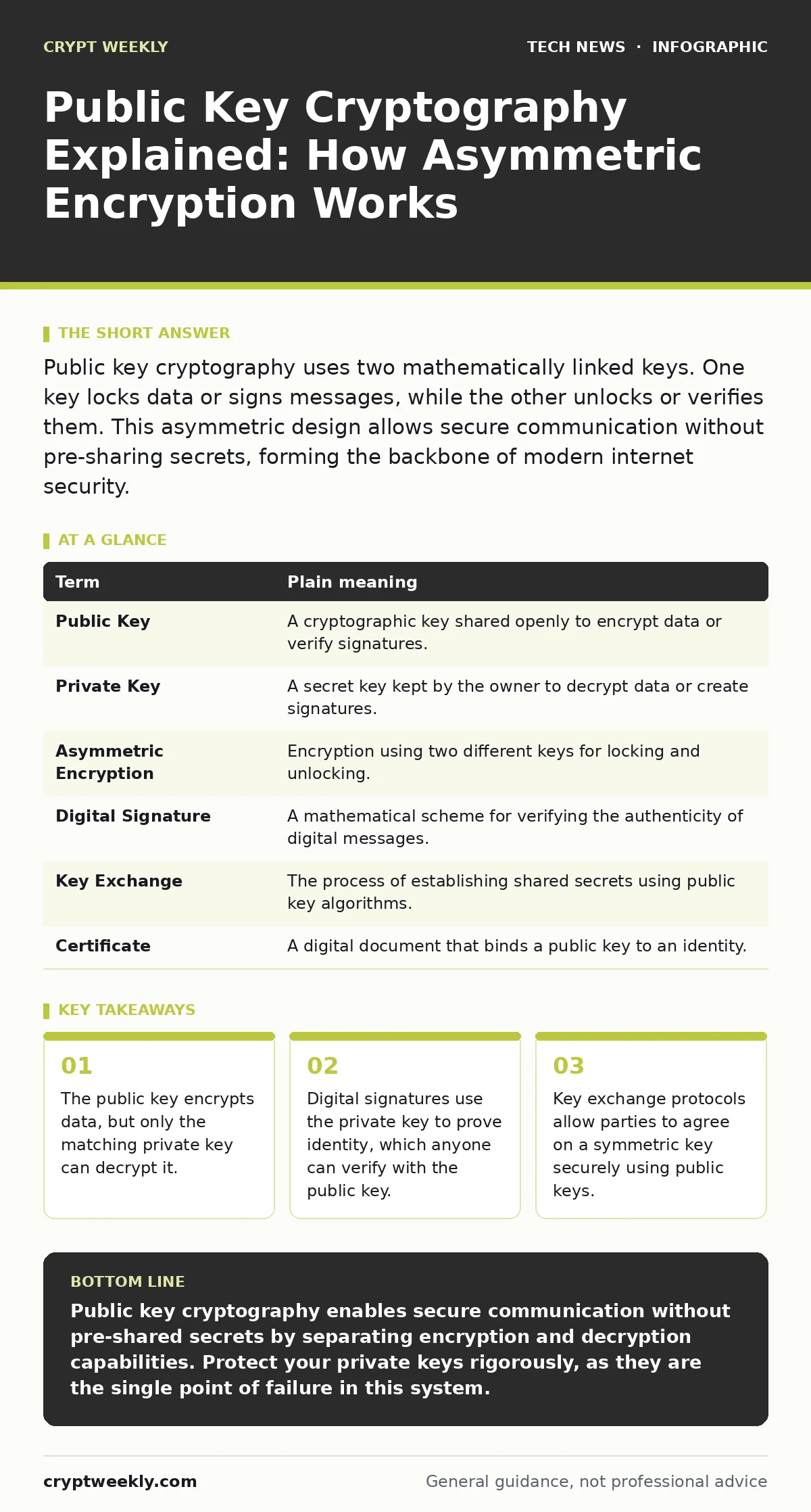
Public key cryptography uses two mathematically linked keys. One key locks data or signs messages, while the other unlocks or verifies them. This asymmetric design allows secure communication without pre-sharing secrets, forming the backbone of modern internet security.
The Locked Mailbox Analogy
Imagine you have a special mailbox with a unique lock. Anyone in the world can drop a letter into this box, but only you hold the key to open it. This is the core concept of public key cryptography, also known as asymmetric encryption. The lock is your public key, which you can share freely. The key inside your pocket is your private key, which you never show anyone.
This system solves a fundamental problem in security. In traditional symmetric encryption, both parties need the same secret key to communicate. Sharing that initial key securely is difficult. With asymmetric cryptography, you do not need to trust the channel used to exchange the lock. You only need to trust that no one else has the key to open the box.
How Encryption Protects Data
When someone wants to send you a secret message, they use your public lock to seal their letter. Once that letter is locked, it cannot be opened by the sender, the postal service, or any hacker who intercepts it. The mathematical relationship between the keys ensures that the lock is easy to apply but impossible to reverse without the specific private key.
This mechanism protects data in transit. When you visit a website, your browser uses the site's public key to encrypt your login credentials. Even if an attacker monitors the network traffic, they only see scrambled data. They cannot decrypt it because they lack the server's private key. This is why certificate management is so critical; if an attacker swaps your public lock with their own, they can read your mail.
Digital Signatures and Trust
The same keys can work in reverse to prove identity. This is called a digital signature. Imagine you write a letter and seal it with a wax stamp that only you possess. Anyone can look at the stamp and verify it matches your unique design. They cannot forge the stamp because they do not have your private key.
In digital terms, you use your private key to sign a message. Anyone with your public key can verify that the message came from you and was not altered in transit. This prevents repudiation, where a sender claims they did not send a message. This verification process relies on the integrity of the Domain Name System to ensure you are actually talking to the entity whose public key you trust.
The Hidden Cost of Asymmetry
Public key cryptography has a significant performance cost. The mathematical operations required to lock and unlock data are computationally expensive. It is much slower than symmetric encryption, which uses simpler algorithms. If you tried to encrypt a large video file using only public keys, it would take an unreasonable amount of time and processing power.
To solve this, systems use a hybrid approach. The public keys are used only at the start of a session to securely exchange a temporary symmetric key. Once both parties have the symmetric key, they switch to faster encryption for the bulk of the data. This is why video conferencing security depends on efficient key exchange protocols to maintain real-time performance without sacrificing safety.
Common Points of Confusion
Many beginners confuse encryption with signing. Encryption hides the content, while signing proves the source. You encrypt with the recipient's public key so only they can read it. You sign with your own private key so everyone can verify it is you. Mixing these up leads to security failures where data is readable by everyone or where identity cannot be verified.
Another confusion involves key storage. Some believe that generating a key pair on a device means the keys are safe. In reality, if the device is compromised, the private key can be extracted. This is why firmware security matters. If the underlying system is untrusted, the keys generated within it are also untrusted. You must protect the private key with strong access controls, often using hardware security modules or secure enclaves.
See also: Encrypted Messaging Misconceptions That Leave You Exposed
Mini Glossary
| Term | Plain meaning |
|---|---|
| Public Key | A cryptographic key shared openly to encrypt data or verify signatures. |
| Private Key | A secret key kept by the owner to decrypt data or create signatures. |
| Asymmetric Encryption | Encryption using two different keys for locking and unlocking. |
| Digital Signature | A mathematical scheme for verifying the authenticity of digital messages. |
| Key Exchange | The process of establishing shared secrets using public key algorithms. |
| Certificate | A digital document that binds a public key to an identity. |
Try This Now
- Check the browser lock icon when visiting a secure site to see the public key certificate in action.
- Generate a PGP key pair for your email to practice signing and encrypting messages locally.
- Review your open port management policies to ensure only necessary services are exposed to public key requests.
Key takeaways
- The public key encrypts data, but only the matching private key can decrypt it.
- Digital signatures use the private key to prove identity, which anyone can verify with the public key.
- Key exchange protocols allow parties to agree on a symmetric key securely using public keys.
Public key cryptography enables secure communication without pre-shared secrets by separating encryption and decryption capabilities. Protect your private keys rigorously, as they are the single point of failure in this system.
Frequently asked questions
Can I recover my private key if I lose it?
No, private keys cannot be recovered if lost. You must generate a new key pair and distribute the new public key to all contacts.
Is public key cryptography unbreakable?
No, it relies on mathematical problems that are hard to solve. Advances in computing, such as quantum computing, could eventually break current algorithms.
Why do I need a certificate authority?
A certificate authority verifies that a public key belongs to a specific entity, preventing man-in-the-middle attacks where attackers impersonate services.
How does this relate to IP addresses?
Public key cryptography secures the data sent between **IP addresses**, but it does not hide the IP addresses themselves. Network traffic patterns remain visible.
How this guide was produced: written by the Crypt Weekly editorial team with AI assistance, checked against the public references listed below, and reviewed when the facts change. See our editorial policy or report an error.