
Anonymization of data often fails because statistical patterns allow attackers to re-identify individuals even when direct identifiers like names are completely removed.
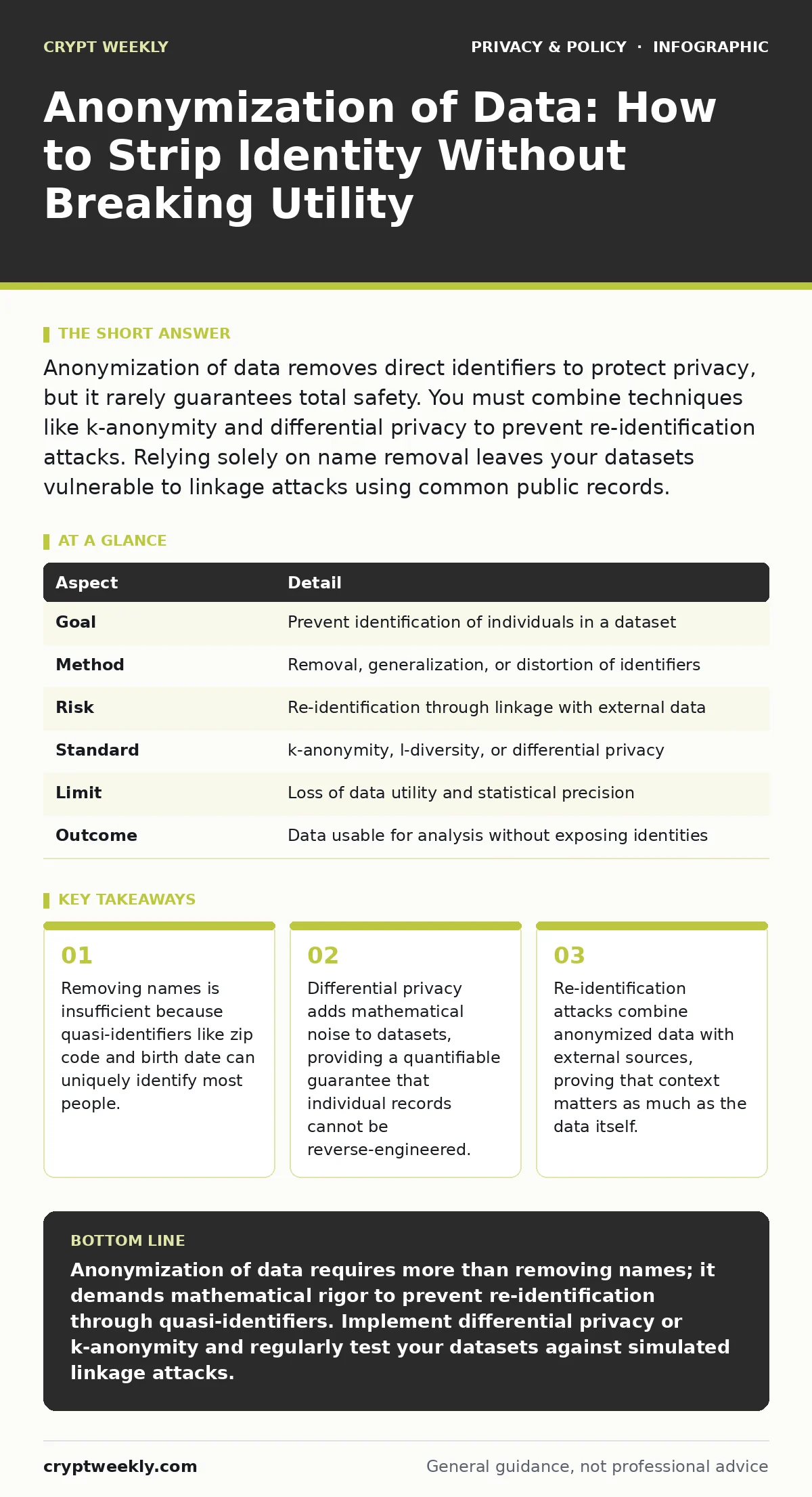
Anonymization of data removes direct identifiers to protect privacy, but it rarely guarantees total safety. You must combine techniques like k-anonymity and differential privacy to prevent re-identification attacks. Relying solely on name removal leaves your datasets vulnerable to linkage attacks using common public records.
Imagine you hand a stranger a list of your friends’ names, ages, and cities. They cannot call them, but they can easily find their social media profiles. Now imagine you remove the names. The stranger still has ages and cities. In many towns, a specific combination of age, gender, and zip code identifies a single person. This is the core problem with data privacy. You think you have hidden identities, but the remaining data points act like a fingerprint.
What Is Anonymization of Data?
Anonymization of data is the process of removing or altering information so that specific individuals can no longer be identified. It differs from pseudonymization, which replaces identifiers with fake ones that can be reversed with a key. True anonymization means the link to the original person is broken permanently. This distinction matters for legal compliance and security posture. If you can reverse the process, you have not anonymized the data; you have only masked it.
| Aspect | Detail |
|---|---|
| Goal | Prevent identification of individuals in a dataset |
| Method | Removal, generalization, or distortion of identifiers |
| Risk | Re-identification through linkage with external data |
| Standard | k-anonymity, l-diversity, or differential privacy |
| Limit | Loss of data utility and statistical precision |
| Outcome | Data usable for analysis without exposing identities |
How Anonymization Techniques Work
Simple methods like removing names and email addresses are insufficient. Attackers use quasi-identifiers, which are data fields that do not uniquely identify a person on their own but do so when combined. Common quasi-identifiers include postal codes, birth dates, and job titles. To counter this, you use generalization. You replace specific values with broader categories. For example, you might change a specific age to an age range or a city to a region. This reduces precision but increases privacy.
Another technique is suppression. You remove entire records or attributes that are too unique. If only one person in your database lives in a specific small town, you must suppress that record or generalize the location to a larger area. This prevents that individual from standing out. You also use perturbation, which involves adding random noise to numerical data. This shifts the values slightly, making it impossible to pinpoint the original number while keeping the overall statistical trends intact.
Who Is Affected by Poor Anonymization
You might assume only large corporations face re-identification risks. This is incorrect. Small organizations, academic researchers, and even individuals sharing data for personal projects are vulnerable. The risk depends on the uniqueness of the data, not the size of the organization. If your dataset contains detailed information about a small community, the risk is high. Attackers do not need massive computing power to re-identify individuals in small datasets. They need access to public records, social media, or voter rolls.
Employees are also affected. Internal datasets often contain performance reviews, salary information, or health records. If these are shared with third-party vendors for analysis, the vendor might combine them with other data sources. This linkage can reveal sensitive information about specific employees. You must treat internal data with the same rigor as external customer data. The human cost of re-identification includes discrimination, harassment, and identity theft.
The Hidden Cost of Privacy
Anonymization creates a trade-off between privacy and utility. The more you obscure the data, the less useful it becomes for analysis. This is the privacy-utility paradox. If you generalize ages into decades, you lose the ability to analyze trends within specific age groups. If you add too much noise, statistical correlations disappear. You must find a balance. This requires careful planning before you collect data. If you collect too much detail, you cannot anonymize it effectively later without destroying its value.
This cost extends to trust. Users expect their data to be safe. If you publish an anonymized dataset that gets re-identified, you lose credibility. The breach may not involve stolen money, but it involves broken promises. You must document your anonymization methods. Explain what techniques you used and what risks remain. Transparency helps users understand the limitations. It also helps you avoid legal pitfalls, as regulations often require demonstrable efforts to protect privacy.
What People Usually Get Wrong
Many practitioners believe that removing names is enough. This is the most common mistake. Names are direct identifiers, but quasi-identifiers are far more dangerous because they are harder to spot. Another error is assuming that aggregated data is always safe. Aggregation helps, but if the group size is small, individuals can still be identified. You must ensure that every group in your data contains enough members to provide anonymity. This is the basis of k-anonymity, where k is the minimum number of people who share the same quasi-identifiers.
You also often ignore the context of the data. Data that is safe in one context may be dangerous in another. For example, location data might be harmless for traffic analysis but dangerous if combined with political affiliation data. You must assess the risk based on how the data might be combined with other available information. This requires a threat model. Identify who might attack your data and what other data they might have. This step is often skipped, leading to false confidence in the anonymization process.
See also: Data Protection Officer Responsibilities: The Real Job Description · What Is GDPR in Cyber Security: Rules, Scope, and Practical Steps
What To Do About It
Start by minimizing data collection. Only collect what you absolutely need. If you do not need a specific identifier, do not collect it. This reduces the attack surface. Next, apply k-anonymity. Determine the minimum group size required for your use case. Generalize or suppress data until every group meets this size. Then, consider l-diversity, which ensures that sensitive attributes within a group are diverse enough to prevent inference attacks. For example, if you are sharing health data, ensure that each group contains a mix of diagnoses, not just one.
Finally, use differential privacy for high-risk datasets. This technique adds mathematically calibrated noise to query results. It provides a strong guarantee that the inclusion or exclusion of any single individual does not significantly affect the output. This is the gold standard for privacy in statistical analysis. You can implement this using open-source libraries designed for differential privacy. Always test your anonymized data against re-identification attacks. Simulate an attacker with access to external data sources. If you can re-identify individuals, your methods are not strong enough.
Beyond Basic Anonymization
Anonymization is not a one-time task. It is an ongoing process. As new data sources become available, the risk of re-identification increases. You must periodically review your anonymization strategies. Check if new public datasets could be linked to your released data. Update your generalization levels or noise parameters as needed. Stay informed about new re-identification techniques. The field of privacy engineering evolves rapidly. What was safe five years ago may be vulnerable today.
Consider using end-to-end encryption for data in transit and at rest. This protects the data from unauthorized access during storage and transmission. It does not replace anonymization, but it complements it. You can also use Tor Browser for accessing sensitive data sources, adding another layer of anonymity for your own operations. Remember that privacy is a system, not a single tool. Combine technical controls with policy and education to build a strong defense.
Key takeaways
- Removing names is insufficient because quasi-identifiers like zip code and birth date can uniquely identify most people.
- Differential privacy adds mathematical noise to datasets, providing a quantifiable guarantee that individual records cannot be reverse-engineered.
- Re-identification attacks combine anonymized data with external sources, proving that context matters as much as the data itself.
Anonymization of data requires more than removing names; it demands mathematical rigor to prevent re-identification through quasi-identifiers. Implement differential privacy or k-anonymity and regularly test your datasets against simulated linkage attacks.
Frequently asked questions
Is anonymization the same as encryption?
No. Encryption scrambles data so it can be decrypted with a key. Anonymization alters data so the original identity cannot be recovered, even with a key. Encryption protects data at rest; anonymization protects identity in analysis.
Can I anonymize data completely?
Complete anonymization is difficult because context always provides clues. You can reduce risk to acceptable levels using techniques like differential privacy, but you must always assume some residual risk of re-identification exists in any released dataset.
How do I choose between k-anonymity and differential privacy?
Use k-anonymity for static datasets where you need to preserve exact values for groups. Use differential privacy when you are releasing statistical queries or aggregates, as it provides stronger mathematical guarantees against individual re-identification.
Does removing IP addresses anonymize web logs?
Removing IP addresses helps, but browser fingerprints, session durations, and request patterns can still identify users. You must combine IP removal with other techniques like generalization of timestamps and aggregation of user actions to achieve true anonymity.
How this guide was produced: written by the Crypt Weekly editorial team with AI assistance, checked against the public references listed below, and reviewed when the facts change. See our editorial policy or report an error.