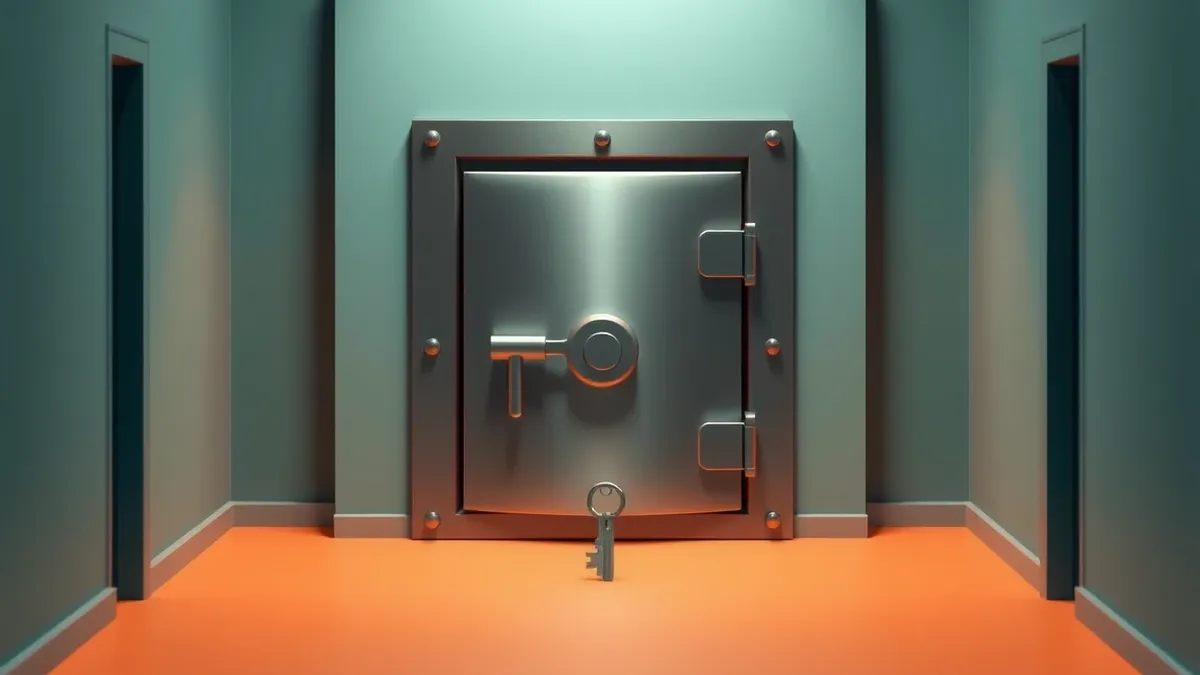
Your service provider cannot read your messages because they never hold the decryption keys, making backdoors impossible without breaking security for everyone.
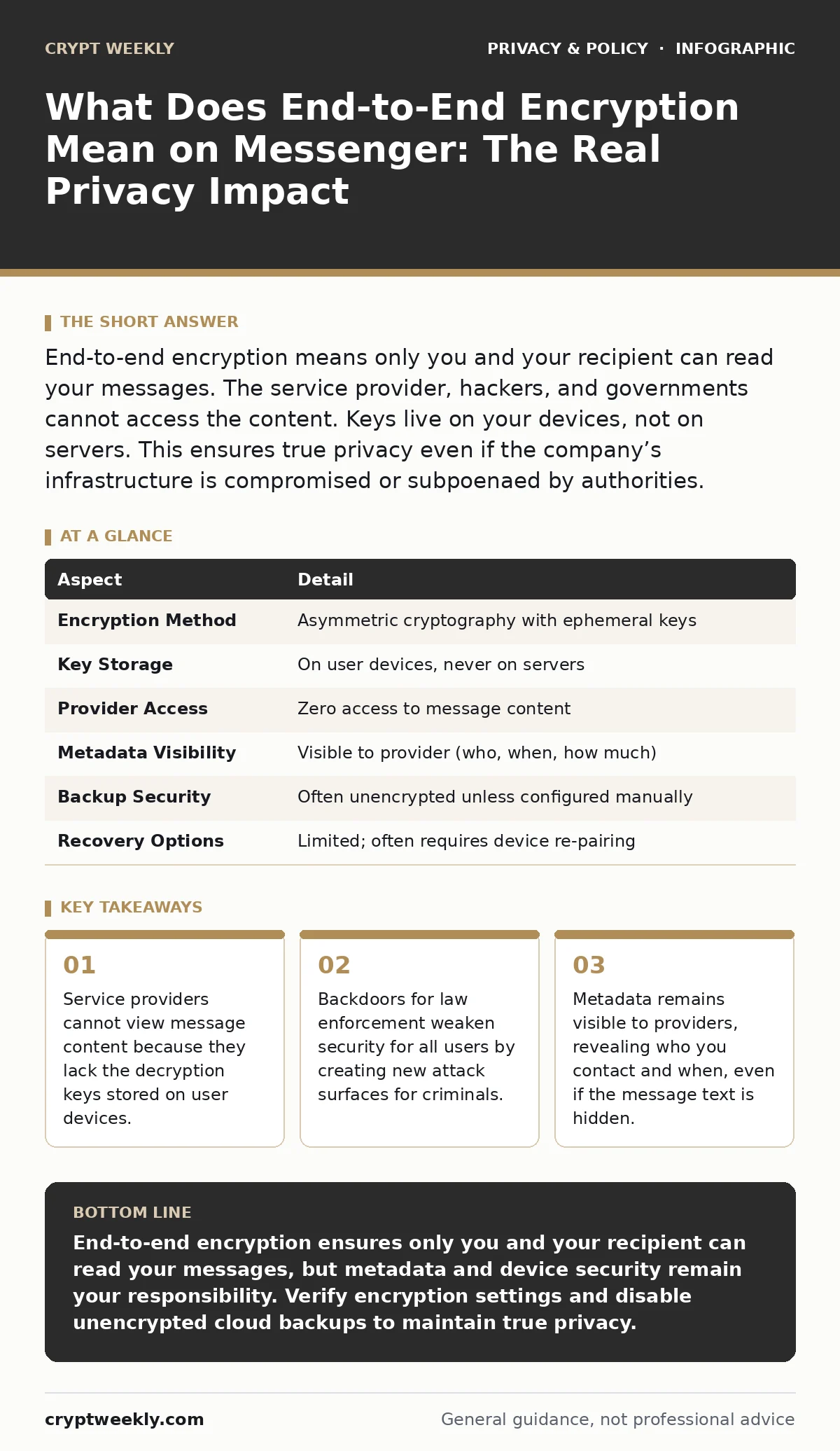
End-to-end encryption means only you and your recipient can read your messages. The service provider, hackers, and governments cannot access the content. Keys live on your devices, not on servers. This ensures true privacy even if the company’s infrastructure is compromised or subpoenaed by authorities.
How End-to-End Encryption Works on Messaging Platforms
Imagine sending a sealed letter through a postal system. The post office handles the package, sorts it, and delivers it, but they cannot open the envelope to read the contents. End-to-end encryption works exactly like that sealed envelope, but for digital data. When you type a message, your device encrypts it using a cryptographic key. Only the recipient’s device holds the matching key to decrypt it. The service provider acts as the postal carrier. They transport the encrypted data but never see the plaintext.
This mechanism relies on asymmetric cryptography. Each user has a public key and a private key. Your device shares the public key with contacts. The sender encrypts the message with your public key. Only your private key, which never leaves your device, can unlock it. This ensures that even if someone intercepts the data in transit, it remains unreadable gibberish. The security depends entirely on the secrecy of the private keys. If a hacker steals your private key, the encryption fails. If you lose your device and backup, you lose access to your messages.
| Aspect | Detail |
|---|---|
| Encryption Method | Asymmetric cryptography with ephemeral keys |
| Key Storage | On user devices, never on servers |
| Provider Access | Zero access to message content |
| Metadata Visibility | Visible to provider (who, when, how much) |
| Backup Security | Often unencrypted unless configured manually |
| Recovery Options | Limited; often requires device re-pairing |
What Does End to End Encryption Mean on Messenger
When people ask what end to end encryption mean on messenger, they often assume it protects everything about their conversation. It does not. It protects only the content of the message. The service provider still sees metadata. Metadata includes who you talk to, how often, and the size of the messages. This data reveals social graphs and behavioral patterns. An adversary can infer sensitive information from metadata alone. They do not need to read the words to know you are planning a meeting or discussing a specific topic.
The encryption also does not protect the endpoints. If malware infects your phone, it can read messages before encryption or after decryption. The security model assumes the devices are trustworthy. It does not assume the network is trustworthy. It does not assume the server is trustworthy. It only assumes the cryptographic algorithms are sound and the keys are secure. This distinction matters for privacy expectations. You are protected from the service provider and network eavesdroppers. You are not protected from compromised devices or social engineering attacks.
Who Benefits and Who Is Exposed
This technology affects everyone who uses digital communication. It benefits individuals seeking privacy from surveillance, journalists protecting sources, and activists avoiding persecution. It shifts trust from corporations to mathematics. You no longer need to trust the company’s privacy policy or its resistance to government pressure. You trust the protocol. This is a powerful shift. It removes the human element of corruption or coercion from the security equation.
However, it also exposes users to operational risks. Law enforcement agencies cannot compel providers to hand over message content. This creates legal friction. Providers may refuse to assist in investigations, citing technical impossibility. Users may face legal consequences if they cannot prove their innocence due to inaccessible evidence. The trade-off is absolute privacy versus absolute transparency. There is no middle ground. You choose which value aligns with your needs. For most users, the benefit of preventing mass surveillance outweighs the cost of reduced investigative access.
Common Misconceptions About Message Privacy
People often confuse transport encryption with end-to-end encryption. Transport encryption secures data while it moves across networks. It protects against casual eavesdropping on public Wi-Fi. However, the service provider can decrypt the data at its servers. End-to-end encryption prevents this. The provider never holds the keys. Another common mistake is assuming all messaging apps use this by default. Many popular services use transport encryption for standard chats. They require users to enable specific modes for end-to-end protection.
Users also believe that deleting a message removes it from all devices. It does not. The sender’s device may retain a copy. The recipient’s device may have already cached the message. Some apps offer remote deletion features, but these rely on the recipient’s app being active and compliant. If the recipient has taken a screenshot, the data persists. Encryption protects data in transit and at rest on the server. It does not control what happens on the recipient’s screen.
The Hidden Cost of Convenience
Convenience often undermines security. Features like cross-device syncing and cloud backups introduce vulnerabilities. To sync messages across devices, the service must decrypt them on one device and re-encrypt them for another. This process requires the service to access the plaintext, or it requires complex key management that users rarely configure correctly. Many users opt for automatic cloud backups. These backups are often stored with keys the provider controls. If the provider’s cloud storage is breached, your messages are exposed.
Suppose you lose your phone. You buy a new one and restore from a cloud backup. If that backup was not end-to-end encrypted, the provider could have accessed your messages during the backup process. Even if they did not, the data sits on their servers in a decryptable format. The convenience of seamless restoration comes at the cost of theoretical privacy. You must manually configure encrypted backups if you want to maintain the security model. Most users do not take this step.
See also: Cookie Consent Management: How It Works and Why It Fails
What To Do About Your Messaging Security
You should verify that your messaging apps use end-to-end encryption by default. Look for indicators provided by the app, such as a specific icon or a verification code. Do not rely on marketing claims. Read the technical documentation. Check if the app uses open-source protocols. Open-source code allows independent experts to audit the implementation for flaws. Proprietary protocols hide potential backdoors or weaknesses from public scrutiny.
Configure your backups manually. Disable automatic cloud backups if they are not end-to-end encrypted. Use local backups encrypted with a strong passphrase. Keep your devices updated. Patches fix vulnerabilities in the encryption libraries. Use strong device passcodes. If someone gains physical access to your unlocked phone, encryption is irrelevant. For sensitive communications, consider using encrypted messaging apps that prioritize privacy features. Compare their security models before choosing.
Limitations of Current Encryption Standards
No encryption system is perfect. Quantum computing poses a future threat. Current algorithms rely on mathematical problems that are hard for classical computers to solve. Quantum computers could solve these problems efficiently. This would break many existing encryption standards. Researchers are developing post-quantum cryptography to address this. It is not yet widely deployed. You cannot protect against quantum attacks today.
Implementation errors are a more immediate risk. A flaw in how the code handles keys can expose data. A bug in the random number generator can weaken keys. These issues are not theoretical. They happen regularly. The security of your messages depends on the competence of the developers. You cannot fix their mistakes. You can only choose services with a strong track record of security audits and responsible disclosure.
Beyond Message Content
End-to-end encryption does not solve all privacy problems. It does not hide your identity. If you register with your real name and phone number, your identity is linked to your communications. It does not hide your location. Some apps share location data with servers. It does not hide your device information. To protect your identity, you must use anonymous registration methods. To protect your location, you must disable location sharing.
For email, consider encrypted email services that use similar principles. For files, use encrypted cloud storage solutions. These tools extend the privacy model beyond instant messaging. They ensure that your data remains private across different platforms. However, each service has its own implementation details. You must evaluate each one independently. There is no single solution that protects all your digital life. You must build a layered defense strategy.
Key takeaways
- Service providers cannot view message content because they lack the decryption keys stored on user devices.
- Backdoors for law enforcement weaken security for all users by creating new attack surfaces for criminals.
- Metadata remains visible to providers, revealing who you contact and when, even if the message text is hidden.
End-to-end encryption ensures only you and your recipient can read your messages, but metadata and device security remain your responsibility. Verify encryption settings and disable unencrypted cloud backups to maintain true privacy.
Frequently asked questions
Can the government force an app to decrypt messages?
They can force the company to provide data, but if end-to-end encryption is used, the company has no data to provide. They cannot force the math to break.
Does end-to-end encryption protect my photos and files?
Yes, if the app supports end-to-end encryption for media. The files are encrypted before upload and decrypted after download. Check the app’s specific media handling policy.
Is WhatsApp end-to-end encrypted by default?
Yes, WhatsApp uses end-to-end encryption for all messages and calls by default. However, its cloud backups are not end-to-end encrypted unless you manually enable that specific setting.
What happens if I change my phone number?
You must update your number in the app. The encryption keys are tied to your device and identity. Changing numbers may require re-verifying contacts to ensure secure communication channels are re-established.
How this guide was produced: written by the Crypt Weekly editorial team with AI assistance, checked against the public references listed below, and reviewed when the facts change. See our editorial policy or report an error.