
Consent management platforms often prioritize legal compliance over user privacy, creating a false sense of security while tracking data persists.
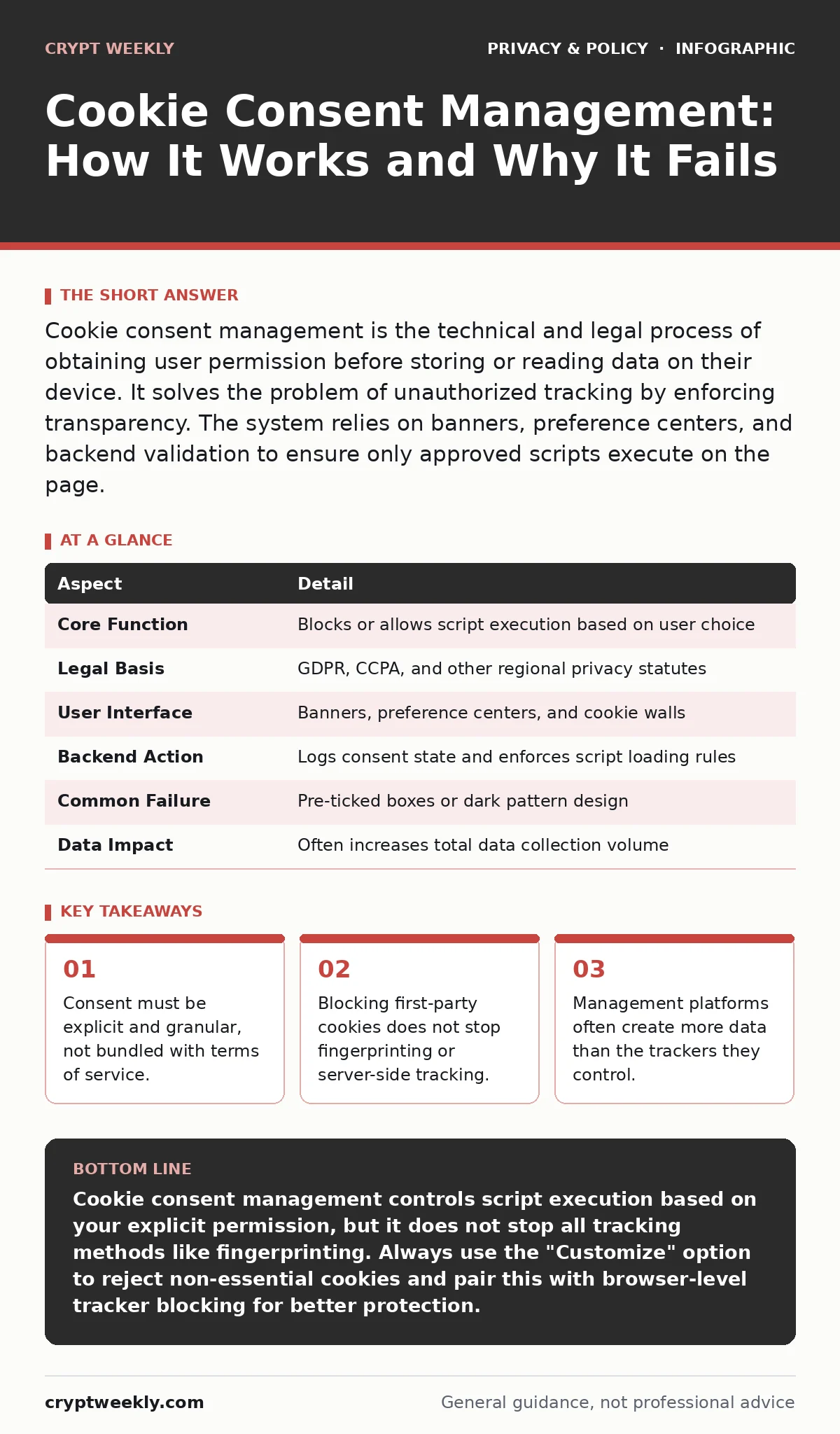
Cookie consent management is the technical and legal process of obtaining user permission before storing or reading data on their device. It solves the problem of unauthorized tracking by enforcing transparency. The system relies on banners, preference centers, and backend validation to ensure only approved scripts execute on the page.
The Digital Toll Booth
Imagine driving through a toll booth where the barrier only lifts after you sign a contract detailing exactly how the road company will sell your license plate number. You cannot pass without agreeing, but the contract is written in dense legal jargon and the "No" button is hidden behind a translucent overlay. This is the current state of web browsing.
Cookie consent management is the mechanism that enforces this exchange. It acts as a gatekeeper between the website code and the user’s browser storage. Without this layer, websites would silently plant tracking identifiers on your device the moment you loaded a page. The system exists to shift control from the publisher to the visitor, at least in theory.
| Aspect | Detail |
|---|---|
| Core Function | Blocks or allows script execution based on user choice |
| Legal Basis | GDPR, CCPA, and other regional privacy statutes |
| User Interface | Banners, preference centers, and cookie walls |
| Backend Action | Logs consent state and enforces script loading rules |
| Common Failure | Pre-ticked boxes or dark pattern design |
| Data Impact | Often increases total data collection volume |
The Problem of Silent Extraction
Before consent frameworks existed, every website you visited could drop small text files called cookies onto your hard drive. These cookies identified you across different sites, allowing advertisers to build a detailed profile of your habits. You had no way to know who was watching, and no easy way to stop them.
The problem was not just privacy; it was trust. Users began to feel that the web was hostile. Browsers started introducing do-not-track headers, but most sites ignored them. The industry needed a standardized way to ask permission and prove that permission was granted. Consent management platforms (CMPs) emerged to fill this void. They provide the interface for asking and the backend logic for respecting the answer.
Anatomy of a Consent System
A functional consent system has three distinct parts. First is the user interface, usually a banner or modal that appears before the page fully loads. This interface must present options clearly. Second is the consent string, a small piece of data that encodes your choices. Third is the enforcement engine, which checks that string before allowing third-party scripts to run.
The consent string is critical. It travels with your request to the server. If the string says you rejected analytics, the server must not load the analytics code. If it does, the system has failed. This separation of interface and enforcement is what makes the system verifiable. Without a strict enforcement engine, the banner is just decoration.
Where It Fits in Defense
Cookie consent is not a security tool. It is a compliance tool. It does not protect you from malware, phishing, or data breaches. It only controls what data is collected for marketing and analytics purposes. You should view it as part of a broader privacy strategy, not a shield.
For deeper protection, you need to look beyond cookies. Browser fingerprinting is a technique where sites identify you by your device configuration, such as screen resolution and installed fonts. This method does not use cookies, so consent banners do not stop it. Similarly, email tracking pixels allow senders to know when you open a message, bypassing browser cookie settings entirely.
Consent management works best when combined with other controls. For instance, using a browser with strict tracker blocking reduces the number of scripts the CMP needs to manage. It also pairs well with end-to-end encryption for communications, ensuring that even if data is collected, it remains unreadable to unauthorized parties. However, consent does not replace the need for encrypted email when sending sensitive information.
What People Usually Get Wrong
Most users believe that clicking "Accept All" is the fastest way to browse. This is a mistake. It grants permission to every tracker, including those that sell your data to brokers you have never heard of. The convenience of a single click comes at the cost of long-term privacy erosion.
Another common error is assuming that consent applies to all data collection. It does not. Functional cookies, which keep you logged in or store items in a shopping cart, are often exempt from consent requirements under certain regulations. You cannot opt out of these without breaking the site’s functionality. This creates a false dichotomy where users think they have control, but only over the least important data.
See also: What Does SOC 2 Stand For: The Real Meaning for Security Pros
The Hidden Cost of Compliance
There is a hidden trade-off in how these systems are built. To prove compliance, companies must log every consent decision. This creates a new database of user behavior. Instead of just tracking what you buy, they now track how you interact with privacy settings. This meta-data is valuable to advertisers and legal teams alike.
Furthermore, the complexity of global laws means sites often default to the strictest standard. This can break functionality for users in regions with fewer restrictions. A site built for European compliance might block useful features for a user in a region where such blocking is unnecessary. The result is a degraded user experience for everyone, justified by legal caution rather than technical necessity.
Navigating the Choices
When you encounter a consent banner, look for a "Manage Preferences" or "Customize" button. Do not settle for binary choices. Granular control allows you to accept functional cookies while rejecting marketing and analytics. This reduces the amount of data shared without breaking the site.
Be aware that some sites use "cookie walls," which block access entirely unless you accept all cookies. These are often illegal under strict privacy frameworks, but enforcement is inconsistent. If you encounter a wall, your only recourse is to leave the site or use a browser extension that blocks the banner script entirely. This is a form of client-side filtering that bypasses the site’s consent mechanism.
Consider how this fits with privacy laws for small businesses. Smaller sites may lack the resources for sophisticated CMPs, leading to simpler, less intrusive tracking. Larger corporations, however, have complex data pipelines that make true opt-out difficult. Understanding the scale of the operation helps you gauge how much control you actually have.
Beyond the Banner
Consent management is a necessary evil in the current web ecosystem. It provides a layer of transparency that did not exist before. However, it is not a complete solution. It does not stop cross-border data transfers, where your information may move to servers in countries with weaker privacy laws.
To truly protect your privacy, you must combine consent management with technical defenses. Use browsers that block third-party cookies by default. Disable JavaScript for untrusted sites. Understand that data subject access requests allow you to see what data has been collected, but they do not prevent future collection.
The goal is not to perfect your consent settings, but to minimize the surface area for tracking. Consent is the first line of defense, but it is a porous one. Treat it as a starting point, not a finish line. By understanding the mechanisms behind the banner, you can make more informed choices about where you spend your time online.
Key takeaways
- Consent must be explicit and granular, not bundled with terms of service.
- Blocking first-party cookies does not stop fingerprinting or server-side tracking.
- Management platforms often create more data than the trackers they control.
Cookie consent management controls script execution based on your explicit permission, but it does not stop all tracking methods like fingerprinting. Always use the "Customize" option to reject non-essential cookies and pair this with browser-level tracker blocking for better protection.
Frequently asked questions
Does clicking "Reject All" stop all tracking?
No. It stops cookie-based tracking for marketing and analytics, but functional cookies and fingerprinting techniques may still identify you.
Why do I see banners on sites that don't seem to track me?
Many sites use standard templates or CMS platforms that include consent banners by default, regardless of whether they actively use third-party trackers.
Can I automate my consent choices?
Yes, browser extensions can automatically interact with consent banners to select your preferred settings, though they may not work on every site.
Is consent management the same as a firewall?
No. A firewall blocks network traffic, while consent management controls which scripts are allowed to run within your browser based on your preferences.
How this guide was produced: written by the Crypt Weekly editorial team with AI assistance, checked against the public references listed below, and reviewed when the facts change. See our editorial policy or report an error.