
Privacy policies are legal disclaimers about data processing, not technical blueprints for security or guarantees of personal anonymity.
Most people treat privacy policies as contracts they can enforce or technical manuals they can verify. They are actually legal disclosures that define how companies handle data. You cannot audit the code through the text. You cannot sue because a policy is vague. Understanding this distinction prevents wasted effort and false confidence.
Misreading: The Policy Is a Security Blueprint
Many users assume that a detailed privacy policy proves a service is secure. They look for mentions of encryption, firewall rules, or intrusion detection. They believe that if the text describes these controls, the implementation must match the description. This is a fundamental error in reasoning.
Correct reading: A privacy policy is a legal document, not a technical specification. It describes intent and liability, not architecture. A company can state it uses "industry-standard encryption" while using deprecated algorithms internally. The policy tells you what the company admits to doing with data, not how it protects that data from external attackers. For technical assurance, you must look at independent audits or open-source code, not the legal text.
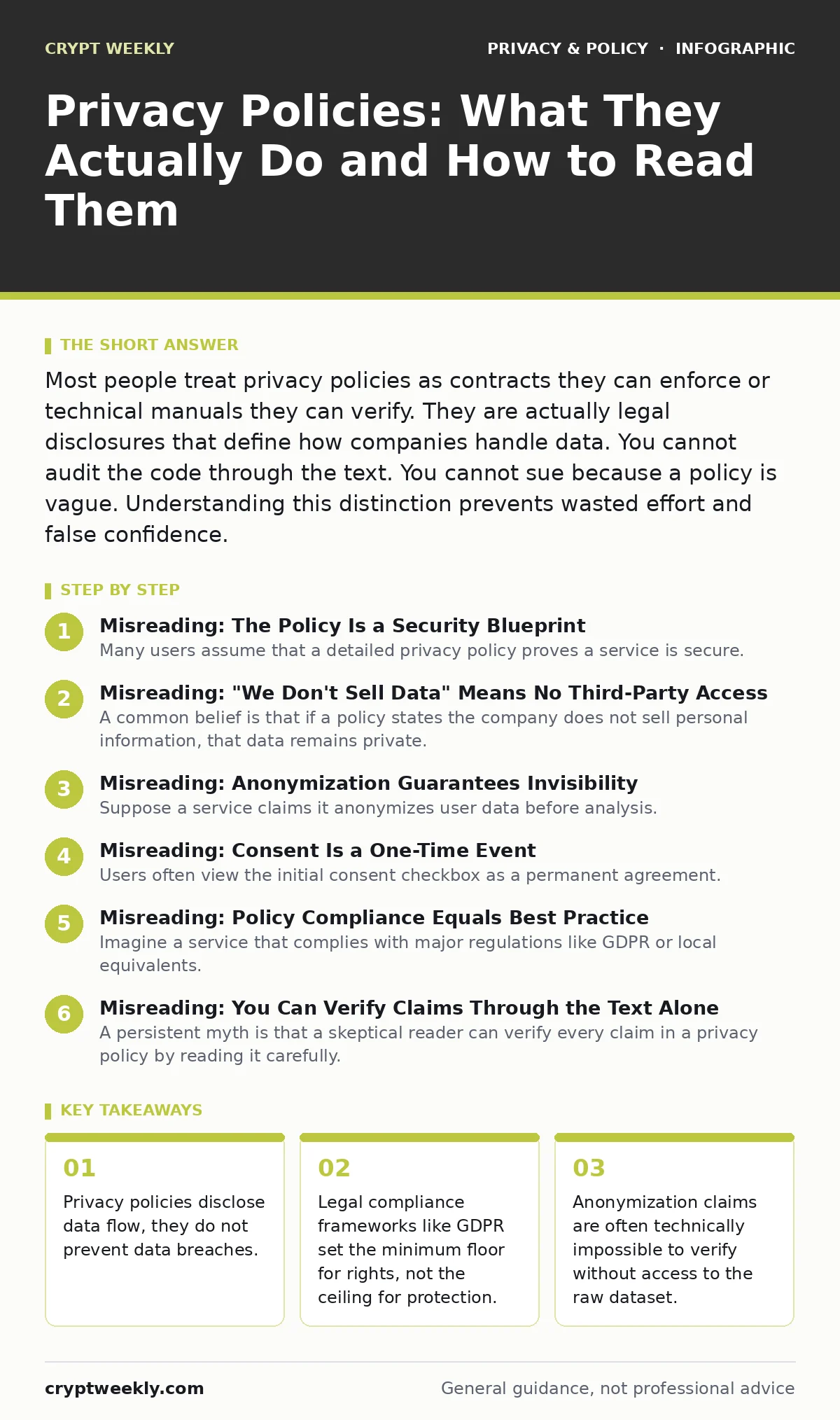
Misreading: "We Don't Sell Data" Means No Third-Party Access
A common belief is that if a policy states the company does not sell personal information, that data remains private. Users equate "not selling" with "not sharing." They assume that because no money changes hands for their profile, their information stays within the company's walls. This interpretation ignores the complex ecosystem of data partnerships.
Correct reading: Companies can share data for service provision, analytics, or advertising without a direct sale. Partners may access logs, usage patterns, or derived profiles to improve products or target ads. The data is traded for value, even if no invoice is generated. This sharing often occurs under broad clauses about "service providers" or "affiliates." You should check the sections on data sharing and third-party processors to see who actually sees your information.
Misreading: Anonymization Guarantees Invisibility
Suppose a service claims it anonymizes user data before analysis. Many readers take this at face value, believing that removing names and addresses makes the data safe. They assume that once personal identifiers are stripped, the remaining data cannot be linked back to a specific individual. This view underestimates the power of re-identification techniques.
Correct reading: Anonymization is often incomplete. When you combine seemingly harmless data points, such as zip code, gender, and purchase history, unique patterns emerge. Researchers have repeatedly shown that small datasets can be cross-referenced with public records to reveal identities. True anonymization requires rigorous statistical noise injection, which degrades data utility. Most policies do not disclose the specific methods used, making it impossible for you to verify the claim. Read our guide on anonymization to understand the technical limits.
Misreading: Consent Is a One-Time Event
Users often view the initial consent checkbox as a permanent agreement. They click "Accept" and assume the terms are fixed for the lifetime of the account. They do not expect that the scope of data collection can change over time. This static view of consent leads to complacency and missed opportunities to opt out of new data practices.
Correct reading: Privacy policies are living documents. Companies update them to reflect new features, legal requirements, or business strategies. These updates often expand data collection scopes. You are usually notified via email or in-app messages, but the notification itself may be buried. Regularly reviewing the update history reveals changes in data retention periods or new sharing partners. Treat consent as a continuous process, not a single transaction.
Misreading: Policy Compliance Equals Best Practice
Imagine a service that complies with major regulations like GDPR or local equivalents. Users often assume this compliance means the service follows best practices for privacy. They believe that because a regulator approved the policy, the service is trustworthy. This conflation ignores the difference between legal minimums and ethical standards.
Correct reading: Regulations set a baseline for data handling, not a gold standard. Compliance focuses on rights like access, deletion, and portability. It does not mandate minimal data collection or strong encryption defaults. A service can be fully compliant while still collecting excessive data or sharing it broadly. You must look beyond compliance checkboxes. Evaluate the company's data minimization practices and transparency efforts separately. See our guide on GDPR to understand the specific rights these laws grant.
See also: Cookie Consent Management: How It Works and Why It Fails
Misreading: You Can Verify Claims Through the Text Alone
A persistent myth is that a skeptical reader can verify every claim in a privacy policy by reading it carefully. People believe that if they read between the lines, they can detect false statements or hidden risks. They assume that legal language, while dense, is always accurate and verifiable by an outsider. This approach wastes time and yields little insight.
Correct reading: You cannot verify technical or operational claims through legal text alone. Statements about data centers, encryption standards, or employee training are self-reported. Without external audits, certifications, or open-source verification, these claims are assertions. The policy tells you what the company says it does. It does not provide evidence. Focus on what the policy admits to doing, such as data retention periods and sharing partners, rather than trying to prove the security measures described.
Misreading: Opt-Out Links Are Effective
Many users believe that clicking an opt-out link in a privacy policy stops all data collection. They assume that once they decline personalized ads or data sharing, the company ceases to track them. This belief overlooks the distinction between different types of data processing and the persistence of tracking technologies.
Correct reading: Opt-out mechanisms often only stop specific types of data usage, such as personalized advertising. They do not necessarily stop data collection for service improvement, fraud prevention, or legal compliance. Some companies use alternative tracking methods that do not fall under the opt-out scope. Additionally, opting out may reset your preferences if you clear your browser cookies. Read our guide on browser cookies to understand how tracking persists across different mechanisms.
Misreading: International Transfers Are Clearly Defined
Suppose a service is based in one country but serves users globally. Users often assume the privacy policy clearly states where their data is stored and processed. They expect a simple map of data locations. This expectation fails because global data flows are complex and often involve multiple jurisdictions with different legal standards.
Correct reading: Privacy policies rarely list every server location. They use broad language about "international transfers" and "affiliates." Your data may move across borders for backup, processing, or customer support. The legal protections differ by region. Understanding these flows requires knowledge of cross-border data transfer mechanisms. See our guide on cross-border data transfers to learn how data moves globally and what protections apply.
Key takeaways
- Privacy policies disclose data flow, they do not prevent data breaches.
- Legal compliance frameworks like GDPR set the minimum floor for rights, not the ceiling for protection.
- Anonymization claims are often technically impossible to verify without access to the raw dataset.
Frequently asked questions
Does a privacy policy legally bind the company to specific security measures?
No, privacy policies generally describe data handling practices, not technical security controls. They are not security certifications or technical standards.
Can I delete my account and all my data just because the policy says so?
Policies usually describe the right to deletion, but technical limitations or legal requirements may prevent immediate or complete erasure. Some data may be retained for backups or legal compliance.
Should I read the entire privacy policy before signing up?
Reading the entire document is rarely efficient. Focus on sections about data collection, sharing, retention, and your rights. These sections contain the most actionable information.
Do privacy policies change if I move to a different country?
Yes, companies often provide region-specific policies to comply with local laws. Your rights and data handling practices may differ based on your jurisdiction. Check for localized versions. BOTTOM LINE: Privacy policies are legal disclosures about data flow, not technical guarantees of security or anonymity. Review the sections on data sharing and retention to understand your actual exposure.
How this guide was produced: written by the Crypt Weekly editorial team with AI assistance, checked against the public references listed below, and reviewed when the facts change. See our editorial policy or report an error.