
Moving data across borders does not change its format, but it changes which government can demand access to it without your knowledge or consent.
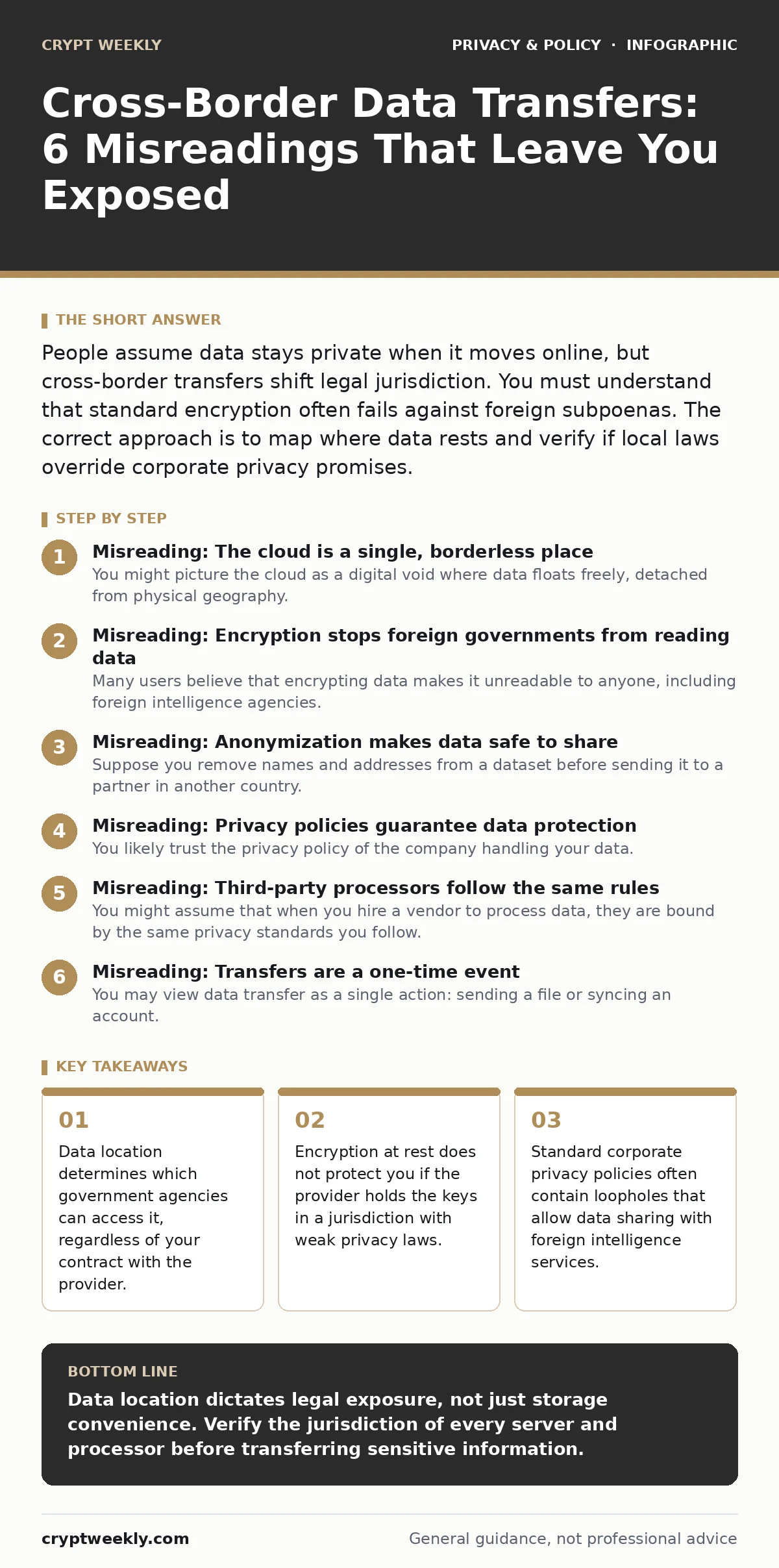
People assume data stays private when it moves online, but cross-border transfers shift legal jurisdiction. You must understand that standard encryption often fails against foreign subpoenas. The correct approach is to map where data rests and verify if local laws override corporate privacy promises.
Misreading: The cloud is a single, borderless place
You might picture the cloud as a digital void where data floats freely, detached from physical geography. This mental model suggests that once information is uploaded, it exists everywhere and nowhere simultaneously. The reality is that data always resides on specific hardware located in a specific country. That physical location subjects the data to the laws of that nation, including surveillance mandates and data localization rules.
Correct reading: Treat every storage location as a distinct legal jurisdiction. When you store data in a cloud region, you are placing it under the authority of that country’s government. If that country has laws requiring providers to hand over data to state actors, your privacy relies on their compliance, not your settings. Always identify the primary jurisdiction where your data rests.
Misreading: Encryption stops foreign governments from reading data
Many users believe that encrypting data makes it unreadable to anyone, including foreign intelligence agencies. This is only true if you control the decryption keys and the provider cannot access the plaintext. In many commercial services, the provider holds the keys to manage backups, search functionality, or compliance requests. If the provider is headquartered in a country with broad surveillance powers, they may be legally compelled to decrypt your data.
Correct reading: Distinguish between encryption at rest and end-to-end encryption. For details on how to verify this in personal communications, see our guide on end-to-end encryption. If the service provider can read your data, they can also hand it over. True protection requires that only you hold the keys, meaning the provider never sees the original content.
Misreading: Anonymization makes data safe to share
Suppose you remove names and addresses from a dataset before sending it to a partner in another country. You assume the data is now anonymous and cannot be traced back to individuals. This is a dangerous assumption because anonymized data can often be re-identified. If the receiving party has other datasets, they can cross-reference patterns to reveal identities. This risk increases when data crosses borders, as different countries may have different public records available for matching.
Correct reading: Anonymization is fragile when data moves between different legal and data ecosystems. To understand how small data points can reveal identity, read our guide on browser fingerprinting. For high-risk data, use differential privacy techniques that add statistical noise, making re-identification mathematically difficult. Never assume that stripping direct identifiers is enough for cross-border transfers.
Misreading: Privacy policies guarantee data protection
You likely trust the privacy policy of the company handling your data. You assume that if they promise not to sell or share your information, they will honor that promise across all borders. However, corporate privacy policies are contracts with the company, not with the government. If a foreign government issues a valid legal demand, the company may be forced to disclose data despite its policy. The policy often includes clauses that allow disclosure to comply with applicable laws.
Correct reading: Read the legal compliance section of any privacy policy carefully. Look for language that permits data sharing with law enforcement or national security agencies. Understand that a company’s commitment to privacy ends where its legal obligations begin. For smaller organizations navigating these contracts, see our guide on privacy laws for small businesses.
Misreading: Third-party processors follow the same rules
You might assume that when you hire a vendor to process data, they are bound by the same privacy standards you follow. This is not always true. Third-party processors often operate in countries with different regulatory frameworks. If your vendor stores data in a jurisdiction with weak privacy protections, your data loses the protection you thought you had. The chain of custody breaks at the border.
Correct reading: Audit your entire supply chain. Identify every entity that touches your data, including subcontractors. Verify where their servers are located and what laws govern them. A weak link in the processing chain can expose your entire dataset. Do not rely on your primary vendor’s assurances; verify the practices of their partners.
See also: Anonymization vs De-identification: How to Choose the Right Data Strategy · Data Protection Officer Responsibilities: The Real Job Description
Misreading: Transfers are a one-time event
You may view data transfer as a single action: sending a file or syncing an account. You assume that once the transfer is complete, the risk is over. In reality, data often replicates, backs up, and migrates automatically. Cloud providers may move data between regions for load balancing or disaster recovery without your explicit consent. This means your data can end up in multiple jurisdictions, each with its own legal risks.
Correct reading: Monitor data lifecycle management. Understand that data is dynamic, not static. Configure settings to restrict automatic replication to approved regions only. If you are unsure about how your data moves, consult technical documentation on data residency controls. For related risks in consumer apps, see our guide on mobile app permission abuse.
Key takeaways
- Data location determines which government agencies can access it, regardless of your contract with the provider.
- Encryption at rest does not protect you if the provider holds the keys in a jurisdiction with weak privacy laws.
- Standard corporate privacy policies often contain loopholes that allow data sharing with foreign intelligence services.
- Anonymization techniques can be reversed if linked with other datasets available in different countries.
Data location dictates legal exposure, not just storage convenience. Verify the jurisdiction of every server and processor before transferring sensitive information.
Frequently asked questions
Does using a VPN protect my data from foreign governments?
A VPN hides your IP address, but it does not change where your data is stored. If your cloud provider is in a country with weak privacy laws, a VPN does not prevent that government from accessing your stored data.
Can I force a provider to keep data in my country?
Some providers offer data residency options, but you must verify this in writing. Check if their disaster recovery backups are stored elsewhere, as those copies may be subject to different laws.
What is the difference between data transfer and data processing?
Transfer moves data across borders. Processing involves analyzing or modifying that data. Both activities expose you to the laws of the jurisdiction where the activity occurs.
Are international treaties enough to protect my data?
Treaties like those between the EU and US provide frameworks, but they do not eliminate risk. Governments can still access data under national security exceptions. Treaties are a baseline, not a guarantee.
How this guide was produced: written by the Crypt Weekly editorial team with AI assistance, checked against the public references listed below, and reviewed when the facts change. See our editorial policy or report an error.