
A broken chain of custody renders digital evidence inadmissible in court and voids forensic conclusions, regardless of technical accuracy.
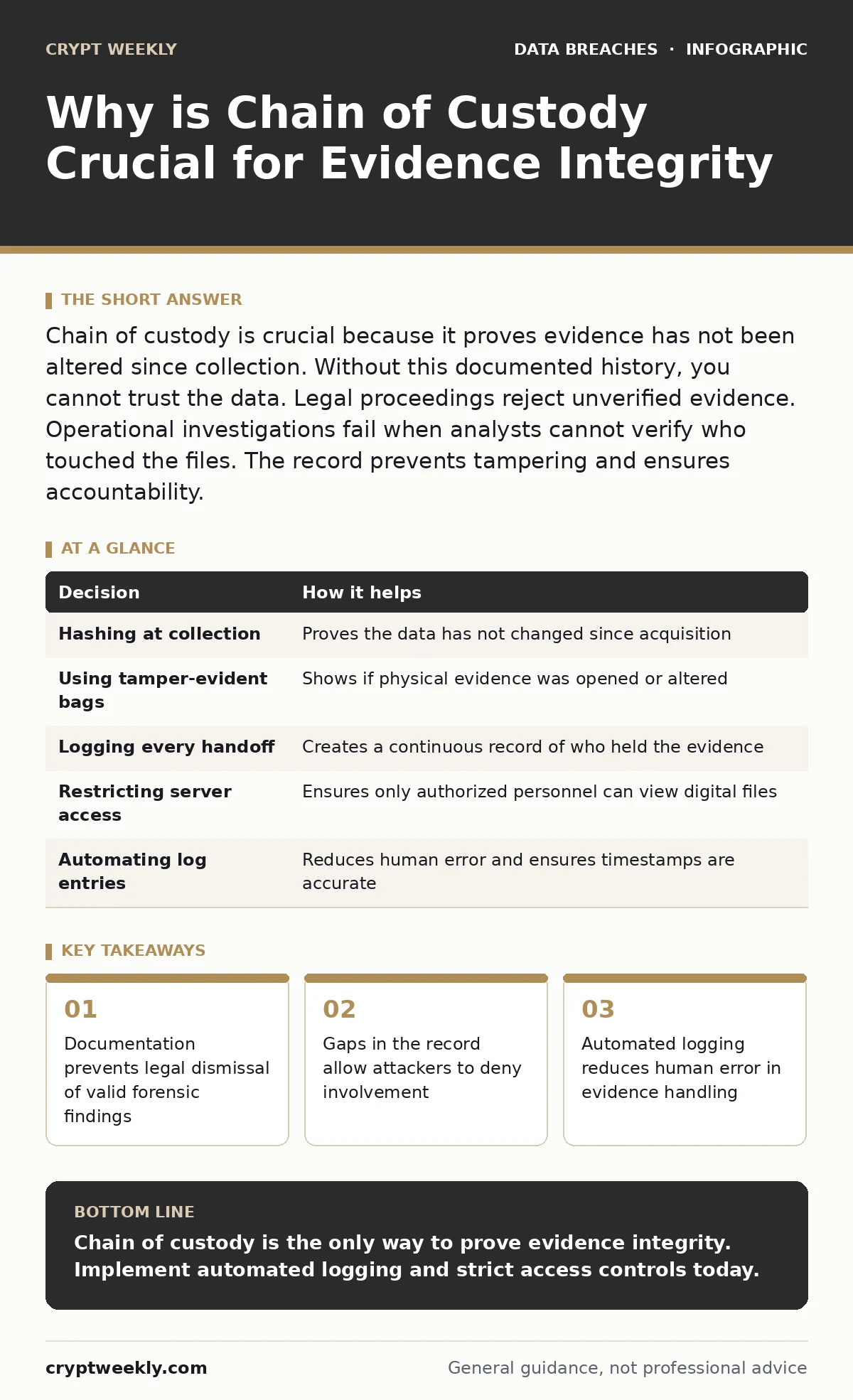
Chain of custody is crucial because it proves evidence has not been altered since collection. Without this documented history, you cannot trust the data. Legal proceedings reject unverified evidence. Operational investigations fail when analysts cannot verify who touched the files. The record prevents tampering and ensures accountability.
Why is chain of custody crucial
Chain of custody is crucial because it establishes an unbroken record of evidence handling. This record proves that data collected during an investigation remains identical to the original source. Without this proof, you cannot demonstrate that the evidence was not altered, deleted, or swapped. Courts and internal audits require this verification. The weight of this reason exceeds all others because it determines whether your findings hold any value. If the chain breaks, the evidence is worthless. You spend hours analyzing data that no one will accept. This failure occurs even when the technical analysis is perfect. The integrity of the data matters less than the integrity of its handling.
What happens when the chain breaks
Imagine a team that collects logs from a compromised server. They copy the files to a USB drive and hand it to an analyst. No one records who held the drive or when. The defense argues the code was planted after collection. The prosecution has no record to contradict this claim. The case collapses. This scenario shows the non-obvious consequence of poor documentation. You do not just lose the case. You lose the ability to trust your own tools. Future investigations become suspect because the process lacks credibility. The hidden cost is the erosion of trust in your entire security function.
Contrast in investigation outcomes
This contrast highlights the mechanical difference between admissible and inadmissible evidence. Team A uses a standardized form or digital log. Each entry includes the date, time, person transferring, and person receiving. Team B relies on memory and informal notes. Memory fades and notes are lost. The formal process creates a barrier against casual tampering. It forces discipline at every step. This discipline is what separates professional forensics from amateur curiosity. The outcome is not just legal. It is operational. You can rely on Team A’s findings for remediation. You cannot rely on Team B’s.
Reasons in order of weight
You must prioritize reasons for maintaining chain of custody. The first reason is legal admissibility. Courts require proof that evidence was not tampered with. The second reason is operational integrity. You need to trust the data you analyze to make security decisions. The third reason is accountability. You need to know who handled the evidence to investigate internal threats.
The fourth reason is audit compliance. Frameworks like SOC 2 require documented controls over data handling. The fifth reason is deterrence. Knowing that every touch is recorded discourages insiders from stealing or altering data. Each reason builds on the previous one. Legal admissibility is the foundation. Without it, the other reasons matter less.
Common points of failure
Evidence handling fails at specific points. The first failure is the initial collection. If you do not hash the data immediately, you cannot prove its original state. The second failure is storage. If evidence is left in an unsecured room, anyone can access it. The third failure is transfer. If you mail evidence without tamper-evident packaging, the carrier can open it.
The fourth failure is digital access. If multiple analysts share a password for the evidence server, you cannot track who viewed what. The fifth failure is documentation gaps. If a shift change is not logged, the chain has a break. These failures are not rare. They happen when teams rush or lack training. Each break introduces doubt. Doubt destroys the value of the evidence.
See also: Mistakes That Trigger Tax Identity Theft and How to Stop Them · What Does Data Minimization Mean and How to Apply It
Decision impact on evidence
| Decision | How it helps |
|---|---|
| Hashing at collection | Proves the data has not changed since acquisition |
| Using tamper-evident bags | Shows if physical evidence was opened or altered |
| Logging every handoff | Creates a continuous record of who held the evidence |
| Restricting server access | Ensures only authorized personnel can view digital files |
| Automating log entries | Reduces human error and ensures timestamps are accurate |
This table shows specific actions and their direct benefits. Hashing is a mathematical fingerprint of the data. If the hash changes, the data changed. Tamper-evident bags break visibly if opened. These physical controls complement digital ones. Logging handoffs ensures no gap in the record. Restricting access limits the number of people who could tamper. Automation removes the risk of forgotten entries. Each decision strengthens the chain. You must implement all of them. One weak link breaks the whole chain.
What to do with this knowledge
You must implement a strict evidence handling policy. Start by defining what constitutes evidence. Not all logs are evidence. Only those related to an incident require chain of custody. Next, create a standard form for logging transfers. This form must include names, dates, times, and hashes. Train all staff on this process. Include analysts, help desk, and management.
Practice the process in mock investigations. Identify where your team tends to skip steps. Fix those gaps. Use automated tools where possible. Manual logging is prone to error. Automation ensures consistency. Review your logs regularly. Look for gaps or inconsistencies. Address them immediately. This knowledge helps you avoid costly failures. It protects your organization legally and operationally.
Integration with other controls
Chain of custody does not exist in isolation. It works with other security controls. Access reviews ensure that only authorized people can handle evidence. Mobile device management policies cover evidence on phones and tablets. Backup testing ensures you have copies of evidence if the original is lost. Data sovereignty laws may dictate where evidence must be stored. Understanding these connections helps you build a stronger program. You cannot rely on chain of custody alone. It must be part of a broader security framework. This integration reduces risk. It ensures that evidence is protected from collection to disposal.
Key takeaways
- Documentation prevents legal dismissal of valid forensic findings
- Gaps in the record allow attackers to deny involvement
- Automated logging reduces human error in evidence handling
Chain of custody is the only way to prove evidence integrity. Implement automated logging and strict access controls today.
Frequently asked questions
Can I use email to transfer evidence?
No, email is not secure enough for evidence transfer. Use encrypted channels with access logs.
What if I forget to log a handoff?
You must note the gap immediately and explain it. The chain is broken until you document the missing period.
Does chain of custody apply to cloud data?
Yes, cloud data requires logging of who accessed it and when. Use provider logs and your own records.
How this guide was produced: written by the Crypt Weekly editorial team with AI assistance, checked against the public references listed below, and reviewed when the facts change. See our editorial policy or report an error.