
Storage location determines legal jurisdiction, meaning your data follows local laws even if your company is headquartered elsewhere.
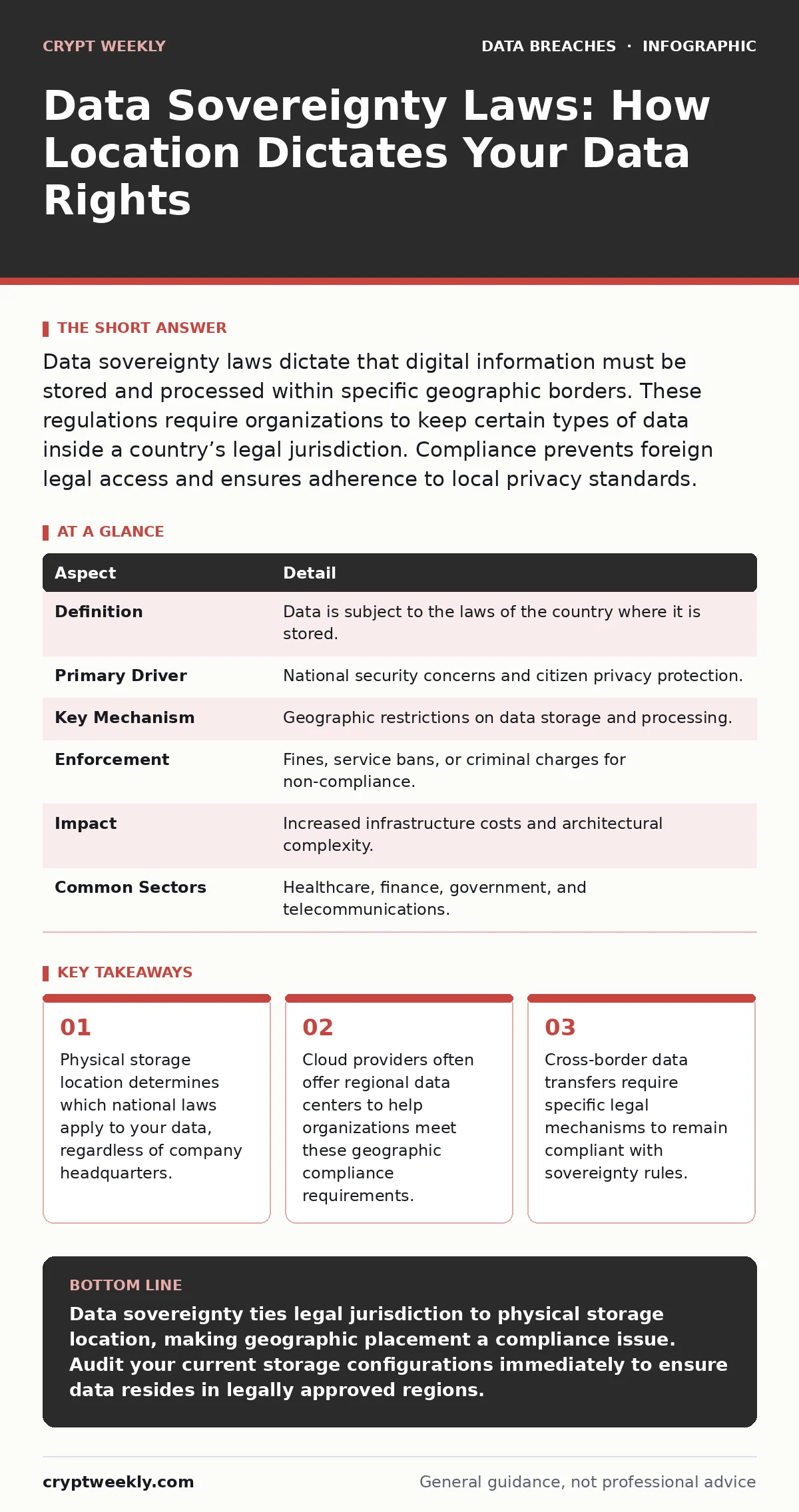
Data sovereignty laws dictate that digital information must be stored and processed within specific geographic borders. These regulations require organizations to keep certain types of data inside a country’s legal jurisdiction. Compliance prevents foreign legal access and ensures adherence to local privacy standards.
Understanding the Core Concept
Data sovereignty is the concept that digital data is subject to the laws and governance structures of the nation in which it is physically located. This principle treats data as if it were a physical object that cannot cross borders without permission. When you store information on a server, that server has a geographic address. That address determines which government can legally demand access to the contents. This creates a direct link between infrastructure location and legal liability.
The concept differs from data privacy. Privacy laws define how you handle personal information. Sovereignty laws define where that information can exist. A company might follow strict privacy protocols but still violate sovereignty rules by storing European customer records on a server in another country. The violation occurs at the moment of storage, not necessarily at the moment of access.
| Aspect | Detail |
|---|---|
| Definition | Data is subject to the laws of the country where it is stored. |
| Primary Driver | National security concerns and citizen privacy protection. |
| Key Mechanism | Geographic restrictions on data storage and processing. |
| Enforcement | Fines, service bans, or criminal charges for non-compliance. |
| Impact | Increased infrastructure costs and architectural complexity. |
| Common Sectors | Healthcare, finance, government, and telecommunications. |
How Data Sovereignty Laws Work
Governments enforce sovereignty by requiring that specific categories of data remain within their borders. This often applies to sensitive personal information, health records, or critical infrastructure data. The law does not care about encryption status in many cases. If the data exists on a disk within the country, the local courts may have jurisdiction over it. This means a foreign government cannot legally compel your company to hand over data if that data is stored in a jurisdiction that refuses to cooperate.
Cloud computing complicates this reality. Major cloud providers operate massive networks of data centers worldwide. When you upload data to a generic cloud bucket, the provider may replicate that data to multiple locations for redundancy. If one copy lands in a country with lax sovereignty laws, you may accidentally violate regulations. You must explicitly configure storage regions to ensure data stays in approved jurisdictions. This configuration is a technical control with legal consequences.
Who Is Affected by These Rules
Organizations that collect data from citizens in different countries face the most pressure. A global software company must navigate dozens of conflicting sovereignty requirements. If the company serves customers in Europe, it must respect European sovereignty rules for those customers' data. If it also serves customers in Asia, it may need separate infrastructure for Asian data. This fragmentation forces companies to build complex, multi-region architectures.
Small businesses are not immune. If you offer services online, you likely have users from various jurisdictions. Even a single user in a country with strict sovereignty laws can trigger compliance requirements for that specific user’s data. You cannot ignore the rule because you are small. The law applies based on the data subject’s location, not the size of the processor. This forces even small teams to consider where their hosting providers store information.
Common Misconceptions About Sovereignty
Many people believe that encrypting data removes sovereignty constraints. This is incorrect. Encryption protects confidentiality, but it does not change jurisdiction. If encrypted data sits on a server in a country with broad surveillance powers, that country may still demand the decryption keys or the data itself. Sovereignty is about location, not just secrecy. You must manage both physical location and cryptographic access separately.
Another common error is assuming that cloud providers handle compliance automatically. Providers offer tools to select regions, but they do not choose them for you. If you select a global default setting, the provider may distribute data across multiple continents. You are responsible for verifying that the selected region aligns with the legal requirements of your customers. The provider gives you the keys to the kingdom, but you must build the walls.
People also confuse sovereignty with data residency. Residency is a technical requirement to keep data in a specific place. Sovereignty is the legal framework that mandates that residency. You can have residency without sovereignty if you choose to keep data local for performance reasons. However, sovereignty forces residency regardless of performance preferences. Understanding this distinction helps in designing compliant architectures.
Technical Implementation Strategies
You must map your data flows to understand where information moves. Start by identifying all sources of data collection. Then trace the path from collection to storage. Identify every point where data crosses a border. This includes backups, disaster recovery sites, and third-party analytics services. Each cross-border transfer is a potential compliance risk. Documenting these flows is the first step in managing sovereignty.
Select hosting providers that offer granular control over data placement. Look for providers that allow you to pin data to specific regions or availability zones. Avoid services that replicate data globally by default. When you cannot avoid cross-border transfers, use legal mechanisms such as standard contractual clauses. These are legal documents that provide a basis for transferring data out of a strict jurisdiction. They do not change the physical location, but they may provide legal cover for the transfer.
Regular audits are necessary to maintain compliance. Cloud configurations drift over time. Engineers may change settings, new services may be added, and providers may update their infrastructure. Automated monitoring tools can alert you when data is written to an unauthorized region. This proactive approach prevents accidental violations. You must treat data location as a continuous operational requirement, not a one-time setup task.
See also: Password Rotation Myths: Why Changing Passwords Regularly Weakens Security · Mistakes That Trigger Tax Identity Theft and How to Stop Them
Legal and Operational Trade-offs
Compliance with data sovereignty laws often increases infrastructure costs. You may need to maintain separate data centers in multiple countries. This redundancy ensures that data stays local but duplicates your hardware and staffing expenses. You lose the efficiency of a single, global pool of resources. The trade-off is clear: higher costs for legal safety. You must justify these costs to stakeholders by highlighting the risks of non-compliance.
Operational complexity also rises. Managing multiple regions requires specialized knowledge. Your engineering team must understand the legal nuances of each region they support. This slows down deployment cycles. You cannot push updates globally if different regions have different compliance requirements. You must test and deploy changes region by region. This fragmentation can delay product releases and increase the burden on development teams.
Integrating with Broader Security Practices
Data sovereignty intersects with other security domains. For instance, backup testing must verify that backups are stored in the correct region. If your primary database is in Region A, your backups must also reside in Region A or an approved equivalent. Testing backups that are stored in the wrong region is a compliance failure, even if the data restores correctly. You must include location checks in your backup validation procedures.
Access controls must also respect sovereignty boundaries. Access reviews should confirm that only authorized personnel in specific regions can access local data. If a support engineer in one country needs to troubleshoot an issue in another, the data transfer must follow established legal channels. You cannot simply grant global access to all data. Role-based access control must be configured with geographic constraints in mind.
Mobile devices present another challenge. Mobile device management solutions must ensure that data cached on employee phones complies with sovereignty rules. If an employee travels across borders, the data on their device may enter a new jurisdiction. You must define policies for data caching and transmission on mobile devices. This prevents accidental violations when employees move physically.
Navigating Future Changes
Data sovereignty laws are evolving. New regulations emerge as governments prioritize digital independence. You must stay informed about legislative changes in the regions where you operate. Subscribe to legal updates from reliable sources. Engage with legal counsel who specialize in international data law. They can help you interpret new requirements and adjust your architecture accordingly.
Proactive planning reduces the shock of new laws. Design your systems with modularity in mind. If a new country enacts strict sovereignty rules, you should be able to spin up a new local region without rewriting your entire application. This architectural flexibility allows you to adapt quickly. You treat sovereignty as a variable parameter in your system design, not a fixed constraint.
Key takeaways
- Physical storage location determines which national laws apply to your data, regardless of company headquarters.
- Cloud providers often offer regional data centers to help organizations meet these geographic compliance requirements.
- Cross-border data transfers require specific legal mechanisms to remain compliant with sovereignty rules.
Data sovereignty ties legal jurisdiction to physical storage location, making geographic placement a compliance issue. Audit your current storage configurations immediately to ensure data resides in legally approved regions.
Frequently asked questions
Does encryption protect against data sovereignty laws?
No, encryption protects confidentiality but does not change the legal jurisdiction of the data. Sovereignty laws apply to the physical location of the storage medium, regardless of whether the data is readable.
Can I store all my data in one global cloud region?
Only if all your customers and legal obligations allow it. Many countries require specific data to remain within their borders, forcing you to use multiple regional data centers.
How do I handle data transfers between countries?
You must use legal mechanisms such as standard contractual clauses or adequacy decisions. These provide a legal basis for moving data across borders while respecting local sovereignty rules.
What happens if I accidentally store data in the wrong region?
You may face fines, legal action, or forced data deletion. You should immediately migrate the data to a compliant region and investigate the configuration error to prevent recurrence.
How this guide was produced: written by the Crypt Weekly editorial team with AI assistance, checked against the public references listed below, and reviewed when the facts change. See our editorial policy or report an error.