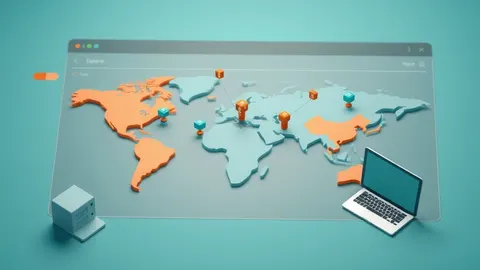
Data sovereignty does not guarantee privacy from government access; it only defines which national laws apply to infrastructure located within specific borders.
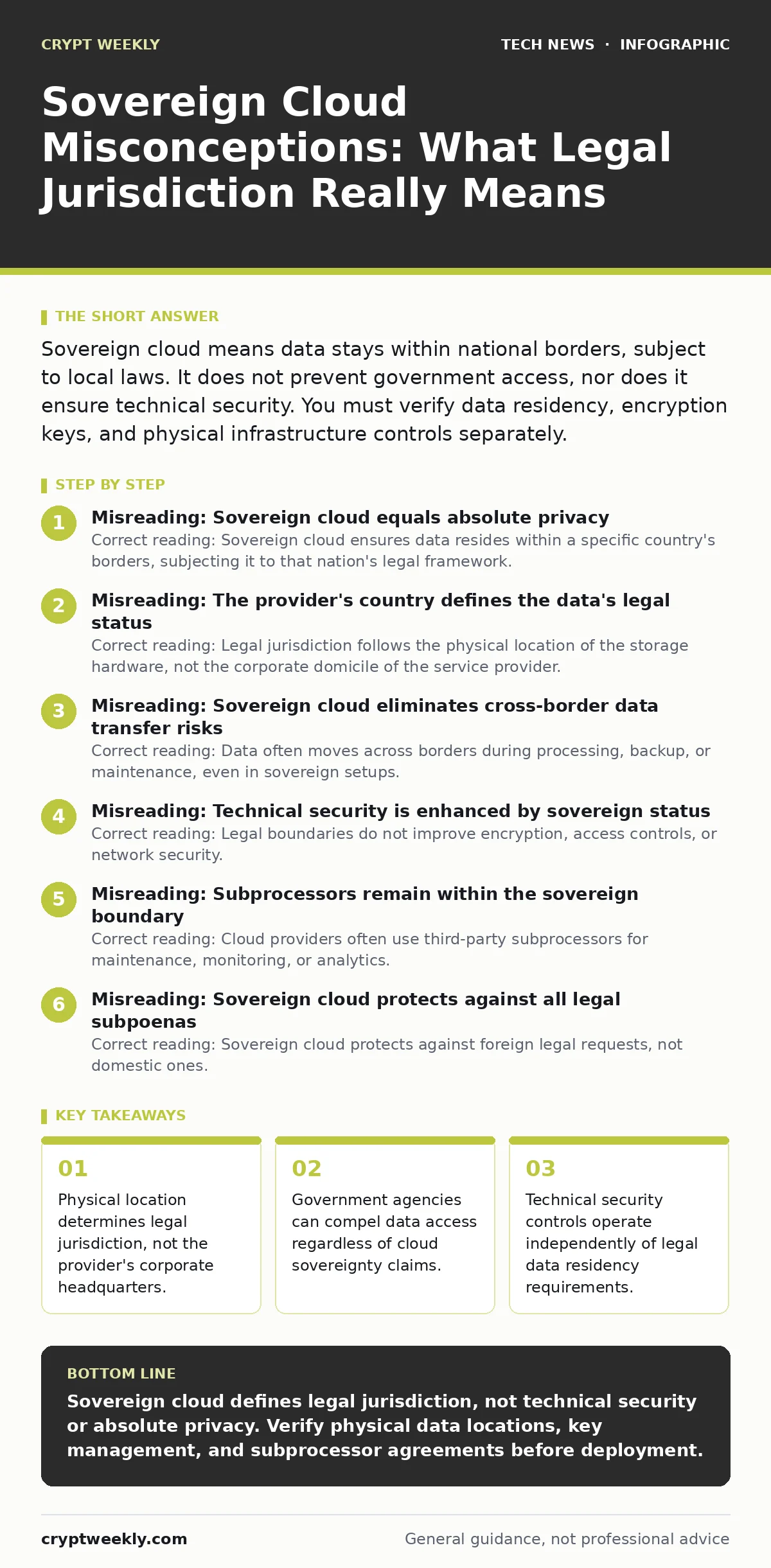
Sovereign cloud means data stays within national borders, subject to local laws. It does not prevent government access, nor does it ensure technical security. You must verify data residency, encryption keys, and physical infrastructure controls separately.
Misreading: Sovereign cloud equals absolute privacy
Correct reading: Sovereign cloud ensures data resides within a specific country's borders, subjecting it to that nation's legal framework. It does not create a privacy shield against government surveillance. National security laws often allow authorities to access data without a warrant or user notification. You gain legal predictability, not secrecy. The provider remains bound by local statutes.
Imagine storing files in a sovereign cloud in Country A. Country A passes a law requiring all cloud providers to hand over encryption keys to intelligence agencies. Your data is still "sovereign," but your privacy is gone. The legal definition of sovereignty addresses jurisdiction, not confidentiality. Do not confuse compliance with protection.
Misreading: The provider's country defines the data's legal status
Correct reading: Legal jurisdiction follows the physical location of the storage hardware, not the corporate domicile of the service provider. A multinational corporation may operate servers in three different countries. Data stored in each region falls under the laws of that specific region. You must verify the exact geographic location of the data centers. Corporate headquarters location is irrelevant to data residency.
Suppose a company is headquartered in Country B but hosts your data in Country C. Country C's laws apply to your data. If Country C has weak privacy protections, your data is exposed, regardless of the provider's reputation in Country B. Always check the physical address of the data center, not the provider's registration address.
Misreading: Sovereign cloud eliminates cross-border data transfer risks
Correct reading: Data often moves across borders during processing, backup, or maintenance, even in sovereign setups. Backup systems may replicate data to secondary sites in different jurisdictions. Support staff accessing logs from remote locations can trigger cross-border data flows. You must map every data movement path. Static storage residency does not prevent dynamic data transit.
Consider a database that replicates to a disaster recovery site abroad. During a failover event, your data temporarily exists in a foreign jurisdiction. If the primary site fails, you might lose sovereign protection for hours or days. Verify where backups live. Check if maintenance tools connect from outside the sovereign boundary.
Misreading: Technical security is enhanced by sovereign status
Correct reading: Legal boundaries do not improve encryption, access controls, or network security. A sovereign cloud can be poorly secured technically. You must implement standard security controls regardless of the cloud's legal status. Encrypt data at rest and in transit. Manage identities strictly. Sovereignty is a legal construct, not a technical feature. Do not skip security audits because the cloud is sovereign.
Imagine a sovereign cloud provider that neglects regular patching. Your data remains within borders, but vulnerabilities allow attackers to breach the system. Sovereignty offers no defense against hacking. You still need rigorous certificate management to validate connections. Use strong encryption standards. Test access controls frequently.
Misreading: Subprocessors remain within the sovereign boundary
Correct reading: Cloud providers often use third-party subprocessors for maintenance, monitoring, or analytics. These subprocessors may operate outside the sovereign boundary. Data might flow to a foreign vendor for software updates or support tickets. You must review the provider's subprocessor list. Verify that no data leaves the country during third-party operations.
Suppose a sovereign provider uses a global network monitoring tool. Traffic metadata might flow to the tool's headquarters abroad. This violates the spirit of sovereignty, even if raw data stays put. Check contracts for subprocessor restrictions. Ensure all support interactions occur within the country.
See also: How to Secure Cloud Storage: Encrypt Data Before Upload
Misreading: Sovereign cloud protects against all legal subpoenas
Correct reading: Sovereign cloud protects against foreign legal requests, not domestic ones. Local courts can still issue subpoenas for data stored within the country. The provider must comply with local law enforcement orders. You face the same legal risks as with on-premise storage. Sovereignty shifts the legal opponent, it does not remove them. Understand local retention laws.
Imagine a local court orders your sovereign cloud provider to hand over emails. The provider must comply. Your data is no longer private from your own government. Sovereignty does not grant immunity. It only prevents foreign governments from easily accessing your data. Plan for local legal exposure.
Misreading: Encryption keys are always local in sovereign clouds
Correct reading: Key management is a separate control from data storage. Some sovereign clouds store encryption keys in a separate jurisdiction. If keys live abroad, foreign authorities might access them. You must control key management. Use Bring Your Own Key (BYOK) or Hold Your Own Key (HYOK) models. Ensure keys never leave the sovereign boundary.
Suppose your data is in Country A, but keys are managed by a service in Country B. An agency in Country B could decrypt your data remotely. Sovereign data is useless if keys are exposed. Check key storage locations. Implement strict key rotation policies.
Misreading: Sovereign cloud requires no additional compliance efforts
Correct reading: Sovereign cloud simplifies some compliance aspects but creates new verification burdens. You must audit physical security, personnel vetting, and supply chain origins. Hardware might be manufactured abroad. Firmware could contain foreign backdoors. Verify the entire supply chain. Document all controls. Sovereignty adds complexity to procurement.
Imagine buying servers from a foreign manufacturer for your sovereign cloud. The hardware might contain vulnerabilities exploitable by the manufacturer's government. Sovereignty does not clean the hardware. Audit hardware origins. Verify firmware integrity.
Key takeaways
- Physical location determines legal jurisdiction, not the provider's corporate headquarters.
- Government agencies can compel data access regardless of cloud sovereignty claims.
- Technical security controls operate independently of legal data residency requirements.
- Cross-border data transfers often bypass sovereign protections through third-party services.
Sovereign cloud defines legal jurisdiction, not technical security or absolute privacy. Verify physical data locations, key management, and subprocessor agreements before deployment.
Frequently asked questions
Does sovereign cloud prevent US authorities from accessing data?
If the data is stored outside the US, US authorities face higher legal hurdles, but can still seek access through international treaties or provider cooperation.
Is sovereign cloud more expensive than public cloud?
Sovereign cloud often costs more due to specialized infrastructure, compliance overhead, and limited provider options in specific regions.
Can I move data between sovereign and non-sovereign clouds?
Yes, but moving data out breaks sovereignty. Moving it in requires re-encryption and verification of the new environment's compliance.
How do I verify a provider's sovereign claims?
Request independent audits, physical data center locations, and detailed subprocessor lists. Verify encryption key storage locations.
How this guide was produced: written by the Crypt Weekly editorial team with AI assistance, checked against the public references listed below, and reviewed when the facts change. See our editorial policy or report an error.