
SOC 2 compliance reveals your internal security posture to auditors, not the public, creating a hidden layer of accountability that often exceeds standard legal requirements.
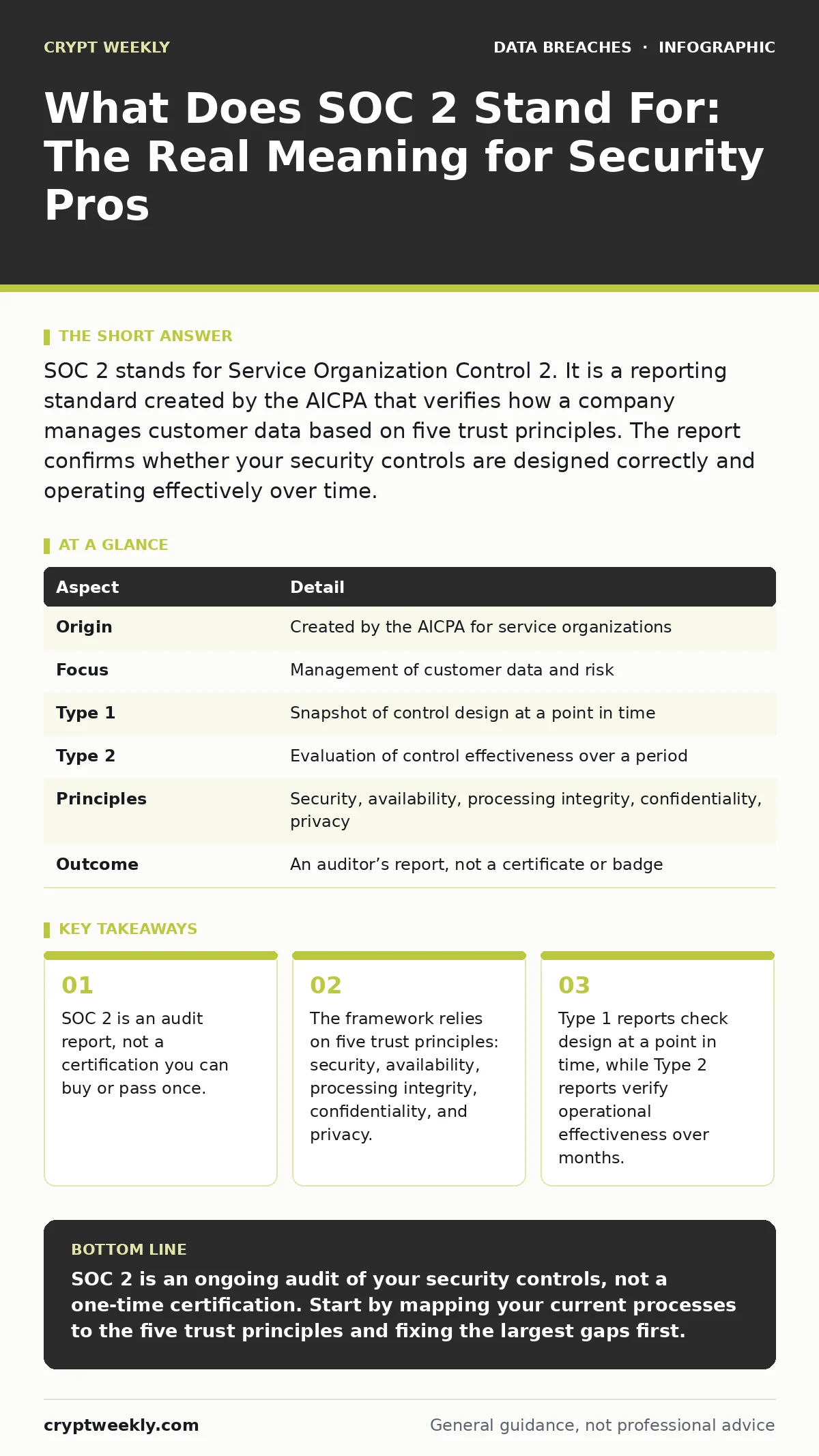
SOC 2 stands for Service Organization Control 2. It is a reporting standard created by the AICPA that verifies how a company manages customer data based on five trust principles. The report confirms whether your security controls are designed correctly and operating effectively over time.
What Does SOC 2 Stand For
SOC 2 stands for Service Organization Control 2. It is a framework developed by the American Institute of Certified Public Accountants to ensure service providers properly manage your data. The standard focuses on five trust service principles: security, availability, processing integrity, confidentiality, and privacy. Security is the only mandatory principle.
The other four are optional and depend on the services you provide. When a company says it is SOC 2 compliant, it means an independent auditor has reviewed their controls against these specific criteria. The report provides assurance to clients that the vendor handles data responsibly. This assurance is critical for building trust in business relationships.
How the Audit Process Works
The audit process involves two distinct types of reports. Type 1 reports evaluate the design of your controls at a specific point in time. This report tells the reader whether your policies are theoretically sound. It does not prove you actually follow those policies day to day. Type 2 reports are more rigorous. They examine how well your controls operated over a period of time, usually six to twelve months. The auditor tests samples of activities to verify consistency. This distinction matters because a well-written policy means little if staff ignore it. Type 2 reports provide much stronger evidence of actual security posture.
| Aspect | Detail |
|---|---|
| Origin | Created by the AICPA for service organizations |
| Focus | Management of customer data and risk |
| Type 1 | Snapshot of control design at a point in time |
| Type 2 | Evaluation of control effectiveness over a period |
| Principles | Security, availability, processing integrity, confidentiality, privacy |
| Outcome | An auditor’s report, not a certificate or badge |
Who Needs This Report
Any organization that processes, stores, or transmits customer data needs to consider this framework. Software-as-a-Service companies are the most common users. They handle sensitive information and must prove they protect it. Cloud infrastructure providers also use these reports to reassure clients. If you sell to other businesses, your customers will likely ask for this report. It becomes a requirement in many enterprise contracts. Startups often face pressure to obtain this report early. Investors view it as a sign of maturity and risk management. Without it, you may lose deals to competitors who have already undergone the audit.
Common Misconceptions About Compliance
Many people believe SOC 2 is a certification you can achieve once. This is incorrect. It is an ongoing reporting process. You must maintain your controls and undergo regular audits. Another common mistake is assuming the report is public. The report is a confidential document shared only with authorized parties. You cannot post it on your website.
Some companies display a badge claiming compliance. This badge proves nothing without the accompanying report. Another error is focusing only on the security principle. While security is mandatory, ignoring privacy or availability can fail the audit if your services depend on those attributes. You must align the report scope with your actual business risks.
The Hidden Costs of Implementation
Implementing these controls requires significant effort and resources. You must document every process that touches customer data. This includes access management, incident response, and change management. Many teams underestimate the time needed for documentation. Auditors will ask for evidence of every control. If you cannot produce logs or records, you receive a qualification.
A qualification is a negative finding that weakens the report. It tells the reader your controls are not working as intended. This can delay sales and damage reputation. The cost is not just the auditor’s fee. It is the internal labor required to maintain readiness. You must balance security rigor with operational efficiency.
Imagine a startup that rushes to get a Type 1 report to close a deal. They write policies but do not implement the technical controls. Six months later, they attempt a Type 2 report. The auditor finds no evidence that the policies are followed. The report includes severe qualifications. The client cancels the contract. The startup loses revenue and must restart the process. This scenario highlights the risk of prioritizing speed over substance. Proper preparation takes time and consistent effort.
See also: Cookie Consent Management: How It Works and Why It Fails
Practical Steps for Readiness
Start by defining your system boundaries. Identify what systems and data are in scope. Map your existing controls to the trust service principles. Look for gaps where you lack documentation or technical enforcement. Implement automated logging where possible. Manual checks are prone to error and are hard to scale. Use tools that generate audit trails automatically. This reduces the burden on your team during the audit. Conduct internal reviews before hiring an external auditor. This helps you identify issues early. Fixing problems internally is cheaper and faster than failing an external audit. Maintain a culture of documentation. Every change should be recorded and justified.
What to Do Next
If you need this report, begin with a gap analysis. Compare your current state against the required principles. Identify the biggest risks and address them first. Do not try to fix everything at once. Prioritize controls that have the highest impact on security and compliance. Engage an auditor early to understand their expectations.
Different auditors may interpret requirements slightly differently. Clear communication prevents surprises later. Remember that this process is about risk management. It is not about achieving perfection. It is about demonstrating that you have reasonable controls in place. Focus on consistency and evidence. Your goal is to show that you protect customer data reliably.
Related Security Concepts
Understanding this framework helps you grasp other security topics. For instance, data minimization reduces the amount of sensitive data you hold, which simplifies the audit scope. Fewer data points mean fewer controls to document and test. Backup testing is another critical area. Auditors will ask how you verify that backups are recoverable. Regular testing proves that your data is not just stored, but usable. This ties directly into the availability principle. Password rotation policies are often reviewed during the audit. However, frequent rotation can lead to weaker passwords if users choose predictable patterns. Balancing security with usability is key.
Stolen session tokens represent a common threat that bypasses traditional authentication controls. Your audit must include controls for session management and token expiration. This ensures that even if a password is compromised, the session is short-lived. Chain of custody is vital for incident response. If a breach occurs, you must prove who accessed the data and when.
Proper logging supports this requirement. Healthcare data breaches highlight the importance of privacy controls. If you handle health information, you must align with relevant regulations. Data sovereignty laws may also impact your controls. You must store data in specific jurisdictions to comply with local laws. Medical identity theft is a growing risk. Strong identity verification controls help prevent this.
Key takeaways
- SOC 2 is an audit report, not a certification you can buy or pass once.
- The framework relies on five trust principles: security, availability, processing integrity, confidentiality, and privacy.
- Type 1 reports check design at a point in time, while Type 2 reports verify operational effectiveness over months.
SOC 2 is an ongoing audit of your security controls, not a one-time certification. Start by mapping your current processes to the five trust principles and fixing the largest gaps first.
Frequently asked questions
Is SOC 2 the same as ISO 27001?
No. SOC 2 is a US-focused framework based on trust principles, while ISO 27001 is an international standard for information security management systems. They overlap but have different scopes and reporting formats.
How long does the audit take?
The timeline varies based on your organization’s size and complexity. Initial readiness assessments can take months. The actual audit period for a Type 2 report is typically six to twelve months of observation.
Can I get SOC 2 without an auditor?
No. You must hire an independent licensed CPA firm to perform the audit and issue the report. Self-assessments are not valid for compliance purposes.
What happens if I fail the audit?
You do not "fail" in a binary sense. The auditor issues a report with qualifications or exceptions for controls that did not meet criteria. You must remediate these issues before the next audit period.
How this guide was produced: written by the Crypt Weekly editorial team with AI assistance, checked against the public references listed below, and reviewed when the facts change. See our editorial policy or report an error.