
Keeping less data reduces your attack surface because attackers cannot steal what you never collected or stored in the first place.
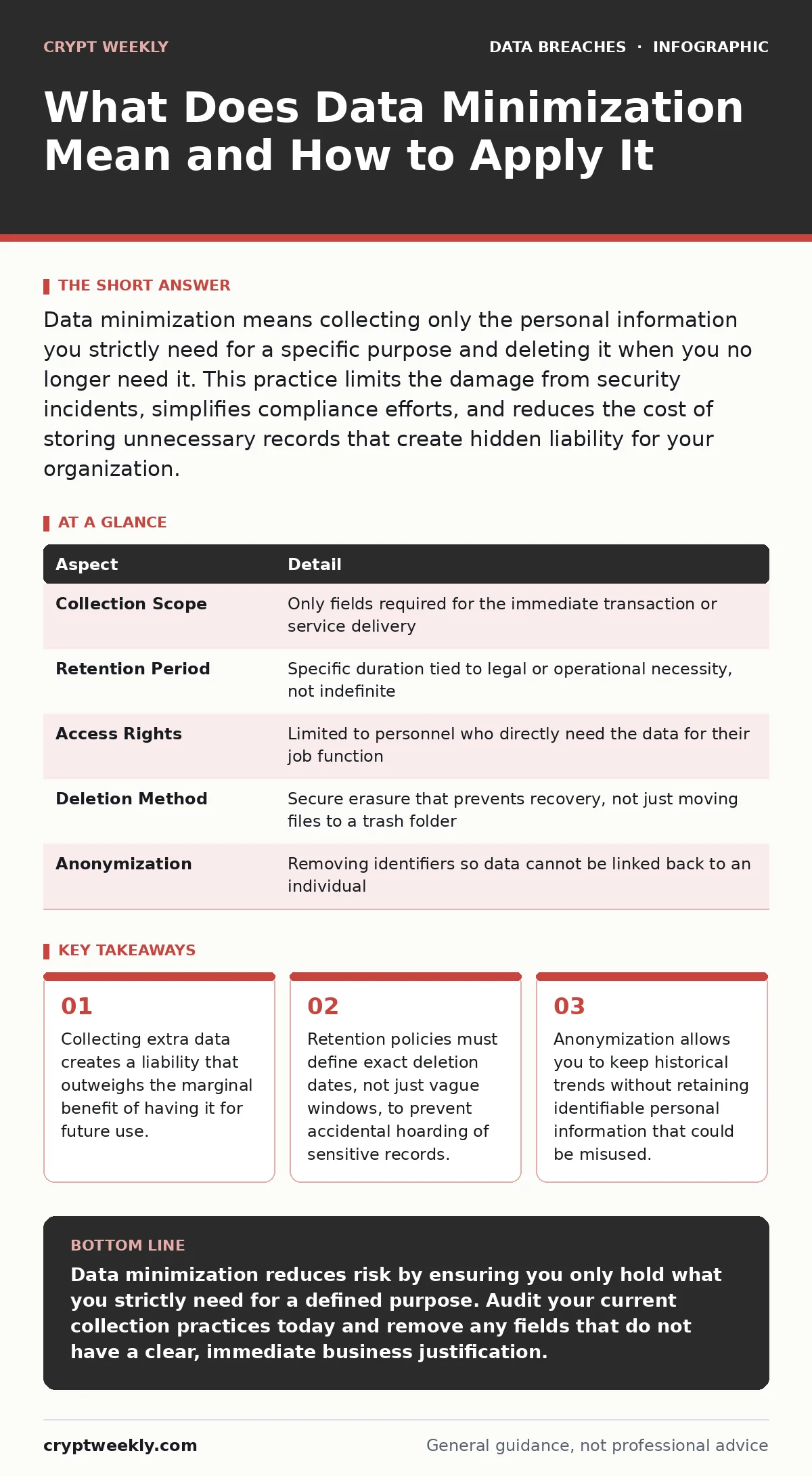
Data minimization means collecting only the personal information you strictly need for a specific purpose and deleting it when you no longer need it. This practice limits the damage from security incidents, simplifies compliance efforts, and reduces the cost of storing unnecessary records that create hidden liability for your organization.
What does data minimization mean in practice
Data minimization is the principle of restricting data collection to what is strictly necessary for a stated purpose. You do not gather information just because you can or because it might be useful someday. This approach directly answers what does data minimization mean by focusing on the boundary of collection rather than the security of storage. You define the specific goal of each data interaction. You then identify the minimum fields required to achieve that goal. Any field outside that strict requirement is excluded from your collection process.
This concept shifts security from a perimeter defense to an internal constraint. Traditional security assumes you have data and must protect it from external threats. Data minimization assumes you should not have the data in the first place. This reduces the value of your systems to attackers. It also reduces the complexity of your compliance efforts. You have fewer records to audit, fewer backups to verify, and fewer assets to secure.
| Aspect | Detail |
|---|---|
| Collection Scope | Only fields required for the immediate transaction or service delivery |
| Retention Period | Specific duration tied to legal or operational necessity, not indefinite |
| Access Rights | Limited to personnel who directly need the data for their job function |
| Deletion Method | Secure erasure that prevents recovery, not just moving files to a trash folder |
| Anonymization | Removing identifiers so data cannot be linked back to an individual |
How the mechanism restricts risk
The mechanism works by reducing the attack surface. Every piece of personal data you store is a potential target. Attackers scan for databases containing names, addresses, and financial details. If you do not store those details, the scan yields nothing. This is not a theoretical benefit. It is a physical reduction in the assets available for exfiltration. You must map every data field to a business requirement. If you cannot articulate why you need a specific field, you delete that field from your intake forms and databases.
Storage costs are not the only factor. The cost of managing access controls for unnecessary data is high. You must grant permissions, audit logs, and monitor usage for every record. Minimizing data simplifies this administrative burden. It also limits the blast radius of insider threats. An employee with malicious intent can only steal what they can access. If you remove access to historical or redundant records, you remove their ability to misuse that information.
Who is affected by these constraints
Every organization that collects personal information is affected. This includes small businesses that collect customer emails for newsletters. It includes large enterprises that process payroll data. The impact varies by industry, but the principle remains constant. You are responsible for the data you hold, regardless of where it resides. Cloud providers, third-party vendors, and legacy systems all fall under your accountability. You must ensure your partners also follow minimization principles.
Healthcare providers face strict requirements under regulations like HIPAA. They must limit protected health information to what is needed for treatment. Financial institutions must limit data to what is needed for transaction processing and fraud prevention. Even casual apps that request location data must justify that request. If the app does not need precise location to function, it should not collect it. This applies to you whether you are a developer, a manager, or a compliance officer.
Common misconceptions about data reduction
Many people confuse data minimization with data deletion. Deletion is the end state. Minimization is the process of limiting collection and retention. You do not delete data immediately after collection. You keep it only as long as the purpose requires. Another common error is assuming encryption replaces minimization. Encryption protects data at rest and in transit. It does not reduce the amount of data you hold. If you encrypt unnecessary data, you still have the liability of storing it.
Some teams believe they need to keep data for "future analytics." This is a hidden cost. Storing raw personal data for vague future uses increases risk without immediate benefit. You can achieve analytics through aggregated or anonymized data. This allows you to spot trends without retaining identifiable records. You must resist the urge to hoard data because it might be useful later. The probability of it being useful is low. The probability of it being leaked is high.
Implementing minimization in your workflow
Start by auditing your current data flows. Identify every form, API endpoint, and manual process that collects personal information. For each field, ask two questions. Is this field required for the service? How long do we need to keep it? If the answer to the first question is no, remove the field. If the answer to the second question is vague, define a specific retention period. Automate the deletion process. Do not rely on manual cleanup.
Review your third-party contracts. Vendors often collect more data than necessary. Ensure your contracts specify that they must minimize data collection. Require them to delete data after the service is complete. This extends your minimization policy beyond your direct control. It also protects you from liability if a vendor suffers a breach. You must verify that their practices align with your standards. This is similar to verifying chain of custody for physical evidence. You need a clear record of who had the data and when it was destroyed.
See also: Data Protection Officer Responsibilities: The Real Job Description · What Is GDPR in Cyber Security: Rules, Scope, and Practical Steps
Handling edge cases and exceptions
Some legal requirements mandate longer retention periods. Tax records, for example, may need to be kept for several years. In these cases, you keep the data but limit access. Store it in a secure, isolated environment. Do not mix it with operational data that is accessed daily. This reduces the chance of accidental exposure. You must also consider data sovereignty laws. Some jurisdictions require data to stay within specific borders. Minimizing data helps you comply with these geographic restrictions by reducing the volume of data you need to manage.
Anonymization is a powerful tool for edge cases. If you need historical data for research, remove all identifiers. Replace names with random codes. Remove dates of birth and precise locations. The data remains useful for statistical analysis but cannot be linked to an individual. This allows you to retain value without retaining risk. You must validate that the anonymization process is irreversible. Re-identification attacks can sometimes reverse weak anonymization. Use established techniques to ensure true anonymity.
The long-term benefits of less data
Reducing data simplifies your security posture. You have fewer systems to patch, fewer logs to monitor, and fewer records to audit. This frees up resources for more critical security tasks. It also builds trust with your users. People are more willing to share data with organizations that demonstrate respect for their privacy. They can see that you only collect what you need. This transparency can be a competitive advantage.
Compliance becomes easier when you have less data. Auditors spend less time reviewing your records. You spend less time preparing for audits. The risk of non-compliance penalties decreases. You are not relying on perfect security controls to protect massive amounts of sensitive data. You are relying on the simple fact that you do not have the data. This is a more sustainable security strategy. It aligns with frameworks like SOC 2, which emphasize the protection of customer information. By minimizing data, you inherently meet many of these control objectives.
Key takeaways
- Collecting extra data creates a liability that outweighs the marginal benefit of having it for future use.
- Retention policies must define exact deletion dates, not just vague windows, to prevent accidental hoarding of sensitive records.
- Anonymization allows you to keep historical trends without retaining identifiable personal information that could be misused.
Data minimization reduces risk by ensuring you only hold what you strictly need for a defined purpose. Audit your current collection practices today and remove any fields that do not have a clear, immediate business justification.
Frequently asked questions
Does data minimization apply to employee data?
Yes, you must limit employee data to what is necessary for payroll, benefits, and legal compliance. Do not collect personal details unrelated to their employment.
How do I handle data minimization with cloud services?
Configure cloud services to collect only necessary fields. Set automated retention policies to delete data after the required period. Verify the provider’s deletion processes.
Is data minimization the same as GDPR compliance?
Data minimization is a core principle of GDPR, but it applies broadly. Even if you are not subject to GDPR, minimizing data reduces risk and simplifies operations for any organization.
What if a user provides more data than needed?
Inform the user that you only require specific fields. Ignore or delete the extra data. Do not store information that the user provided voluntarily if it is not necessary for the service.
How this guide was produced: written by the Crypt Weekly editorial team with AI assistance, checked against the public references listed below, and reviewed when the facts change. See our editorial policy or report an error.