
Anonymization removes the legal identity link forever, while de-identification only masks identifiers, leaving a path to re-identify individuals if new data emerges.
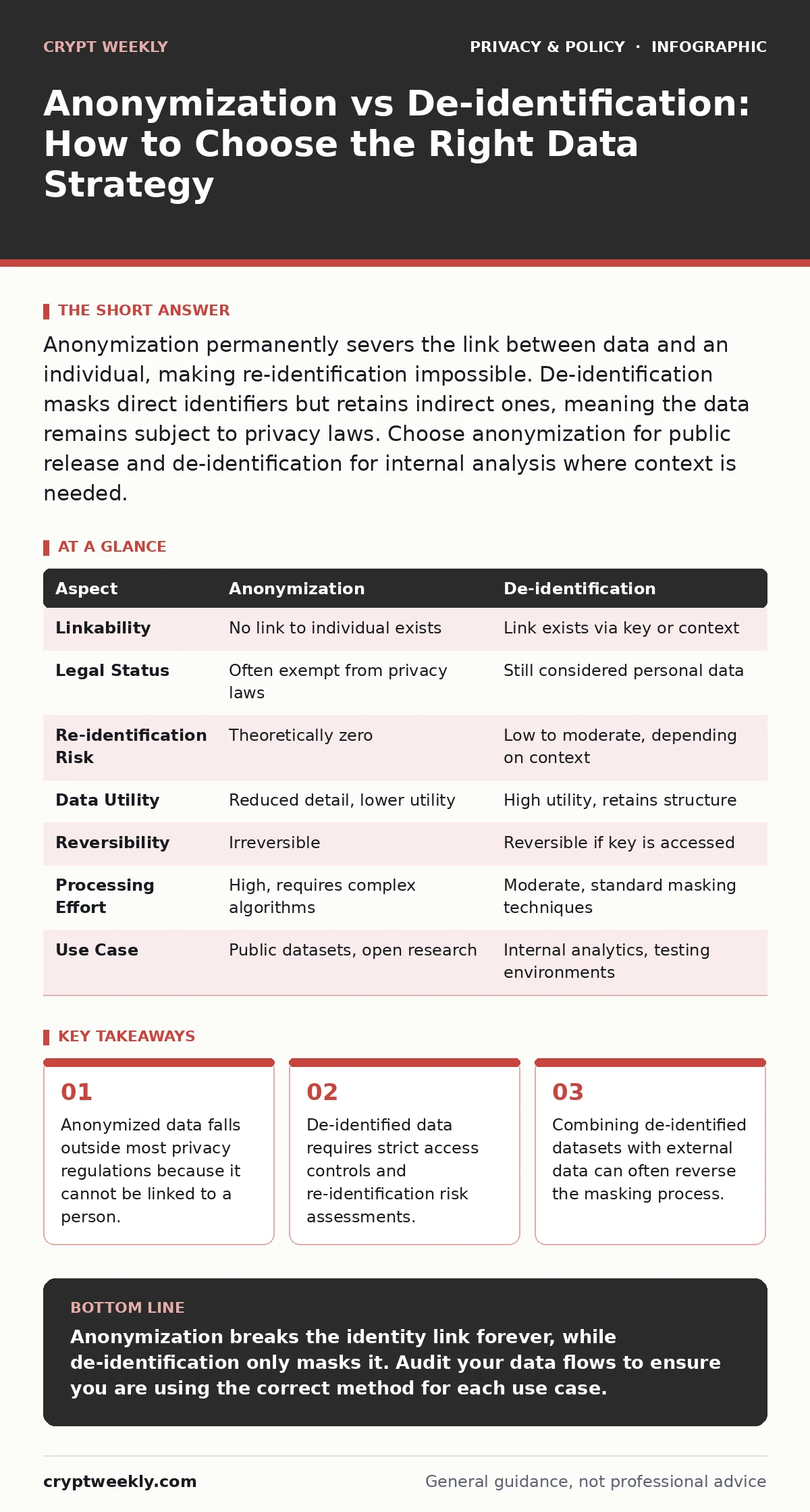
Anonymization permanently severs the link between data and an individual, making re-identification impossible. De-identification masks direct identifiers but retains indirect ones, meaning the data remains subject to privacy laws. Choose anonymization for public release and de-identification for internal analysis where context is needed.
The Core Difference Between Anonymization and De-identification
Anonymization and de-identification are often used interchangeably, but they represent fundamentally different approaches to data privacy. Anonymization transforms data so that no individual can be identified, ever. This process breaks the link between the data subject and the information permanently. Once data is anonymized, it is no longer considered personal data under most legal frameworks.
De-identification, by contrast, removes or masks direct identifiers like names and social security numbers. The data still contains enough indirect information to potentially re-identify individuals if combined with other datasets. You must understand this distinction before handling any user information.
What Anonymization Actually Does
Anonymization strips data of all identifiers, both direct and indirect. Direct identifiers include names, email addresses, and precise geographic coordinates. Indirect identifiers include combinations of age, gender, and zip code that can uniquely pinpoint a person. True anonymization uses techniques like generalization, suppression, and noise addition.
Generalization replaces specific values with broader categories, such as changing an exact age to an age range. Suppression removes rare or unique values entirely. Noise addition introduces random variations into the data to obscure individual records. The goal is to ensure that even with unlimited computational power, an attacker cannot link the data back to a specific human being.
What De-identification Actually Does
De-identification focuses on removing direct identifiers while preserving the utility of the data for analysis. It replaces names with codes or hashes. It masks portions of identifiers, such as showing only the last four digits of an account number. This method allows organizations to use the data for research, testing, or business intelligence without exposing raw personal information.
However, the data remains linked to an individual through a secure key or mapping table. If that key is compromised, or if the de-identified data is cross-referenced with external sources, re-identification becomes possible. This makes de-identification a risk management strategy rather than a total privacy solution.
Anonymization vs De-identification Comparison
| Aspect | Anonymization | De-identification |
|---|---|---|
| Linkability | No link to individual exists | Link exists via key or context |
| Legal Status | Often exempt from privacy laws | Still considered personal data |
| Re-identification Risk | Theoretically zero | Low to moderate, depending on context |
| Data Utility | Reduced detail, lower utility | High utility, retains structure |
| Reversibility | Irreversible | Reversible if key is accessed |
| Processing Effort | High, requires complex algorithms | Moderate, standard masking techniques |
| Use Case | Public datasets, open research | Internal analytics, testing environments |
When to Choose Anonymization
Choose anonymization when the data must leave your control permanently. This includes publishing datasets for public research or sharing information with third parties who have no contractual obligation to protect privacy. Anonymization is the correct choice when the risk of re-identification must be eliminated entirely. It is also necessary when complying with strict regulatory requirements that demand data minimization. If you are building a public API or releasing open-source data, anonymization ensures you do not create liability. The trade-off is a loss of granular detail. You cannot perform precise individual-level analysis on anonymized data.
See also: Data Protection Officer Responsibilities: The Real Job Description · What Is GDPR in Cyber Security: Rules, Scope, and Practical Steps
When to Choose De-identification
Choose de-identification when you need to analyze data internally while maintaining compliance. This approach works well for software testing, where realistic data structures are needed but real user identities must be hidden. It is also suitable for business intelligence reports that require specific demographic breakdowns. De-identification allows you to retain the statistical value of the dataset. You can still spot trends and anomalies that would be lost in heavy anonymization. However, you must maintain strict access controls. The mapping keys that link back to individuals must be stored separately and encrypted.
Where the Approaches Overlap
Both methods aim to reduce privacy risks while preserving data value. They both require a clear understanding of what constitutes an identifier in your specific context. A field that is safe in one dataset might be risky in another. Both approaches benefit from regular risk assessments. You should evaluate the potential for re-identification periodically, especially as new data sources become available. The rise of AI and machine learning has made re-identification easier than ever. Techniques that were safe five years ago may now be vulnerable. You must stay current with evolving threats.
Related practices like end-to-end encryption protect data in transit, but they do not address the privacy of the data at rest. Similarly, browser fingerprinting can track users even if their cookies are cleared, highlighting the complexity of digital identity. Understanding these adjacent concepts helps you build a stronger overall privacy posture.
Practical Implementation Steps
- Inventory all data fields and classify them as direct or indirect identifiers.
- Assess the risk of re-identification for each dataset based on its context.
- Select the appropriate technique: anonymization for external release, de-identification for internal use.
- Implement technical controls such as encryption for de-identification keys.
- Document your process and review it annually to account for new threats.
Key takeaways
- Anonymized data falls outside most privacy regulations because it cannot be linked to a person.
- De-identified data requires strict access controls and re-identification risk assessments.
- Combining de-identified datasets with external data can often reverse the masking process.
Anonymization breaks the identity link forever, while de-identification only masks it. Audit your data flows to ensure you are using the correct method for each use case.
Frequently asked questions
Can de-identified data be re-identified?
Yes, if the de-identification keys are compromised or if the data is combined with other external datasets that contain identifying information.
Is anonymization always irreversible?
True anonymization is irreversible by design. If a method can be reversed, it is not anonymization but rather pseudonymization or de-identification.
Does anonymization comply with GDPR?
Anonymized data falls outside the scope of GDPR because it is no longer considered personal data. De-identified data remains subject to GDPR rules.
What is the main risk of de-identification?
The main risk is re-identification through data linkage attacks, where masked data is cross-referenced with other available information to reveal identities.
How this guide was produced: written by the Crypt Weekly editorial team with AI assistance, checked against the public references listed below, and reviewed when the facts change. See our editorial policy or report an error.