
The regulation treats security controls as legal obligations, meaning a technical failure becomes a reportable incident with financial consequences.
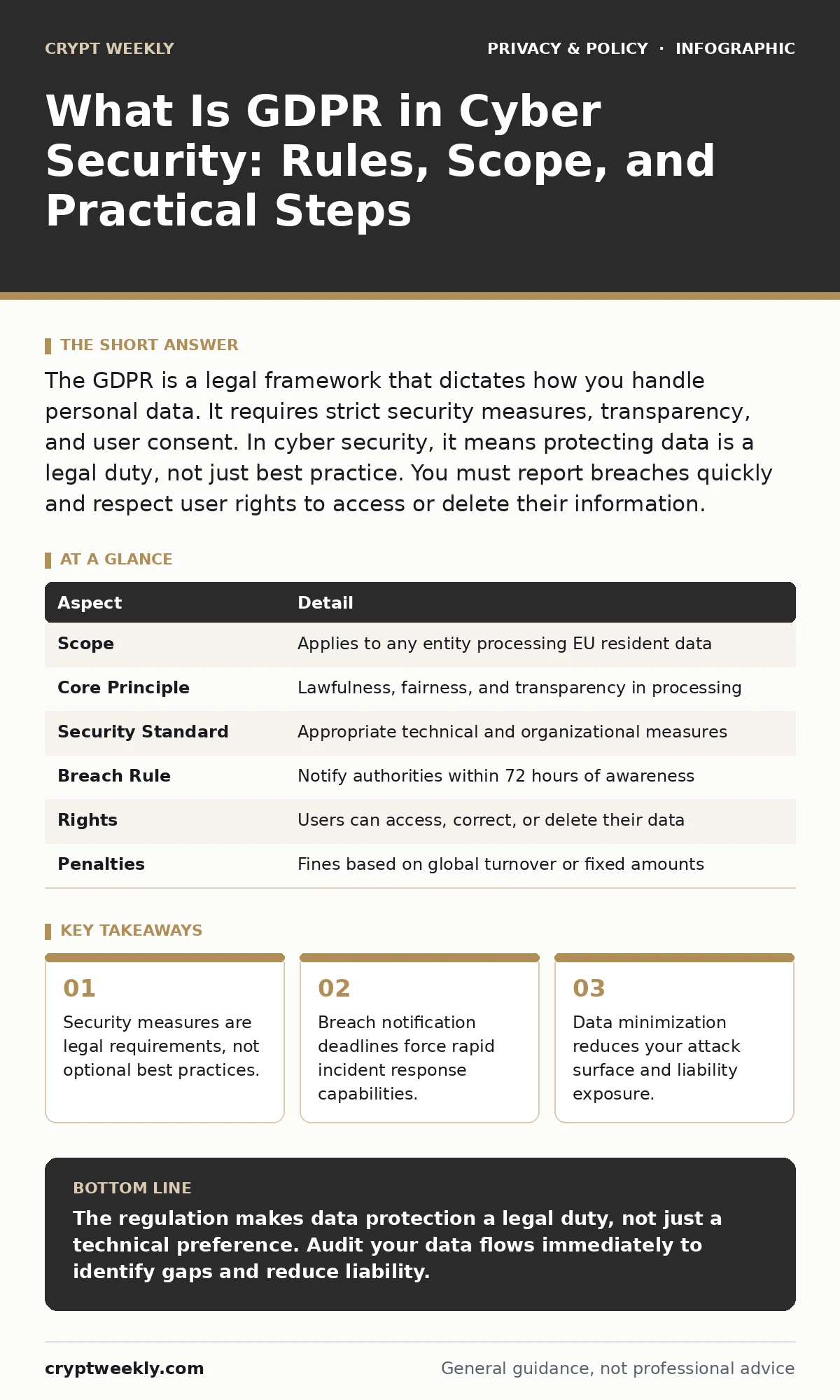
The GDPR is a legal framework that dictates how you handle personal data. It requires strict security measures, transparency, and user consent. In cyber security, it means protecting data is a legal duty, not just best practice. You must report breaches quickly and respect user rights to access or delete their information.
Why You Should Care About Data Protection
Imagine you run a small coffee shop that collects customer names for loyalty cards. You store those names in a simple spreadsheet on a shared laptop. If that laptop is stolen, you have a privacy problem. Under older rules, this might have been a minor nuisance. Under modern data protection laws, it is a reportable incident with potential fines. This shift changes how you view security. It moves protection from an IT task to a core business requirement. You must treat data as a liability you manage, not just an asset you collect.
The regulation applies to any organization processing personal data of individuals within the European Union. It does not matter where your servers are located. It does not matter if your company is based in Asia, North America, or South America. If you offer services to people in the EU, you fall under its jurisdiction. This extraterritorial reach is the primary reason global companies pay attention. You cannot ignore these rules by hosting your infrastructure outside Europe.
| Aspect | Detail |
|---|---|
| Scope | Applies to any entity processing EU resident data |
| Core Principle | Lawfulness, fairness, and transparency in processing |
| Security Standard | Appropriate technical and organizational measures |
| Breach Rule | Notify authorities within 72 hours of awareness |
| Rights | Users can access, correct, or delete their data |
| Penalties | Fines based on global turnover or fixed amounts |
What Is GDPR in Cyber Security
When people ask what is gdpr in cyber security, they want to know how the law impacts technical work. The short answer is that the law defines security as a legal obligation. You must implement measures that ensure a level of security appropriate to the risk. This is known as the principle of integrity and confidentiality. It requires you to assess threats, evaluate controls, and document your decisions. You cannot claim ignorance of a breach. You must prove you took reasonable steps to prevent it.
The regulation introduces the concept of data protection by design and by default. This means you build security into your systems from the start. You do not add it as an afterthought. You also collect only the data you strictly need. This is data minimization. If you do not need a user’s phone number, you do not ask for it. This reduces the value of your database to attackers. It also reduces your liability if a breach occurs. You have less data to lose.
Security measures include encryption, pseudonymization, and regular testing. Encryption scrambles data so only authorized parties can read it. Pseudonymization replaces identifiable information with artificial identifiers. Testing ensures your controls work as intended. You must also ensure resilience. Your systems should remain available and intact even under attack. This is not about preventing every hack. It is about demonstrating due care.
Who Must Comply with These Rules
The regulation distinguishes between two main roles: data controllers and data processors. A controller determines why and how data is processed. A processor acts on behalf of the controller. Most companies act as controllers for their own customer data. Cloud providers often act as processors. Both have specific legal duties. Controllers bear the primary responsibility for compliance. Processors must follow strict instructions and maintain their own security records.
You must map your data flows to identify these roles. If you hire a third-party email marketing service, you are the controller. The service provider is the processor. You must have a contract that outlines security obligations. This contract is often called a data processing agreement. It ensures the processor meets the same standards as you. Without this agreement, you share liability for their failures. You cannot outsource your legal responsibility.
Suppose you use a popular analytics tool that tracks user behavior. The tool provider is a processor. If they suffer a breach, you are still responsible for your users’ data. You must vet their security practices. You must ensure they can notify you of incidents quickly. This chain of responsibility extends to sub-processors. You need visibility into the entire supply chain. Blind spots in vendor management are common failure points.
How the Regulation Works in Practice
The regulation operates through a set of principles. Lawfulness requires a valid reason for processing data. Consent must be freely given, specific, and informed. You cannot bundle consent into terms of service. Users must opt in explicitly. Legitimate interest allows processing without consent if it does not override user rights. You must balance your interests against the user’s privacy. This balance test requires documentation.
Accountability is the cornerstone of the framework. You must be able to demonstrate compliance. This means keeping records of processing activities. You must document data categories, purposes, and retention periods. You must appoint a data protection officer if certain conditions are met. This role oversees compliance and acts as a contact point for regulators. You must conduct data protection impact assessments for high-risk processing. These assessments identify risks and define mitigation strategies.
Transparency requires clear privacy notices. You must tell users who you are, why you process data, and how long you keep it. You must provide easy ways for users to exercise their rights. This includes the right to access, rectify, erase, and restrict processing. You must respond to these requests within one month. Automation helps manage these requests. Manual processes often fail under volume.
Common Misconceptions About Compliance
Many organizations believe they are too small to matter. This is incorrect. The regulation applies to all entities processing EU data. Size affects the severity of fines, not the applicability of the rules. Small businesses can face significant penalties relative to their revenue. They also face reputational damage that can be fatal. Ignorance of the law is not a defense. You must know the rules that apply to your operations.
Another common mistake is treating compliance as a one-time project. It is an ongoing process. Threats evolve. Business processes change. You must update your controls and documentation regularly. Annual reviews are a minimum. Continuous monitoring is better. You must adapt to new technologies and threats. Static security plans become outdated quickly. Dynamic risk management keeps you aligned with current realities.
Some assume that encryption solves everything. Encryption protects data at rest and in transit. It does not protect against insider threats. It does not fix poor access controls. It does not prevent phishing attacks. You need a layered defense. You must combine encryption with identity management, monitoring, and training. Relying on a single control creates a false sense of security.
See also: Anonymization vs De-identification: How to Choose the Right Data Strategy
Practical Steps for Implementation
Start by inventorying your data. Identify what you collect, where it comes from, and where it goes. Map the flow of data through your systems. Identify third parties involved. This data map is the foundation of your compliance program. It reveals gaps in your knowledge. It highlights unnecessary data retention. It helps you prioritize security efforts.
Next, assess your risks. Identify potential threats to the data you hold. Evaluate the likelihood and impact of each threat. Define controls to mitigate these risks. Document your decisions. This documentation proves you acted reasonably. It supports your defense in case of an incident. It also guides your security investments. You spend resources where they matter most.
Implement technical controls. Use encryption for sensitive data. Enforce strong authentication. Limit access based on need. Monitor for unusual activity. Test your incident response plan. Ensure you can detect and report breaches within the required timeframe. Train your staff on data handling procedures. Human error is a major cause of incidents. Education reduces this risk.
Integrating Privacy into Security Operations
Privacy and security are complementary disciplines. Security protects data from unauthorized access. Privacy ensures data is used appropriately. You must integrate both into your operations. This means involving privacy experts in security design reviews. It means security teams understand legal constraints. It means privacy teams understand technical risks. Collaboration prevents conflicts and gaps.
Consider how biometric data requires special handling. Biometric data is unique and irreversible. If compromised, users cannot change their fingerprints or facial features. You must apply stricter controls to this data. You must justify its collection. You must ensure it is stored securely. Many organizations fail to recognize the heightened risk. They treat biometric data like passwords. This is a dangerous error.
Be aware of tracking technologies. Browser fingerprinting creates unique identifiers for users. This can be considered personal data. You must disclose this practice. You must obtain consent where required. Email tracking pixels monitor user behavior. They also raise privacy concerns. You must balance marketing needs with user rights. Transparency builds trust. Deception destroys it.
Managing Incident Response and Reporting
When a breach occurs, speed is critical. You must assess the incident quickly. Determine if personal data was compromised. Evaluate the risk to individuals. If there is a risk, you must notify the supervisory authority. You have 72 hours from awareness to report. Delaying notification increases fines. It also harms your reputation. You must have a clear process for internal reporting.
You must also notify affected individuals if the breach poses a high risk. This communication must be clear and helpful. It should explain what happened and what users can do. You must preserve evidence for investigation. You must cooperate with regulators. Documentation of the incident and response is vital. It demonstrates your commitment to remediation. It helps prevent future occurrences.
Post-incident review is essential. Analyze what went wrong. Identify gaps in your controls. Update your security posture. Communicate lessons learned to staff. Continuous improvement is the goal. You cannot prevent every breach. You can minimize impact and recover quickly. This resilience is what regulators look for.
Key takeaways
- Security measures are legal requirements, not optional best practices.
- Breach notification deadlines force rapid incident response capabilities.
- Data minimization reduces your attack surface and liability exposure.
The regulation makes data protection a legal duty, not just a technical preference. Audit your data flows immediately to identify gaps and reduce liability.
Frequently asked questions
Does GDPR apply to US companies?
Yes, if you process personal data of individuals in the European Union, you must comply regardless of your physical location.
How long must I keep breach records?
You must maintain a record of all personal data breaches for your own reference and potential regulatory inspection.
Is encryption mandatory under GDPR?
Encryption is not strictly mandatory for all data, but it is considered a best practice to meet the requirement for appropriate security measures.
What is the difference between a controller and a processor?
A controller decides why and how data is processed, while a processor handles data on behalf of the controller under strict instructions.
How this guide was produced: written by the Crypt Weekly editorial team with AI assistance, checked against the public references listed below, and reviewed when the facts change. See our editorial policy or report an error.