
Responsible disclosure balances public safety with vendor reaction time, preventing attackers from exploiting known gaps before a fix exists.
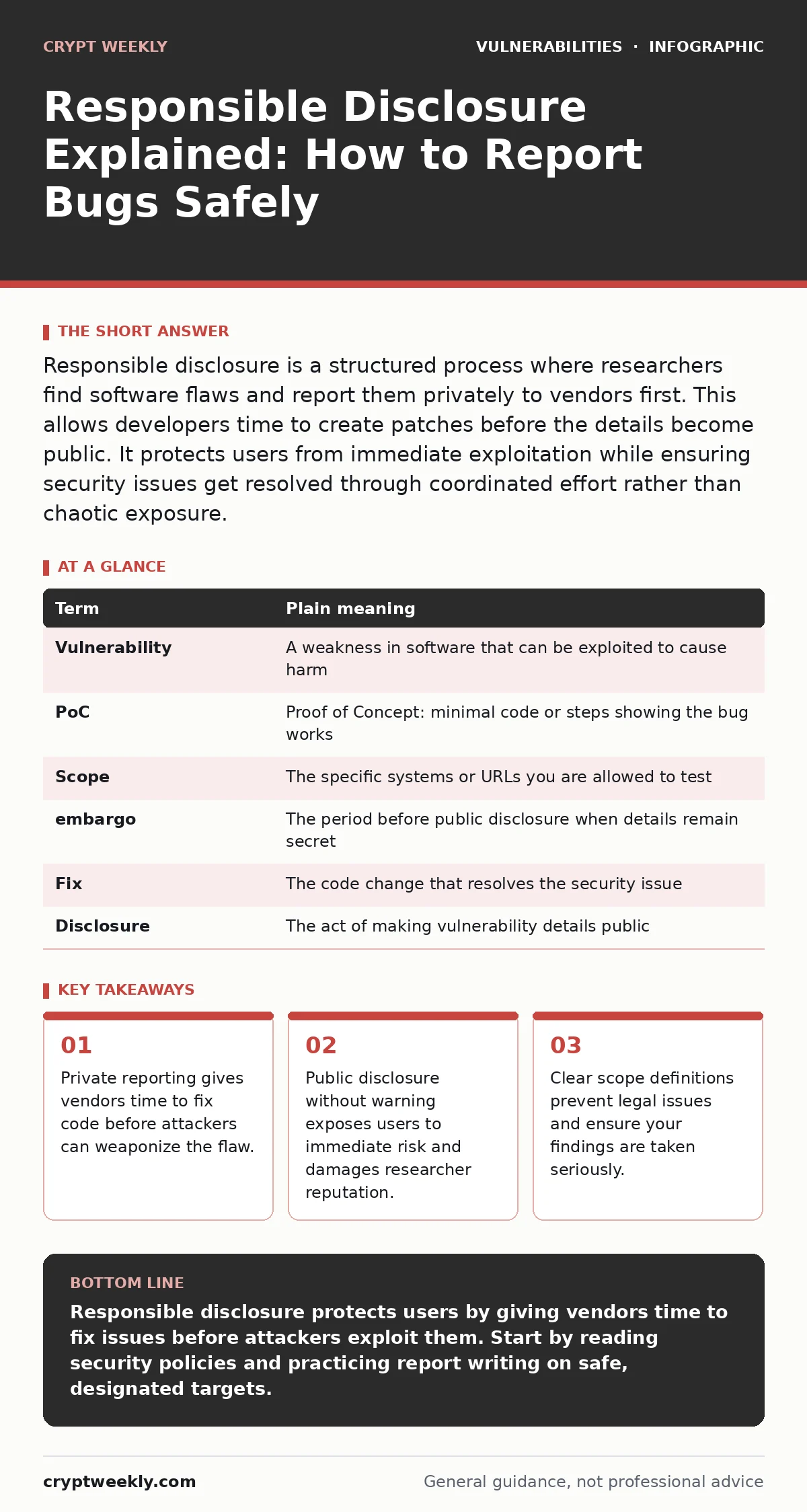
Responsible disclosure is a structured process where researchers find software flaws and report them privately to vendors first. This allows developers time to create patches before the details become public. It protects users from immediate exploitation while ensuring security issues get resolved through coordinated effort rather than chaotic exposure.
The Library Book Analogy
Imagine you find a hole in the fence of a public library. If you shout about it on social media, kids might wander into the dangerous construction site next door. If you ignore it, someone could get hurt. Responsible disclosure is like telling the librarian privately. She locks off that section, repairs the fence, and only then announces that the library is safe again. This analogy carries through every step of the process. The hole is the vulnerability. The librarian is the vendor. The repair is the patch. The announcement is the public report.
Key Terms Defined
Understanding the vocabulary prevents misunderstandings during communication. Researchers often use specific jargon that vendors expect. Using these terms correctly signals professionalism. It also helps you navigate frameworks like the OWASP Top 10 when categorizing issues.
| Term | Plain meaning |
|---|---|
| Vulnerability | A weakness in software that can be exploited to cause harm |
| PoC | Proof of Concept: minimal code or steps showing the bug works |
| Scope | The specific systems or URLs you are allowed to test |
| embargo | The period before public disclosure when details remain secret |
| Fix | The code change that resolves the security issue |
| Disclosure | The act of making vulnerability details public |
Why Private First Matters
Public disclosure before a fix exists creates a race against attackers. Once details are online, automated bots scan for vulnerable systems within minutes. Vendors need time to analyze, develop, and test a solution. Rushing this process leads to incomplete fixes. These broken patches often introduce new bugs or leave the original hole partially open. This is why coordinated disclosure exists. It prioritizes user safety over researcher fame. It also aligns with the principles of penetration testing, where the goal is improvement, not exposure.
Defining Scope and Rules
Before testing anything, you must understand what is off-limits. Most organizations publish a security policy. If not, you must ask. Testing outside the agreed scope can be interpreted as an attack. This is especially true for API vulnerabilities, which often handle sensitive data without standard interface protections. Do not test production systems if the policy forbids it. Use staging environments if available. Clear boundaries protect you from legal liability. They also help the vendor prioritize your report. A report within scope is actionable. A report outside scope is noise.
Crafting the Report
Your report must be clear, concise, and reproducible. Start with a summary of the impact. Then provide step-by-step instructions to trigger the bug. Include screenshots or logs. Avoid vague descriptions like "the site is slow." Specifics allow developers to fix the issue quickly. If you found a business logic flaw, explain the expected flow versus the actual flow. Developers need to see the deviation. Do not include unnecessary personal attacks or demands. Professionalism speeds up the process. Emotional language slows it down.
See also: How Container Escape Vulnerabilities Work: A Step-by-Step Breakdown
Waiting for the Fix
After submitting, you wait. This period is called the embargo. Vendors may ask for clarification. Respond promptly but politely. Do not share details publicly during this time. If the vendor is unresponsive, you may escalate. Escalation usually involves contacting higher management or using a trusted intermediary. Never threaten public disclosure as leverage. This damages trust and may violate laws. Patience is difficult but necessary. A rushed fix is worse than no fix.
Public Disclosure Timing
Once the vendor releases a patch, you can disclose details. Wait until most users have updated. This window varies by product size. Large platforms take longer to patch. Small apps may patch quickly. Check for a CVE ID if one is assigned. This helps users search for the fix. Your public report should focus on the lesson. Explain how to detect similar issues. Avoid naming the vendor if possible. Focus on the technical pattern. This helps the entire industry improve.
Try This Now
- Find a bug bounty program or security policy for a service you use. Read the scope carefully.
- Identify one low-risk issue in a test environment. Do not touch production data.
- Write a draft report using the structure above. Ask a peer to review it for clarity.
Key takeaways
- Private reporting gives vendors time to fix code before attackers can weaponize the flaw.
- Public disclosure without warning exposes users to immediate risk and damages researcher reputation.
- Clear scope definitions prevent legal issues and ensure your findings are taken seriously.
Responsible disclosure protects users by giving vendors time to fix issues before attackers exploit them. Start by reading security policies and practicing report writing on safe, designated targets.
Frequently asked questions
What if the vendor ignores my report?
Wait for the agreed timeframe, then escalate through their management or use a trusted third-party disclosure service. Do not publish details prematurely.
Can I report bugs in closed-source software?
Yes, but scope is critical. Only test if the vendor has an open policy. Testing proprietary code without permission is illegal in many jurisdictions.
How do I know if my finding is a real vulnerability?
If you can demonstrate unauthorized access, data exposure, or system disruption, it is likely valid. Compare against known frameworks to confirm.
Do I get paid for responsible disclosure?
Only if the vendor runs a bug bounty program. Most responsible disclosure is unpaid. Payment depends on severity and vendor policy.
How this guide was produced: written by the Crypt Weekly editorial team with AI assistance, checked against the public references listed below, and reviewed when the facts change. See our editorial policy or report an error.