
Large language models introduce prompt injection and data leakage risks that traditional web security controls cannot detect or block effectively.
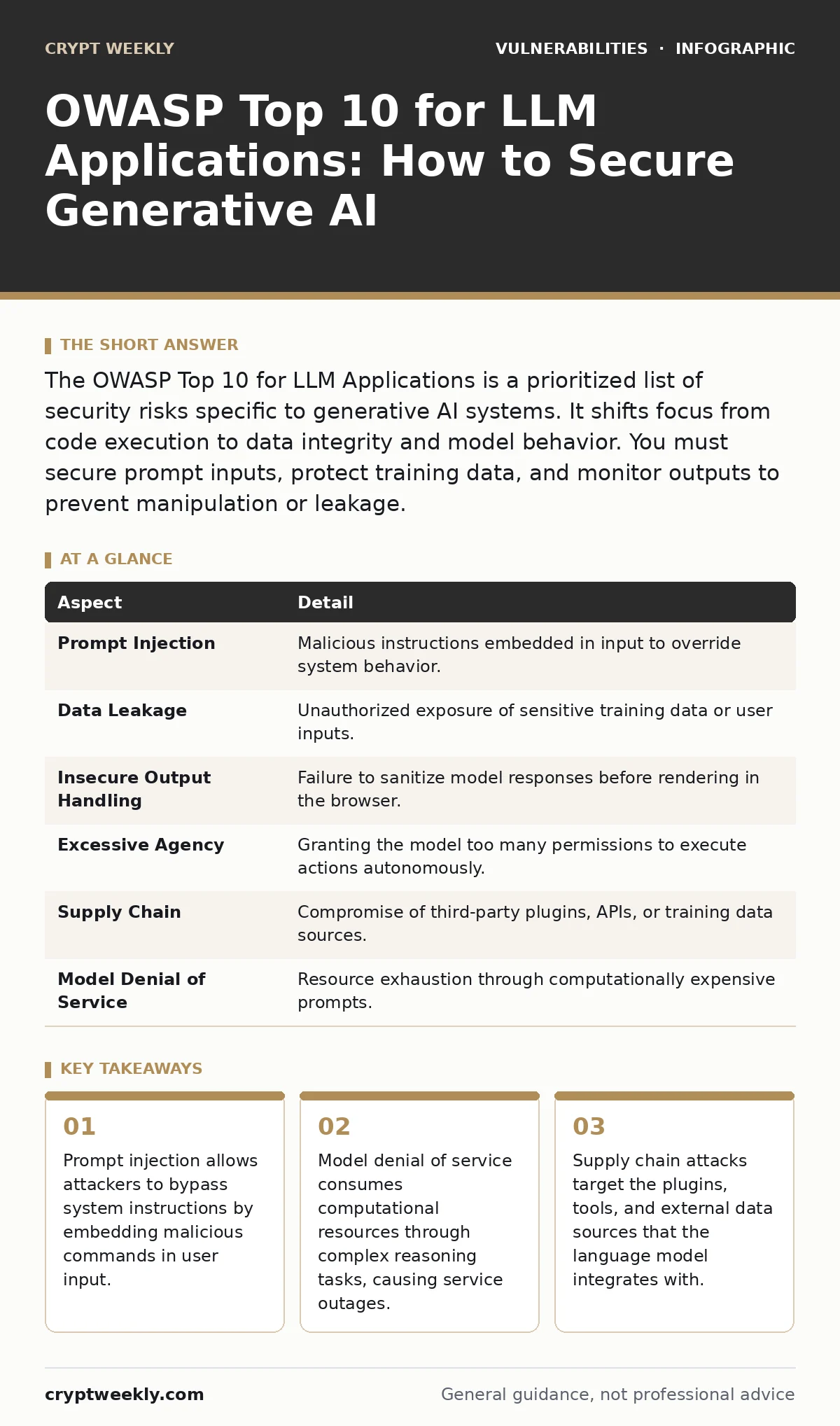
The OWASP Top 10 for LLM Applications is a prioritized list of security risks specific to generative AI systems. It shifts focus from code execution to data integrity and model behavior. You must secure prompt inputs, protect training data, and monitor outputs to prevent manipulation or leakage.
What Is the OWASP Top 10 for LLM Applications
The OWASP Top 10 for LLM Applications is a curated list of the most critical security risks facing systems that use large language models. It serves as a baseline for developers who integrate generative AI into their products. This list differs from traditional web security frameworks because the attack surface is linguistic rather than purely structural. You face risks where natural language itself becomes the vector for exploitation. The framework helps you prioritize which vulnerabilities to address first based on potential impact and likelihood.
Traditional security focuses on preventing unauthorized access to code or databases. Generative AI security focuses on preventing unauthorized influence over the model's reasoning process. The model acts as an interpreter of intent. If an attacker can alter that intent, they control the outcome. This list provides a common vocabulary for discussing these unique threats. It ensures that teams do not overlook risks inherent to the architecture of large language models.
How the Risk Landscape Has Changed
Imagine a library where the librarian reads books aloud to patrons. Traditional security locks the doors to the library. LLM security must ensure the librarian does not read inappropriate content or follow instructions hidden inside the books. The model processes text without inherent understanding of context or consequence. It follows patterns it learned during training. Attackers exploit this pattern-matching behavior. They craft inputs that trigger unintended responses. This shifts the burden from perimeter defense to content verification.
The speed of AI development outpaces traditional security testing. You cannot scan a model for every possible malicious prompt. The input space is effectively infinite. This requires a different approach to validation. You must assume that any input can contain hidden instructions. The system must be designed to isolate these instructions from the core logic. This architectural change is the primary defense against manipulation.
At a Glance: Key LLM Risks
| Aspect | Detail |
|---|---|
| Prompt Injection | Malicious instructions embedded in input to override system behavior. |
| Data Leakage | Unauthorized exposure of sensitive training data or user inputs. |
| Insecure Output Handling | Failure to sanitize model responses before rendering in the browser. |
| Excessive Agency | Granting the model too many permissions to execute actions autonomously. |
| Supply Chain | Compromise of third-party plugins, APIs, or training data sources. |
| Model Denial of Service | Resource exhaustion through computationally expensive prompts. |
Common Misconceptions About AI Security
People often assume that standard input validation prevents AI attacks. This assumption fails because language models are designed to interpret ambiguous text. A string that looks like harmless text to a regex filter might be a command to the model. You cannot rely on traditional filters to stop prompt injection. The model itself must be guided to ignore embedded instructions. This requires careful design of the system prompt and output parsing.
Another common error is believing that sandboxing the model is sufficient. Sandboxing limits what the model can do to the system. It does not stop the model from leaking data through its text output. You must treat the output as untrusted data. Just as you sanitize HTML to prevent cross-site scripting, you must sanitize AI responses. This prevents the model from becoming a conduit for data exfiltration.
Practical Mitigation Strategies
Start by implementing strict input validation. While this does not stop all injections, it reduces the attack surface. Use allowlists for expected data formats. Reject inputs that deviate significantly from the norm. This adds a layer of defense before the data reaches the model. It forces attackers to craft inputs that look benign but still carry malicious intent. This raises the bar for successful attacks.
Next, isolate the model from direct system access. Never let the model execute code or access databases directly. Use an intermediary layer that translates model requests into specific, pre-approved actions. This layer checks permissions and validates parameters. It ensures that the model acts only within defined boundaries. This containment strategy limits the damage of any successful injection.
Integrating With Existing Security Practices
You must integrate AI security with your existing development lifecycle. Treat model prompts as code. Version control them. Review them for security issues. This ensures that changes to system instructions are tracked and audited. It prevents accidental introduction of vulnerabilities through prompt updates. It also allows for rapid rollback if an issue is detected.
Monitor model behavior continuously. Log all inputs and outputs for anomaly detection. Look for patterns that suggest manipulation or data leakage. Automated monitoring can flag suspicious activity in real-time. This complements static analysis and testing. It provides visibility into how the model behaves under real-world conditions. This feedback loop helps you refine your defenses over time.
Consider input validation techniques that are specific to natural language. Traditional validation checks for syntax errors. AI-specific validation checks for intent and context. This requires more sophisticated tools. It may involve using a smaller model to verify the intent of a prompt before the main model processes it. This adds latency but significantly improves security.
Beyond the Top 10 Checklist
The OWASP Top 10 for LLM Applications is a starting point, not a finish line. Security is an ongoing process. New attack vectors emerge as models become more capable. You must stay informed about developments in AI safety. Participate in responsible disclosure programs to report vulnerabilities responsibly. This helps the community improve defenses collectively. It also builds trust with your users.
Regularly update your models and dependencies. Outdated models may contain known vulnerabilities. Patching ensures you benefit from the latest security improvements. Test your applications thoroughly after each update. Security regression testing ensures that new changes do not introduce old vulnerabilities. This discipline maintains the integrity of your security posture.
Remember that human error remains a significant risk. Train your team on AI-specific threats. Encourage a culture of security awareness. When developers understand how models can be manipulated, they are better equipped to build secure systems. This human factor is often the weakest link. Strengthening it improves overall resilience.
What People Usually Get Wrong
Many teams focus solely on preventing prompt injection. They neglect data leakage and output handling. This creates a false sense of security. An attacker might not be able to control the model, but they can still extract sensitive data from it. You must protect the data flowing through the system, not just the control flow. This holistic view is necessary for true security.
Another mistake is assuming that the vendor handles security. The vendor secures the model infrastructure. You secure the application layer. You are responsible for how you use the model. You define the permissions and constraints. You manage the data. Shifting responsibility to the vendor leaves your application exposed. You must own the security of your implementation.
Key takeaways
- Prompt injection allows attackers to bypass system instructions by embedding malicious commands in user input.
- Model denial of service consumes computational resources through complex reasoning tasks, causing service outages.
- Supply chain attacks target the plugins, tools, and external data sources that the language model integrates with.
Frequently asked questions
Does the OWASP Top 10 for LLM Applications replace traditional web security?
No, it supplements it. You still need to secure your web server, database, and network. The LLM list addresses risks specific to the AI component. Both sets of controls are necessary for a complete security posture.
Can I use the same input validation for AI as for web forms?
Traditional validation helps but is insufficient. AI models interpret natural language, which is ambiguous. You need additional layers to detect intent and context. Relying only on regex or syntax checks will leave gaps in your defense.
How do I prevent data leakage from a large language model?
Filter sensitive data before sending it to the model. Use redaction techniques to mask personal or confidential information. Monitor outputs for accidental inclusion of training data. Assume the model may reveal information you did not intend to share.
Is prompt injection a real threat or just theoretical?
Prompt injection is a real and actively exploited threat. Attackers have demonstrated successful injections in various commercial applications. It can lead to data theft, unauthorized actions, and reputational damage. You must treat it as a high-priority risk.
How this guide was produced: written by the Crypt Weekly editorial team with AI assistance, checked against the public references listed below, and reviewed when the facts change. See our editorial policy or report an error.