Container escapes succeed not by breaking the container walls, but by exploiting the shared kernel that runs underneath them.
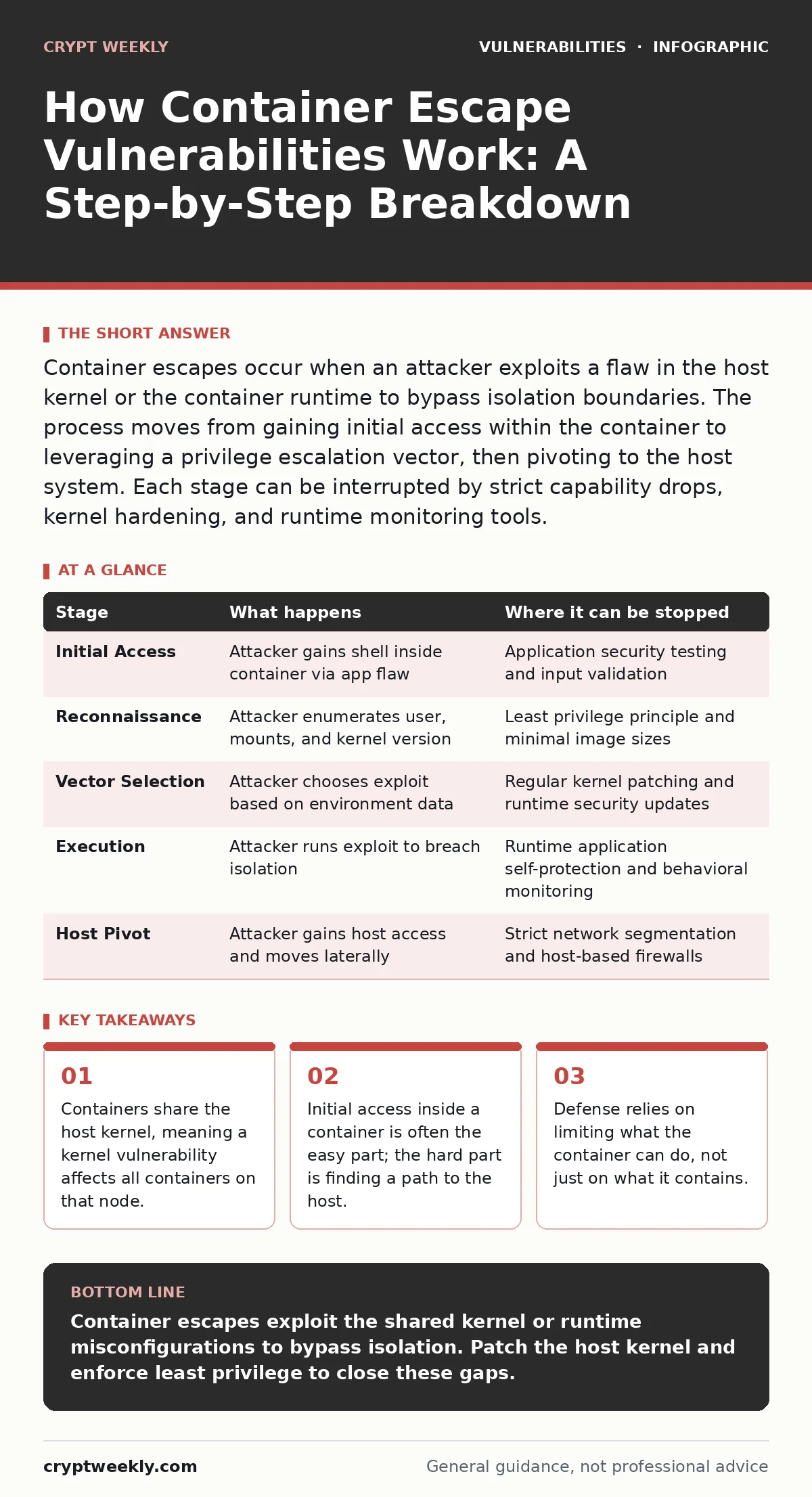
Container escapes occur when an attacker exploits a flaw in the host kernel or the container runtime to bypass isolation boundaries. The process moves from gaining initial access within the container to leveraging a privilege escalation vector, then pivoting to the host system. Each stage can be interrupted by strict capability drops, kernel hardening, and runtime monitoring tools.
Understanding the Shared Kernel Reality
Container isolation differs fundamentally from virtual machine isolation. Virtual machines run their own operating systems on emulated hardware. Containers run processes that share the host operating system's kernel. This shared kernel is the single point of failure for container security. If the kernel has a vulnerability, every container on that host is exposed to that same risk.
You cannot patch a container to fix a kernel bug. The host system must be patched. This architectural choice enables high density and fast startup times. It also creates a hidden dependency. The security of your application depends on the security of the infrastructure beneath it. Many teams focus on securing the application code while ignoring the platform layer. This imbalance leaves a large attack surface open.
Stage 1: Initial Access Within the Container
The attacker must first gain execution privileges inside the target container. This stage rarely involves a direct attack on the container boundary. Instead, it mirrors traditional application attacks. An attacker might exploit a web application running inside the container. They could use techniques similar to those found in SQL injection or other PHP application vulnerabilities to execute arbitrary commands.
This stage relies on the container exposing a service. If the container runs a web server, database, or API, it presents an entry point. The attacker needs to move from a network connection to a shell session. They often use standard exploitation tools to achieve this. Once they have a shell, they are confined by the container's namespaces and cgroups. They cannot see the host filesystem or network interfaces directly. Yet they have a foothold. This foothold is the starting point for the escape.
Stage 2: Reconnaissance and Capability Enumeration
With a shell inside the container, the attacker begins reconnaissance. They check what user account they are running as. They list installed packages and running processes. They examine environment variables for secrets or configuration details. They check the mounted volumes to see if any host directories are accessible. This phase is critical for identifying the escape vector.
The attacker looks for specific conditions. They check if the container runs as root. They verify if the container has access to the host's Docker socket. They test for writable mount points that might allow them to modify system files. They probe for kernel version information. This data helps them select the right exploit. Many public exploits require specific kernel versions or configuration settings. The attacker matches their findings to known vulnerabilities. This step is purely information gathering. It does not yet breach the container boundary.
Stage 3: Identifying the Escape Vector
The attacker selects a method to break out of the container. There are three main categories of escape vectors. The first involves vulnerabilities in the container runtime itself. These are bugs in the software that manages the container lifecycle. The second involves misconfigurations in how the container was launched. These include running with unnecessary privileges or mounting sensitive host paths. The third involves kernel vulnerabilities. These are flaws in the Linux kernel that allow processes to escalate privileges beyond their intended limits.
Choosing the right vector depends on the environment. If the container runs as root and has access to the host filesystem, the attacker might use a simple misconfiguration exploit. If the environment is hardened, they may need a complex kernel exploit. Kernel exploits are harder to find and easier to detect. Misconfiguration exploits are common and often go unnoticed. The attacker weighs the difficulty of the exploit against the likelihood of success. They often choose the path of least resistance.
Stage 4: Executing the Privilege Escalation
The attacker executes the chosen exploit. This is the moment where the container boundary is breached. If using a runtime bug, they might craft a specific request that triggers a buffer overflow or a logic error. If using a misconfiguration, they might write a malicious file to a mounted host directory. If using a kernel vulnerability, they might run a custom binary that exploits a race condition or a null pointer dereference bug in the kernel.
This stage requires precise timing and conditions. The exploit must match the exact version of the software or kernel. A mismatch causes the exploit to fail. The attacker may try multiple variants to increase their chances. This activity generates system calls and memory operations that deviate from normal behavior. These deviations can be detected by runtime security tools. However, many environments lack this level of monitoring. The exploit runs silently in the background. It aims to create a new process that runs with higher privileges than the container allows.
Stage 5: Pivoting to the Host System
If the exploit succeeds, the attacker gains access to the host system. They now have a shell or process running on the host kernel. They are no longer confined by the container's namespaces. They can see all other containers on the node. They can access the host filesystem, network interfaces, and management tools. This is the final stage of the escape. The attacker has achieved their primary goal.
From here, the attacker moves laterally. They might install persistence mechanisms on the host. They could compromise other containers or steal data from the host storage. They might use the host as a launchpad for further attacks within the network. The container isolation is completely bypassed. The attacker treats the host as a compromised server. They operate with full control over the infrastructure node. This level of access allows them to disrupt services, exfiltrate data, or deploy ransomware.
| Stage | What happens | Where it can be stopped |
|---|---|---|
| Initial Access | Attacker gains shell inside container via app flaw | Application security testing and input validation |
| Reconnaissance | Attacker enumerates user, mounts, and kernel version | Least privilege principle and minimal image sizes |
| Vector Selection | Attacker chooses exploit based on environment data | Regular kernel patching and runtime security updates |
| Execution | Attacker runs exploit to breach isolation | Runtime application self-protection and behavioral monitoring |
| Host Pivot | Attacker gains host access and moves laterally | Strict network segmentation and host-based firewalls |
Defense Strategies and Interruption Points
You can interrupt the escape process at multiple stages. The most effective defense is to prevent the initial access. Secure your applications against common vulnerabilities. Use dependency scanning to identify outdated libraries. This stops the attacker before they ever reach the container shell. If they do gain access, limit what they can do.
Run containers as non-root users. Drop all Linux capabilities except those strictly needed. Do not mount host directories unless absolutely necessary. If you must mount directories, use read-only flags. Keep your host kernel updated. Kernel vulnerabilities are a major source of escapes. Patching the kernel removes the exploit surface. Use runtime security tools to monitor for unusual system calls. These tools can detect and block escape attempts in real time.
The Hidden Cost of Complexity
Managing container security adds operational complexity. You must manage the security of the application, the container image, the runtime, and the host kernel. Each layer introduces new potential failures. Many teams focus on the application layer and neglect the others. This creates a false sense of security. A secure application running in an insecure container is still vulnerable.
You need a holistic approach. Integrate security checks into your build and deployment pipelines. Automate vulnerability scanning for images and dependencies. Perform security regression testing to ensure new updates do not introduce weaknesses. Educate your team on the risks of shared kernels. Understanding the architecture helps you make better security decisions. The goal is to reduce the attack surface at every level.
Key takeaways
- Containers share the host kernel, meaning a kernel vulnerability affects all containers on that node.
- Initial access inside a container is often the easy part; the hard part is finding a path to the host.
- Defense relies on limiting what the container can do, not just on what it contains.
Container escapes exploit the shared kernel or runtime misconfigurations to bypass isolation. Patch the host kernel and enforce least privilege to close these gaps.
Frequently asked questions
Can a container escape if it is not running as root?
Yes, non-root containers can still escape if the host kernel has vulnerabilities or if the container runtime is compromised. Root access makes exploits easier but is not the only path.
Does using Kubernetes prevent container escapes?
No, Kubernetes orchestrates containers but relies on the underlying node's security. A kernel vulnerability on a worker node can compromise the entire cluster.
How do I know if my container has been escaped?
Look for unexpected processes on the host, unusual network connections, or modified system files. Runtime security tools provide alerts for suspicious behavior.
Are container escapes more common than traditional server breaches?
The frequency depends on the environment. Misconfigured containers are frequent targets. Properly hardened containers are as secure as traditional servers.
How this guide was produced: written by the Crypt Weekly editorial team with AI assistance, checked against the public references listed below, and reviewed when the facts change. See our editorial policy or report an error.