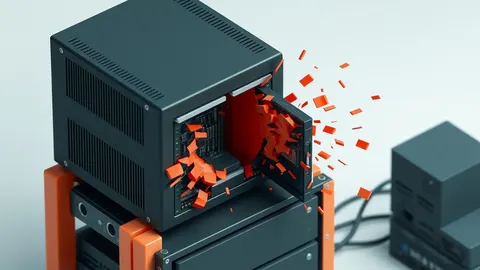
Buffer overflows let attackers overwrite adjacent memory to hijack program execution, bypassing standard access controls and crashing systems.
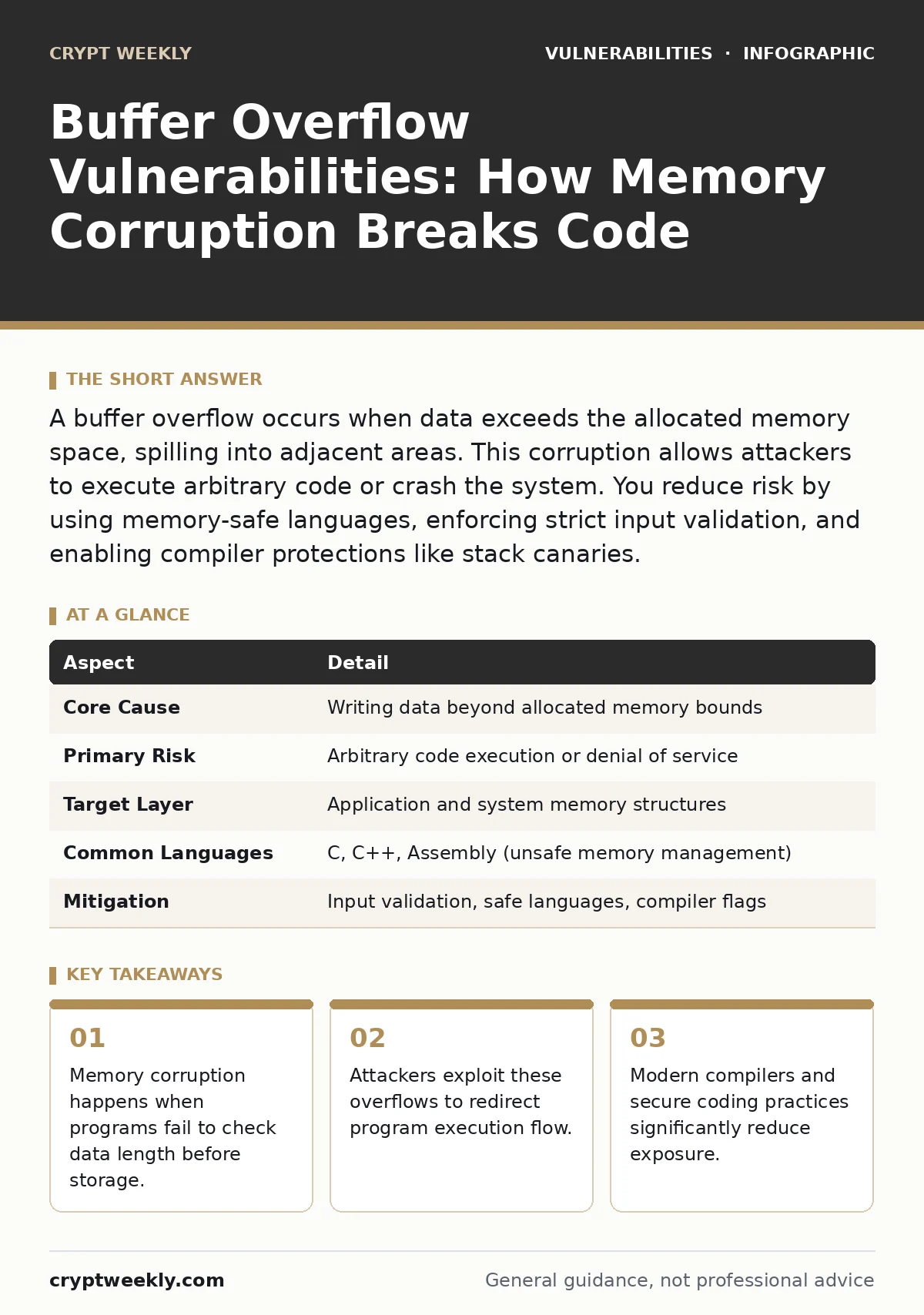
A buffer overflow occurs when data exceeds the allocated memory space, spilling into adjacent areas. This corruption allows attackers to execute arbitrary code or crash the system. You reduce risk by using memory-safe languages, enforcing strict input validation, and enabling compiler protections like stack canaries.
Memory Boundaries and Data Overflow
Imagine a mailbox with a fixed slot size. If you shove a large package into that slot, it does not disappear. It bulges out, damaging the neighboring box or jamming the entire row. Computer memory works similarly. Programs reserve specific blocks of memory, called buffers, to hold data. These buffers have fixed sizes. When a program receives more data than the buffer can hold, the excess data spills over. This spillage is the buffer overflow. The overflow writes data into memory addresses that belong to other variables or control structures.
This behavior is not a glitch in the hardware. It is a consequence of how low-level programming languages handle memory management. Languages like C and C++ give programmers direct control over memory for performance. This control requires manual checks. If the programmer forgets to verify the size of incoming data, the language does not stop the write operation. The data overwrites whatever sits next to the buffer in the memory map.
The Mechanics of Control Hijacking
The damage from a simple data overwrite is often limited. The real danger arises when the overflow reaches critical control structures. Every running program uses a stack to manage function calls. The stack holds return addresses, which tell the program where to go after a function finishes. If an overflow writes into the stack, it can overwrite this return address.
When the function completes, the program reads the corrupted return address. It jumps to the memory location specified by the attacker. Attackers often place malicious code, known as shellcode, in the overflowed buffer itself. By overwriting the return address to point to this shellcode, the attacker forces the program to execute their instructions. This turns a data storage error into a code execution vulnerability. The program effectively works for the attacker instead of the user.
This mechanism allows attackers to bypass authentication, install malware, or create backdoors. The program continues running, often unaware that its logic has been hijacked. This stealth makes detection difficult. The system appears normal, but an unauthorized process is now active.
| Aspect | Detail |
|---|---|
| Core Cause | Writing data beyond allocated memory bounds |
| Primary Risk | Arbitrary code execution or denial of service |
| Target Layer | Application and system memory structures |
| Common Languages | C, C++, Assembly (unsafe memory management) |
| Mitigation | Input validation, safe languages, compiler flags |
Who Is at Risk
Buffer overflow vulnerabilities affect any software written in languages that allow direct memory manipulation. This includes many operating systems, network services, and legacy applications. You see these flaws in server software, embedded devices, and even some desktop applications. The risk is highest in code that processes untrusted input from the network or users.
Developers who prioritize speed over safety are often the creators of these flaws. Performance-critical systems, like routers or database engines, often use low-level languages. These systems handle massive amounts of external data. If the input handling code lacks bounds checking, every connection attempt is a potential attack vector. You are also at risk if you run outdated software. Older versions of popular tools often contain known overflow vulnerabilities that have not been patched.
The impact scales with the privilege level of the affected process. A buffer overflow in a web server running with high privileges can compromise the entire server. An overflow in a small user application might only crash that single app. The severity depends on what the program can access.
Common Forms of Buffer Overflow
Not all overflows work the same way. The structure of the memory determines how the attack proceeds. Stack-based overflows are the most common form. They target the call stack, which stores temporary data for functions. Because the stack grows and shrinks dynamically, predicting the layout can be challenging for attackers, but the potential for code execution is high.
Heap-based overflows target the heap, where dynamic memory is allocated. The heap is more complex than the stack. It contains metadata about memory blocks. Overwriting this metadata can allow attackers to manipulate memory allocation itself. This can lead to more subtle attacks, such as freeing memory that is still in use or allocating overlapping blocks. These attacks are harder to detect but can be equally devastating.
Format string vulnerabilities are a related cousin. They occur when user input is treated as a formatting instruction. While not always a pure overflow, they allow reading or writing to arbitrary memory locations. This often serves as a stepping stone to a full buffer overflow. Understanding these distinctions helps you identify the specific protections needed.
What People Usually Get Wrong
Many developers believe that modern operating systems have solved this problem. They are partially right. Operating systems now include features like Address Space Layout Randomization (ASLR) and Data Execution Prevention (DEP). These features make exploitation harder. ASLR randomizes memory locations, so attackers cannot easily guess where their code lands. DEP marks certain memory areas as non-executable, preventing shellcode from running.
These protections are not complete shields. They raise the cost of an attack but do not eliminate the vulnerability. Attackers use techniques like return-oriented programming to bypass DEP. They reuse small snippets of existing code to perform actions, avoiding the need to inject new code. Relying solely on compiler or OS protections is a false sense of security. The underlying memory corruption still exists. It can still cause crashes or data leaks, even if full control is prevented.
Another common mistake is assuming that input validation at the user interface is enough. Attackers can bypass front-end checks by sending raw requests directly to the server. You must validate and sanitize data at every layer. The last line of defense is the code that actually writes to memory. If that code does not check bounds, the overflow will occur regardless of earlier filters.
Reducing the Risk Through Design
The most effective defense is to avoid unsafe memory management entirely. Using memory-safe languages like Rust, Go, or Java eliminates entire classes of buffer overflow vulnerabilities. These languages manage memory automatically or enforce strict bounds checking at runtime. If you must use C or C++, you need rigorous discipline. Enable compiler flags that add stack canaries and other protections. A stack canary is a random value placed before the return address. If an overflow occurs, the canary is overwritten. The program detects this change and aborts before the return address is used.
Input validation is your second line of defense. Always check the length of incoming data. Reject or truncate data that exceeds expected limits. Do not trust any data from users, network sockets, or files. Treat all input as hostile. Implement strict type checking and length constraints. This practice overlaps with general input validation principles. You can read more about these practices in the input validation guide.
Regular code audits and static analysis tools help find these flaws before deployment. These tools scan code for common patterns that lead to overflows. They cannot catch every issue, but they reduce the surface area. When you find a vulnerability, follow responsible disclosure practices to inform the vendor. This helps protect the broader community. You should also consider patch testing to ensure updates fix the issue without introducing new problems.
The Hidden Cost of Legacy Code
Refactoring old code to fix buffer overflows is expensive. Legacy systems often contain deeply nested logic with unclear memory dependencies. Changing one function can break others. This creates a tension between security and stability. Organizations often delay fixes because they fear breaking existing functionality. This delay leaves the system exposed.
The cost of a breach often exceeds the cost of refactoring. However, the decision is rarely that simple. You must balance the risk of exploitation against the risk of operational disruption. Security regression testing helps here. It ensures that new code does not reintroduce old vulnerabilities. You should integrate these tests into your development pipeline. This catches regressions early, when they are cheaper to fix.
Buffer overflows remain a foundational concept in cybersecurity. Understanding them reveals how software interacts with hardware. This knowledge helps you appreciate why secure coding matters. It also highlights the importance of defense in depth. No single control stops all attacks. You need a combination of safe languages, strict input handling, and runtime protections.
Key takeaways
- Memory corruption happens when programs fail to check data length before storage.
- Attackers exploit these overflows to redirect program execution flow.
- Modern compilers and secure coding practices significantly reduce exposure.
Frequently asked questions
Can a buffer overflow occur in a web browser?
Yes, browsers process complex data from untrusted sources. If the rendering engine has a flaw, a malicious website could trigger an overflow to execute code on your machine. Keeping browser updates current is critical.
How do I know if my code has a buffer overflow?
Use static analysis tools during development and dynamic analysis tools during testing. Fuzzing, which sends random data to your program, is particularly effective at finding these memory corruption bugs.
Are buffer overflows still common in new software?
They are less common in new applications written in safe languages. However, they persist in legacy systems, embedded devices, and libraries that interface with hardware or legacy protocols.
What is the difference between a stack and heap overflow?
Stack overflows target the call stack, often leading to immediate code execution. Heap overflows target dynamic memory, which is harder to exploit but can lead to complex memory manipulation and persistent backdoors.
How this guide was produced: written by the Crypt Weekly editorial team with AI assistance, checked against the public references listed below, and reviewed when the facts change. See our editorial policy or report an error.