
Modern defenses like ASLR and DEP reduce exploit success, but they do not eliminate the underlying memory corruption flaws that attackers still exploit in legacy and embedded code.
Buffer overflows remain dangerous because modern mitigations like ASLR and DEP are not absolute barriers. Attackers bypass these defenses using information leaks and return-oriented programming. You must treat memory safety as a continuous engineering discipline, not a solved problem.
Myth: Modern Operating Systems Prevent Buffer Overflows
Reality: Operating systems and processors implement mitigations that make exploitation harder, but they do not stop the overflow from occurring. You might assume that running a modern desktop or server OS makes your code immune to memory corruption. This is false. The buffer overflow still happens at the application level, overwriting adjacent memory with unintended data.
These mitigations, such as Address Space Layout Randomization (ASLR) and Data Execution Prevention (DEP), change how the system responds to the error. ASLR randomizes the memory locations of key program components, making it difficult for an attacker to predict where to jump. DEP marks certain areas of memory as non-executable, preventing the system from running code stored in data regions. However, if an attacker can leak memory addresses or use existing code snippets, they can bypass these controls. The underlying vulnerability remains in your code.
Myth: Buffer Overflows Are Only a Problem for C and C++
Reality: While C and C++ are the most common sources due to manual memory management, other languages and environments can suffer from similar flaws. You may believe that using Java, Python, or C# eliminates this risk entirely. These languages use garbage collection and bounds checking, which prevents traditional stack-based overflows. However, they often rely on native libraries written in C or C++ for performance-critical tasks.
When your high-level code calls these native libraries, you reintroduce the risk of memory corruption. If a library function does not validate input length, an overflow can occur within the native code, crashing the application or allowing arbitrary code execution. Additionally, some managed environments have their own memory safety issues that do not involve traditional buffers but still result in unauthorized memory access. You must audit your entire dependency chain, not just your primary source code.
Myth: Static Analysis Tools Catch All Buffer Overflows
Reality: Static application security testing (SAST) tools identify patterns that look like vulnerabilities, but they cannot execute the code to see how memory behaves at runtime. You might think that running a scanner before deployment guarantees safety. These tools analyze source code or binaries without running them, looking for unsafe functions or missing bounds checks. They produce false positives and false negatives.
A static tool might flag a strcpy call as dangerous. It cannot determine if the input is always shorter than the destination buffer in every execution path. Conversely, it might miss a complex logic error that only causes an overflow under specific timing conditions or data states. To find these hidden issues, you need dynamic testing methods. Fuzz testing is particularly effective here, as it feeds random or mutated inputs to your program to trigger crashes that static analysis would miss.
Myth: A Buffer Overflow Always Leads to Remote Code Execution
Reality: Not every buffer overflow allows an attacker to run commands on your system. Some only cause a crash, leading to a denial of service. You may assume that if a vulnerability exists, it must be exploitable for control. This is a dangerous assumption. The outcome depends on the memory layout, the data being written, and the system’s mitigations.
In many cases, an overflow corrupts critical data structures without providing a way to redirect execution flow. This results in a crash, which is a valid attack vector for disrupting services. Other times, the overflow might leak sensitive information from memory, such as encryption keys or user credentials, without granting code execution. You must treat any memory corruption as a security failure, regardless of whether it leads to full control.
Myth: Patching Once Fixes the Problem Forever
Reality: Software changes constantly, and new code paths can reintroduce memory safety issues even after previous fixes. You might believe that applying a patch for a known vulnerability solves the problem permanently. This is incorrect. As developers add features, refactor code, or integrate new libraries, they can inadvertently create new buffers without proper bounds checking.
This is why security regression testing is vital. It ensures that changes to the codebase do not reintroduce previously fixed vulnerabilities. Without continuous testing, you risk deploying new flaws alongside your new features. The process of securing memory is ongoing, not a one-time event. You must integrate security checks into your development lifecycle to catch regressions early.
Myth: Smart Developers Never Write Unsafe Code
Reality: Even experienced engineers make mistakes when managing memory, especially under pressure or in complex systems. You might think that hiring skilled developers eliminates the risk of buffer overflows. Human error is inevitable. Complex logic, tight deadlines, and subtle edge cases lead to oversights.
A developer might correctly allocate a buffer but fail to account for null terminators in string handling. They might assume an input is always within bounds because it comes from an internal system. These assumptions break when the system behavior changes or when an attacker manipulates the input. Trusting human diligence is not a security strategy. You need automated checks and rigorous code reviews to catch these human errors.
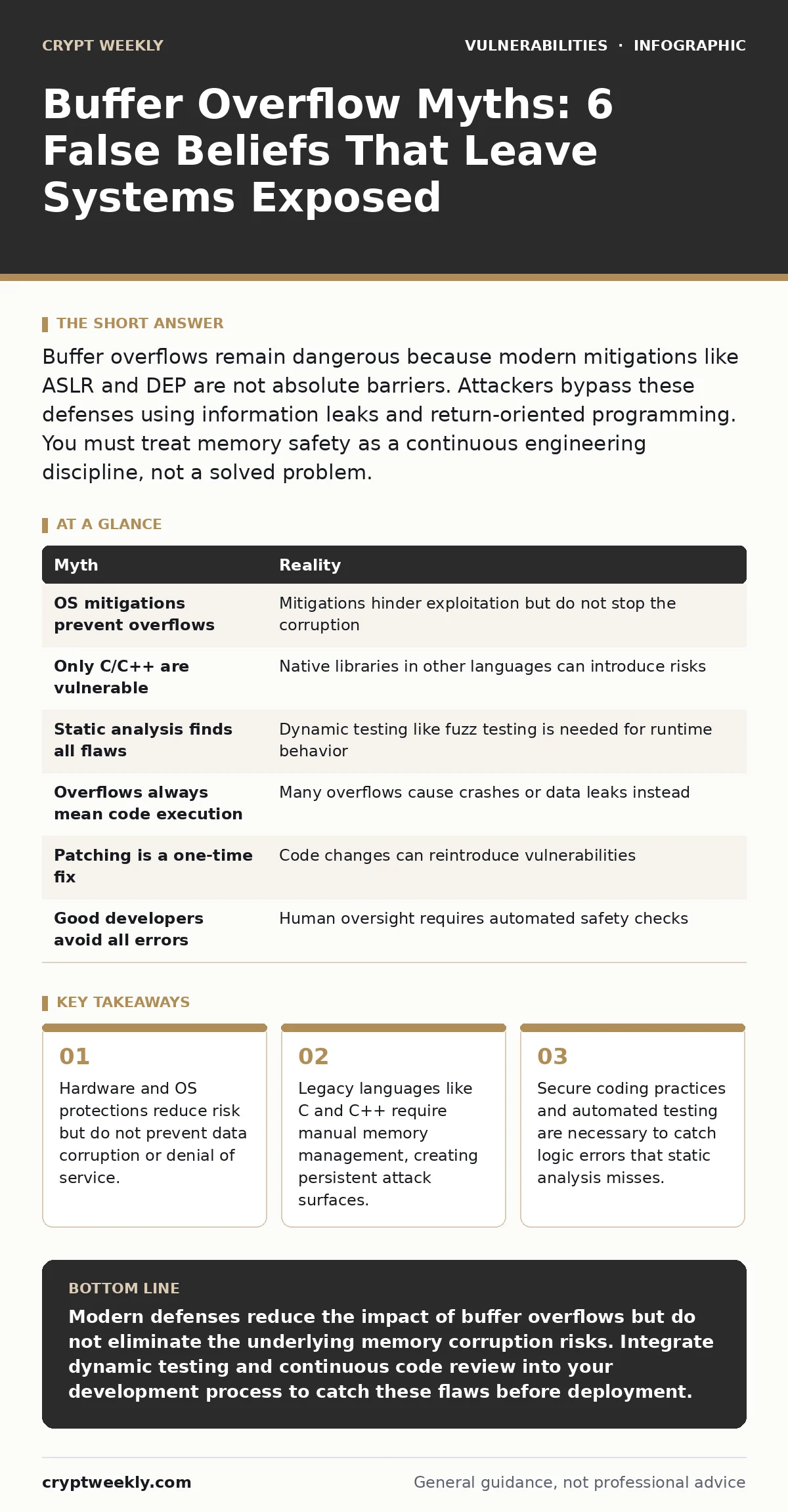
| Myth | Reality |
|---|---|
| OS mitigations prevent overflows | Mitigations hinder exploitation but do not stop the corruption |
| Only C/C++ are vulnerable | Native libraries in other languages can introduce risks |
| Static analysis finds all flaws | Dynamic testing like fuzz testing is needed for runtime behavior |
| Overflows always mean code execution | Many overflows cause crashes or data leaks instead |
| Patching is a one-time fix | Code changes can reintroduce vulnerabilities |
| Good developers avoid all errors | Human oversight requires automated safety checks |
Key takeaways
- Hardware and OS protections reduce risk but do not prevent data corruption or denial of service.
- Legacy languages like C and C++ require manual memory management, creating persistent attack surfaces.
- Secure coding practices and automated testing are necessary to catch logic errors that static analysis misses.
Modern defenses reduce the impact of buffer overflows but do not eliminate the underlying memory corruption risks. Integrate dynamic testing and continuous code review into your development process to catch these flaws before deployment.
Frequently asked questions
How do I know if my application is vulnerable to buffer overflows?
Run static analysis tools on your source code and perform dynamic fuzz testing to trigger memory corruption errors. Review crash logs for stack traces that indicate memory access violations.
Is using a memory-safe language enough to prevent these issues?
Memory-safe languages reduce the risk significantly, but you must still audit native dependencies and ensure that your application logic does not contain other flaws like API vulnerabilities or business logic flaws.
What is the difference between a stack and heap overflow?
A stack overflow occurs in function call memory, often allowing control flow hijacking. A heap overflow occurs in dynamically allocated memory, often corrupting metadata or adjacent objects, which is harder to exploit but still dangerous.
Should I worry about buffer overflows in web applications?
Yes, if your web application uses native plugins, backend services written in C/C++, or interacts with external APIs that process unvalidated binary data. Cross-site request forgery (CSRF) is a different class of web vulnerability, but memory issues in backend services can still compromise your infrastructure.
How this guide was produced: written by the Crypt Weekly editorial team with AI assistance, checked against the public references listed below, and reviewed when the facts change. See our editorial policy or report an error.