
PHP vulnerabilities arise when code treats untrusted input as executable instructions, turning standard web interactions into remote command execution opportunities.
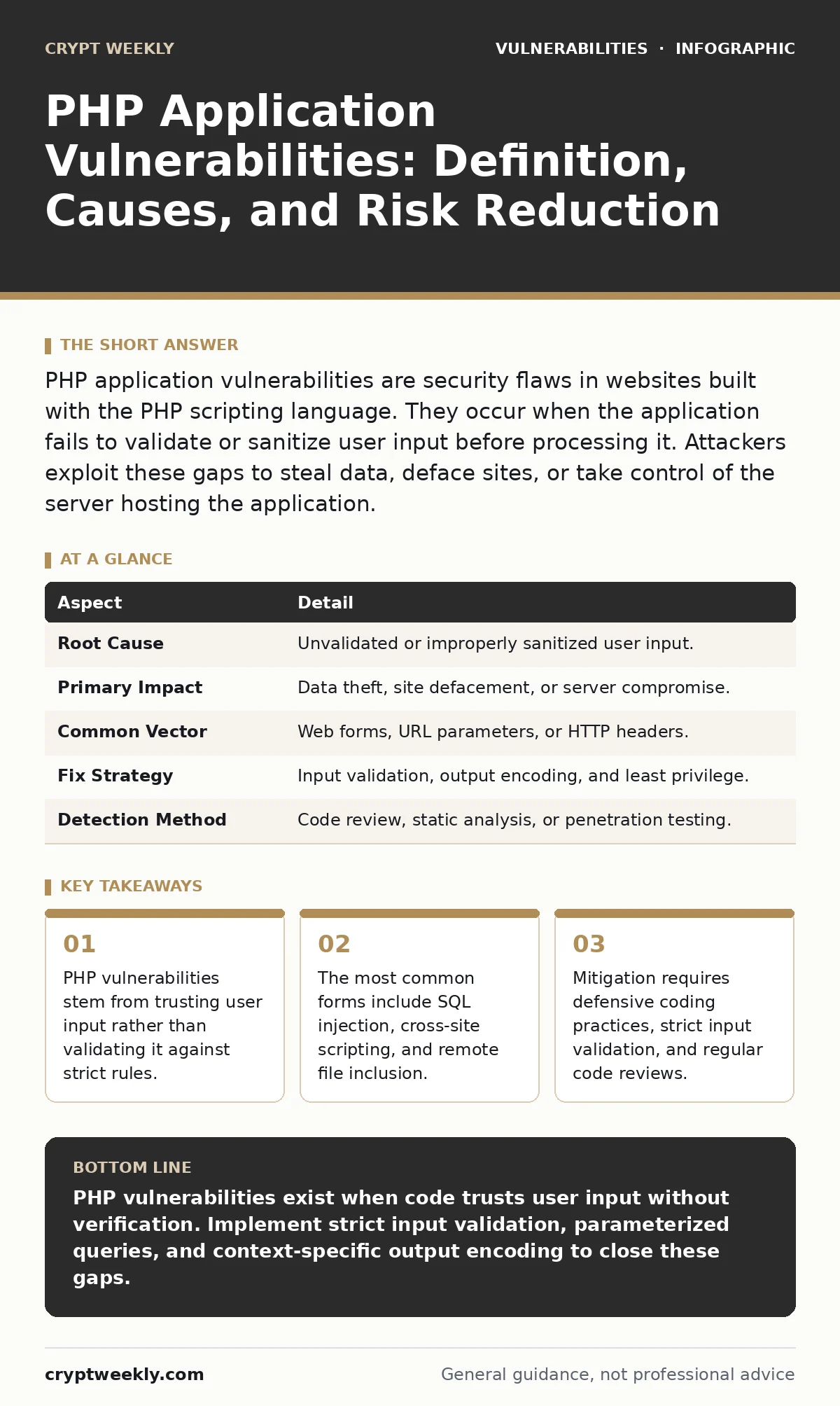
PHP application vulnerabilities are security flaws in websites built with the PHP scripting language. They occur when the application fails to validate or sanitize user input before processing it. Attackers exploit these gaps to steal data, deface sites, or take control of the server hosting the application.
What PHP Application Vulnerabilities Actually Are
PHP application vulnerabilities are weaknesses in code written for the PHP server-side scripting language. The language processes requests from web browsers and interacts with databases. A vulnerability exists when the code assumes user input is safe. This assumption allows an attacker to inject malicious commands. The server then executes these commands instead of performing the intended task. The result is unauthorized access or data exposure. The flaw lives in the logic, not in the PHP engine itself. Most modern PHP versions are secure by default. The danger comes from how developers structure their applications.
Imagine a library where anyone can write a new book. The librarian does not check the content. A visitor writes a book that tells other readers to steal money. The librarian shelves it. Other readers follow the instructions. The library loses funds. The library’s system works as designed. The failure is the lack of content review. PHP applications often operate like this library. They process whatever data arrives in the request.
| Aspect | Detail |
|---|---|
| Root Cause | Unvalidated or improperly sanitized user input. |
| Primary Impact | Data theft, site defacement, or server compromise. |
| Common Vector | Web forms, URL parameters, or HTTP headers. |
| Fix Strategy | Input validation, output encoding, and least privilege. |
| Detection Method | Code review, static analysis, or penetration testing. |
How These Flaws Develop in Code
Developers create PHP scripts to handle dynamic content. They need to accept data from users. This data might be a username, a search term, or a file upload. The script incorporates this data into a larger operation. It might insert the data into a database query. It might display the data on a webpage. It might use the data to include another file. The vulnerability appears when the script does not separate data from code. It treats the input as part of the instruction set. This blurs the line between what the user says and what the system does.
Consider a search function. The code builds a database query by adding the user's search term to a string. If the user enters a special character sequence, the query changes structure. The database executes the altered command. This happens because the code trusted the input string. It did not escape or parameterize the value. The mechanism relies on the interpreter reading the input as syntax. This is the core of injection flaws. The code fails to enforce boundaries between data and logic.
Who Faces the Greatest Risk
Anyone running a PHP-based website faces risk. This includes personal blogs, e-commerce stores, and enterprise portals. The risk increases with the complexity of the application. Simple sites with few inputs have fewer attack surfaces. Complex applications with many forms and dynamic features have more opportunities for error. Developers who reuse code snippets from the internet often introduce known flaws. They copy solutions without understanding the security context.
Third-party plugins and themes add significant risk. These components are often maintained by different teams. They may not follow the same security standards as the core application. A single vulnerable plugin can compromise the entire site. Organizations that neglect updates also face higher risk. Old code contains known weaknesses. Attackers scan the internet for these known signatures. They target sites that have not patched their software. The victim is usually the organization that owns the server, but the impact extends to their users.
Common Forms of PHP Vulnerabilities
SQL injection remains a frequent issue. It occurs when user input alters a database query. The attacker can read, modify, or delete data. Cross-site scripting, or XSS, happens when the application reflects user input back to the browser without encoding. The browser executes the injected script. This can steal session cookies or redirect users. Remote file inclusion allows an attacker to specify a file path. The PHP engine includes and executes that file. If the path points to a remote server, the attacker runs arbitrary code.
Insecure direct object reference occurs when an application exposes internal identifiers. A user might change an ID number in a URL to access another user's data. Server-side request forgery tricks the server into making requests to internal services. This bypasses firewall rules that protect those services. Command injection happens when the application passes user input to a system shell. The attacker executes operating system commands. Each form exploits a different trust boundary within the application stack.
What People Usually Get Wrong
Many assume that using a framework prevents all vulnerabilities. Frameworks provide secure defaults and helper functions. They do not enforce security if developers bypass them. Raw SQL queries or direct file operations still exist in framework-based apps. Another mistake is relying solely on input validation. Validation checks if input matches an expected pattern. It does not guarantee the input is safe for every context. Output encoding is equally important. Data must be encoded before being sent to the browser or database.
Some believe that hiding error messages stops attackers. Detailed errors help attackers understand the code structure. Hiding them helps, but it does not fix the underlying flaw. The code remains vulnerable. It just becomes harder to exploit. Security is not a single toggle. It is a series of defensive layers. Removing one layer leaves the system exposed. Thinking that one tool solves everything creates false confidence. This false confidence leads to neglected risks in other areas.
See also: Input Validation Errors: 6 Misconceptions Blocking Your Security
How to Reduce the Risk Effectively
Start with input validation. Define strict rules for what each input field accepts. Reject anything that does not match. Use allowlists rather than blocklists. An allowlist specifies what is permitted. A blocklist tries to guess what is bad. Attackers find ways around blocklists. Validation alone is not enough. You must also use parameterized queries for database interactions. This separates code from data. The database treats the input as a literal value. It never interprets it as a command.
Encode output before rendering it. HTML encoding prevents XSS by converting special characters into safe entities. The browser displays them as text, not code. Use prepared statements for all database queries. Avoid dynamic file paths based on user input. If you must include files, use a strict allowlist of local files. Never include files from external URLs. Keep your PHP version and extensions updated. Older versions contain known security issues. Review third-party components regularly. Replace outdated plugins with maintained alternatives.
The Role of Proactive Testing
You cannot fix what you do not know. Regular security testing reveals hidden flaws. Static application security testing scans the code without running it. It finds patterns that match known vulnerability signatures. Dynamic application security testing runs the application and probes for weaknesses. It simulates attacks to see how the system responds. These tools provide automated coverage. They catch common errors quickly.
Human review adds depth. A security expert examines the business logic. They look for flaws that tools miss. Business logic flaws often involve incorrect workflow handling. These are hard to automate. Combining automated scanning with manual review gives the best results. You should also consider bug bounty programs. These programs pay researchers to find and report vulnerabilities. They extend your testing reach beyond your internal team. Regular testing ensures that new code does not introduce old problems.
Key takeaways
- PHP vulnerabilities stem from trusting user input rather than validating it against strict rules.
- The most common forms include SQL injection, cross-site scripting, and remote file inclusion.
- Mitigation requires defensive coding practices, strict input validation, and regular code reviews.
PHP vulnerabilities exist when code trusts user input without verification. Implement strict input validation, parameterized queries, and context-specific output encoding to close these gaps.
Frequently asked questions
Does using a web application firewall stop PHP vulnerabilities?
A web application firewall blocks known attack patterns. It does not fix the underlying code flaw. Attackers can bypass filters with novel techniques. You still need secure coding practices.
Can I fix PHP vulnerabilities without rewriting the code?
Some issues can be patched with configuration changes. Others require code updates to add validation or encoding. Complex flaws often need structural changes to the application logic.
How this guide was produced: written by the Crypt Weekly editorial team with AI assistance, checked against the public references listed below, and reviewed when the facts change. See our editorial policy or report an error.