Bug bounty programs shift security costs to variable payouts while relying on crowd-sourced testing that misses logic flaws and complex workflows.
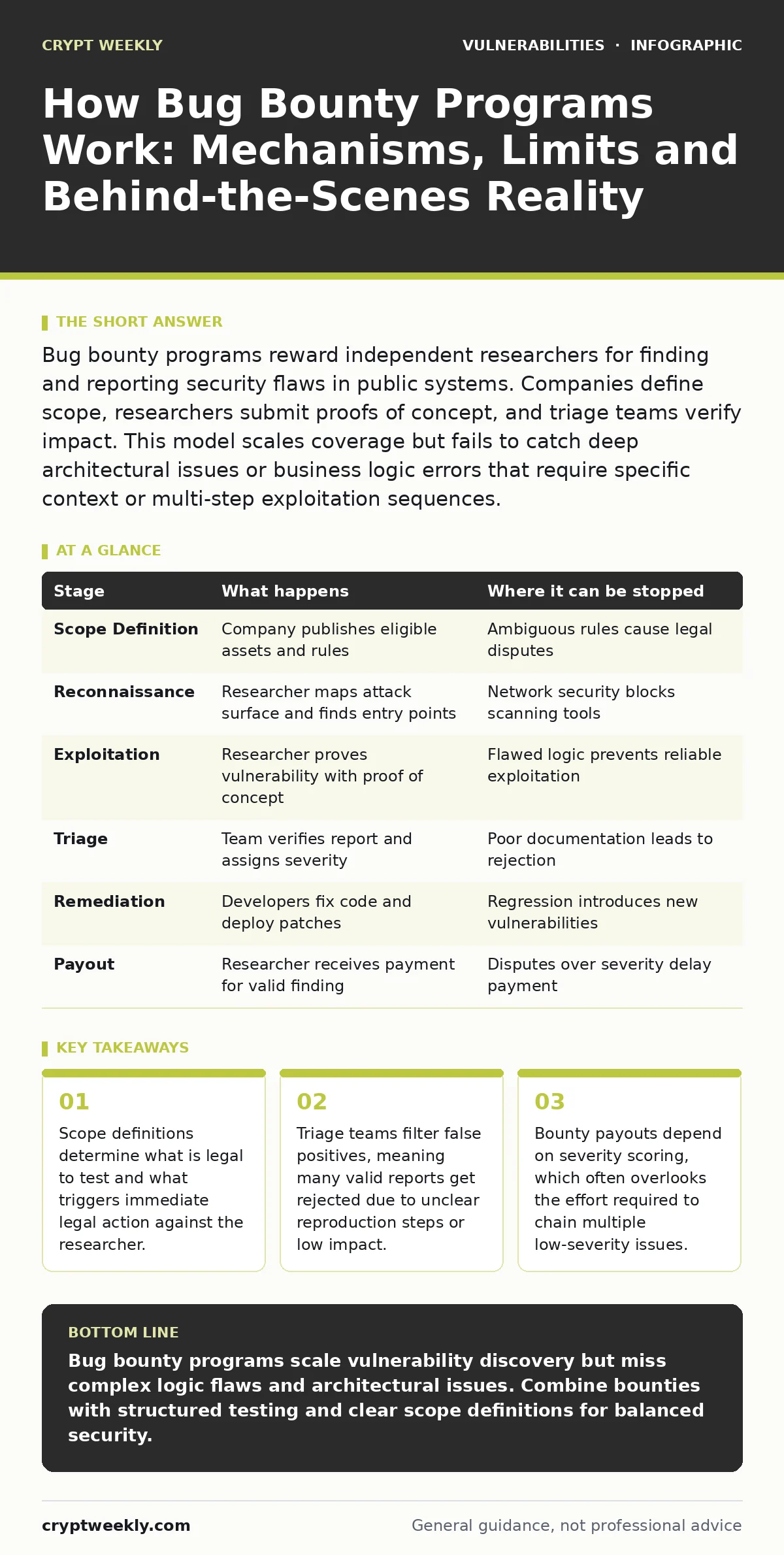
Bug bounty programs reward independent researchers for finding and reporting security flaws in public systems. Companies define scope, researchers submit proofs of concept, and triage teams verify impact. This model scales coverage but fails to catch deep architectural issues or business logic errors that require specific context or multi-step exploitation sequences.
Defining Scope and Rules of Engagement
Bug bounty programs begin with a strict definition of scope. Organizations publish a list of domains, subdomains, APIs and applications that are eligible for testing. Anything outside this list is off-limits. This boundary protects the company from accidental damage to production systems while giving researchers clear legal permission to probe specific assets.
The rules of engagement specify prohibited actions. Scanning during peak hours might be banned. Testing that affects availability is usually forbidden. Researchers must follow these constraints to avoid criminal charges for unauthorized access. Clear scope prevents legal ambiguity and ensures testing targets only intended infrastructure.
Discovery and Reconnaissance Phase
Researchers start by mapping the attack surface. They use passive reconnaissance to identify subdomains, IP addresses and technologies without interacting with the target. This phase gathers information from public records, certificate transparency logs and search engine indexes. Active scanning follows, probing open ports and services.
Tools automate the detection of known vulnerabilities, but manual inspection reveals unique configurations. Researchers look for misconfigured cloud storage, exposed administrative panels or outdated software versions. This stage requires patience and precision. Automated tools miss context-specific flaws that human intuition catches. The goal is to find entry points before attempting exploitation.
Vulnerability Identification and Exploitation
Once an entry point is identified, researchers attempt to exploit it. They craft specific inputs to trigger unexpected behavior in the application. This might involve SQL injection to extract database contents or input validation failures to execute code. The researcher must prove the vulnerability exists and demonstrates its potential impact.
They create a proof of concept that shows data leakage, privilege escalation or remote code execution. The exploit must be reproducible. Vague reports without clear steps are rejected during triage. Researchers document every step, including headers, payloads and responses. This documentation helps the triage team verify the finding quickly. The quality of the report determines whether the bounty is paid.
Submission and Triage Process
The researcher submits the report through a secure platform. The report includes a title, description, impact analysis and reproduction steps. The company’s triage team reviews the submission. They attempt to reproduce the issue in a controlled environment. If the issue is valid, they assign a severity rating. Common frameworks use critical, high, medium and low categories.
The rating determines the bounty amount. Triage teams filter out false positives, duplicates and known issues. They also reject reports that lack sufficient evidence or fall outside the defined scope. This process can take days or weeks. Researchers often need to provide additional details or clarify steps. Effective communication speeds up verification and payout.
Remediation and Patch Deployment
After verification, the development team fixes the vulnerability. Developers analyze the root cause and implement a code change. They might update libraries, fix logic errors or add sanitization checks. The fix undergoes internal testing to ensure it resolves the issue without introducing new problems. Security regression testing confirms that previous fixes remain effective.
Once approved, the patch is deployed to production. The organization monitors for any signs of instability or exploitation attempts. This phase closes the loop for the researcher. They receive notification that the issue is resolved. Some programs allow researchers to verify the fix before the bounty is released. This transparency builds trust and encourages future participation.
See also: Prevent Cisco IOS XE Vulnerabilities: A Practical Defense Plan · Penetration Testing vs Red Teaming: Scope, Goals, and Selection
Payout and Program Limitations
The organization pays the bounty to the researcher. Payments vary based on severity, impact and effort. Higher severity issues receive larger rewards. Some programs offer bonuses for novel techniques or complex chains. However, bug bounty programs have significant limitations. They rely on individual effort and motivation. Researchers focus on quick wins that yield payouts.
Deep architectural flaws, business logic errors and complex workflows often go untested. These issues require extensive context and time to exploit. Penetration testing engagements provide deeper coverage for such scenarios. Bug bounties complement traditional testing but do not replace it. Organizations must understand this trade-off when designing their security strategy.
| Stage | What happens | Where it can be stopped |
|---|---|---|
| Scope Definition | Company publishes eligible assets and rules | Ambiguous rules cause legal disputes |
| Reconnaissance | Researcher maps attack surface and finds entry points | Network security blocks scanning tools |
| Exploitation | Researcher proves vulnerability with proof of concept | Flawed logic prevents reliable exploitation |
| Triage | Team verifies report and assigns severity | Poor documentation leads to rejection |
| Remediation | Developers fix code and deploy patches | Regression introduces new vulnerabilities |
| Payout | Researcher receives payment for valid finding | Disputes over severity delay payment |
Strategic Trade-offs and Hidden Costs
Bug bounty programs shift security costs from fixed salaries to variable payouts. This model scales coverage across large attack surfaces. However, it introduces hidden costs. Triage teams require skilled staff to filter reports. Legal teams manage scope disputes and liability. Reputation risks arise from public disclosures or negative sentiment.
Organizations must balance these costs against the value of crowd-sourced testing. They should integrate bounties with other security practices. OWASP Top 10 awareness helps researchers focus on common risks. Programs should encourage ethical behavior and clear communication. Understanding these trade-offs ensures sustainable security operations.
Key takeaways
- Scope definitions determine what is legal to test and what triggers immediate legal action against the researcher.
- Triage teams filter false positives, meaning many valid reports get rejected due to unclear reproduction steps or low impact.
- Bounty payouts depend on severity scoring, which often overlooks the effort required to chain multiple low-severity issues.
Bug bounty programs scale vulnerability discovery but miss complex logic flaws and architectural issues. Combine bounties with structured testing and clear scope definitions for balanced security.
Frequently asked questions
Can I test systems not listed in the bug bounty scope?
No. Testing assets outside the defined scope is unauthorized and may violate computer crime laws. Always stick to the published list of eligible domains and applications.
How do I avoid having my bug bounty report rejected?
Provide clear, step-by-step reproduction instructions and evidence of impact. Include request headers, payloads and responses. Avoid vague descriptions or assumptions about internal systems.
Do bug bounty programs replace penetration testing?
No. Bounties cover broad surface areas but miss deep logic flaws. Penetration testing provides structured, comprehensive assessments of complex workflows and architectural weaknesses.
What happens if two researchers find the same bug?
The first valid report usually receives the bounty. Organizations define duplicate policies in their rules. Researchers should submit quickly and ensure their reports are clear and reproducible.
How this guide was produced: written by the Crypt Weekly editorial team with AI assistance, checked against the public references listed below, and reviewed when the facts change. See our editorial policy or report an error.