Segmentation stops lateral movement faster than patching because it limits the blast radius of any zero-day exploit in your network infrastructure.
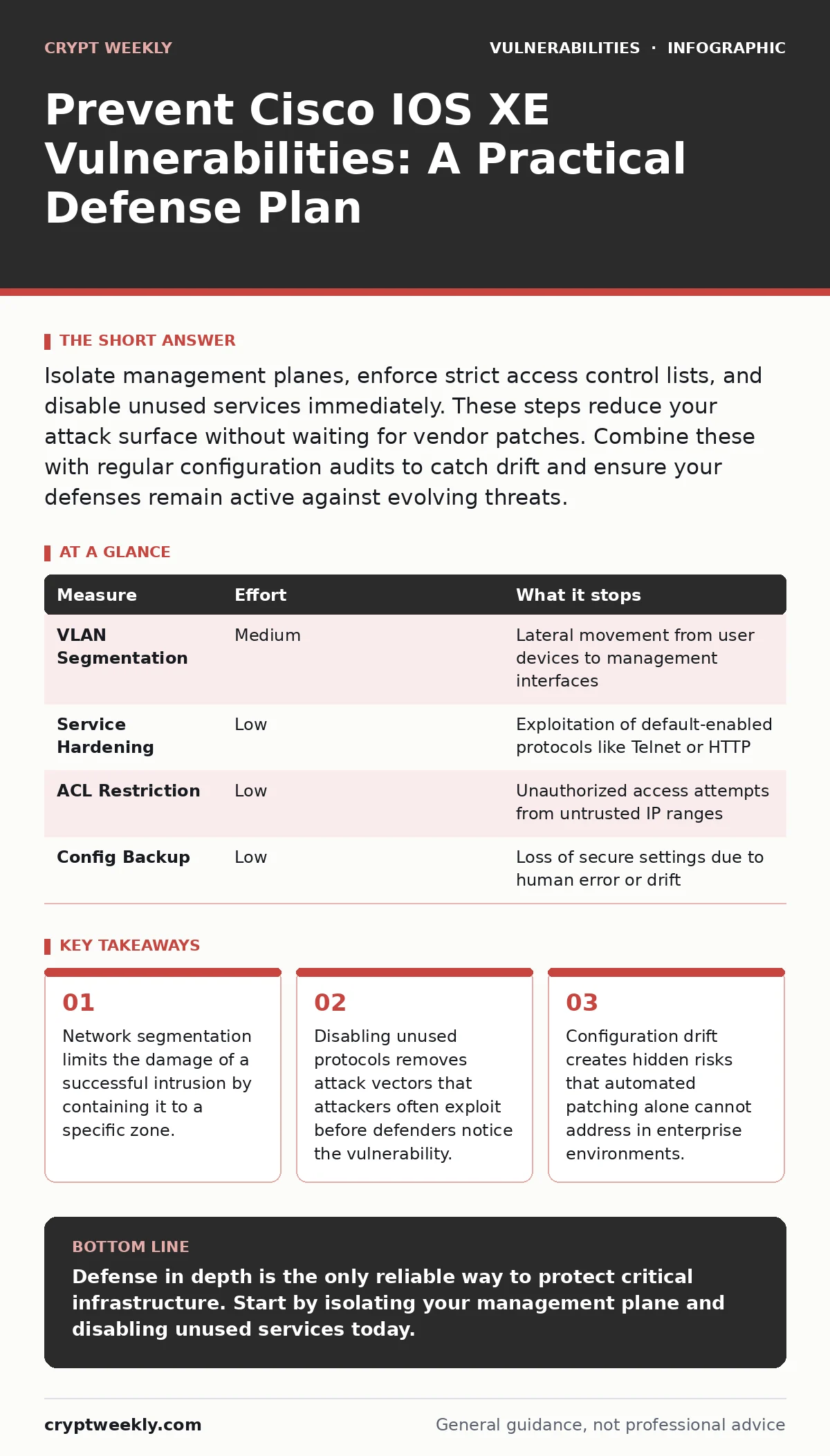
Isolate management planes, enforce strict access control lists, and disable unused services immediately. These steps reduce your attack surface without waiting for vendor patches. Combine these with regular configuration audits to catch drift and ensure your defenses remain active against evolving threats.
Isolate the Management Plane First
Management interfaces provide the highest privilege access to your network devices. Attackers target these interfaces to gain full control of the routing and switching infrastructure. You must separate the management plane from the data plane. This separation ensures that even if a user device is compromised, the attacker cannot easily reach the device’s command line interface.
Use a dedicated Virtual LAN for all management traffic. Assign this VLAN to a separate physical interface or a dedicated sub-interface. Do not share this VLAN with user traffic or guest networks. Configure firewalls to allow only specific administrative workstations to communicate with this management VLAN. This isolation prevents brute-force attacks from originating within the general network.
Disable Unused Services and Protocols
Every enabled service increases the attack surface. Cisco IOS XE devices often come with many services enabled by default for convenience during initial setup. These services remain active unless you explicitly disable them. Unused services provide entry points for attackers who scan for open ports and known vulnerabilities.
Audit your device configuration to identify services you do not use. Common examples include Telnet, HTTP, and certain SNMP versions. Replace Telnet with SSH for encrypted command-line access. Replace HTTP with HTTPS for web-based management. Disable any SNMP community strings that are not required for monitoring. Each disabled service removes a potential vector for exploitation.
| Measure | Effort | What it stops |
|---|---|---|
| VLAN Segmentation | Medium | Lateral movement from user devices to management interfaces |
| Service Hardening | Low | Exploitation of default-enabled protocols like Telnet or HTTP |
| ACL Restriction | Low | Unauthorized access attempts from untrusted IP ranges |
| Config Backup | Low | Loss of secure settings due to human error or drift |
Enforce Strict Access Control Lists
Access Control Lists define which traffic is permitted to reach your network devices. Without strict ACLs, any device on the network can attempt to communicate with your routers and switches. This open access allows attackers to probe for vulnerabilities and attempt login brute-force attacks.
Apply ACLs to both the VTY lines and the physical interfaces. Restrict SSH and HTTPS access to known administrative IP addresses. Use the permit host command to allow only specific management stations. Deny all other traffic by default. This principle of least privilege ensures that only authorized personnel can interact with the device’s control mechanisms.
Monitor for Configuration Drift
Configuration drift occurs when the live configuration of a device diverges from the intended baseline. Administrators often make temporary changes for troubleshooting and forget to revert them. These temporary changes can introduce security weaknesses over time. Drift is a silent risk that accumulates until an attacker exploits it.
Implement a configuration management system that compares the current running configuration against a known good baseline. Alert immediately when unauthorized changes occur. Regular audits help identify deviations before they are exploited. This process supports security regression testing by ensuring that new changes do not reintroduce old vulnerabilities.
Secure the Control Plane
The control plane processes routing protocol packets and management traffic. If an attacker floods the control plane with traffic, the device becomes unresponsive. This condition is known as a Control Plane Attack. It does not require exploiting a software bug to disrupt service.
Enable Control Plane Policing to rate-limit traffic destined for the control plane. This feature drops packets that exceed a defined threshold. Configure thresholds based on normal traffic patterns to avoid dropping legitimate traffic. Policing protects the CPU from exhaustion during denial-of-service attempts. It ensures the device remains manageable even under attack.
See also: Network Monitoring Checklist: Detect Anomalies Before Breaches
Automate Vulnerability Management
Manual tracking of vulnerabilities is error-prone and slow. New vulnerabilities are discovered constantly. You need a process to identify which vulnerabilities affect your specific devices. This process must be integrated into your change management workflow.
Use automated tools to scan your network for known weaknesses. Cross-reference these findings with your asset inventory. Prioritize remediation based on the risk level and exposure of the device. Integrate these checks into your dependency scanning processes to ensure that software components are up to date. This approach reduces the time between vulnerability discovery and mitigation.
Verify Defense Effectiveness
You must test your defenses to ensure they work as intended. Configuration errors are common and can render security controls ineffective. Regular testing validates that ACLs, segmentation, and service restrictions are functioning correctly.
Perform penetration tests that simulate real-world attacks against your infrastructure. Focus on lateral movement and privilege escalation scenarios. Use the results to refine your security posture. This practice aligns with threat modeling for applications by identifying weaknesses in the overall architecture.
Review and Update Regularly
Security is not a one-time task. Threats evolve, and new vulnerabilities are discovered. You must review your security posture regularly. This review should include an assessment of new threats and an update to your defense mechanisms.
Schedule quarterly reviews of your network security configuration. Update your access control lists to reflect changes in personnel and network topology. Review your segmentation strategy to ensure it still meets your business needs. Continuous improvement ensures that your defenses remain effective against current threats.
Key takeaways
- Network segmentation limits the damage of a successful intrusion by containing it to a specific zone.
- Disabling unused protocols removes attack vectors that attackers often exploit before defenders notice the vulnerability.
- Configuration drift creates hidden risks that automated patching alone cannot address in enterprise environments.
Defense in depth is the only reliable way to protect critical infrastructure. Start by isolating your management plane and disabling unused services today.
Frequently asked questions
How do I know if my Cisco IOS XE version is vulnerable?
Check the vendor’s security advisories and compare them against your installed software version. Use automated tools to map known vulnerabilities to your specific asset inventory.
What is the biggest risk in IOS XE security?
Configuration drift and weak access controls pose significant risks. These issues persist even on patched devices and are often the entry point for successful intrusions.
How this guide was produced: written by the Crypt Weekly editorial team with AI assistance, checked against the public references listed below, and reviewed when the facts change. See our editorial policy or report an error.