
Most threat models fail because they map data incorrectly and ignore the human operators who maintain the system in production.
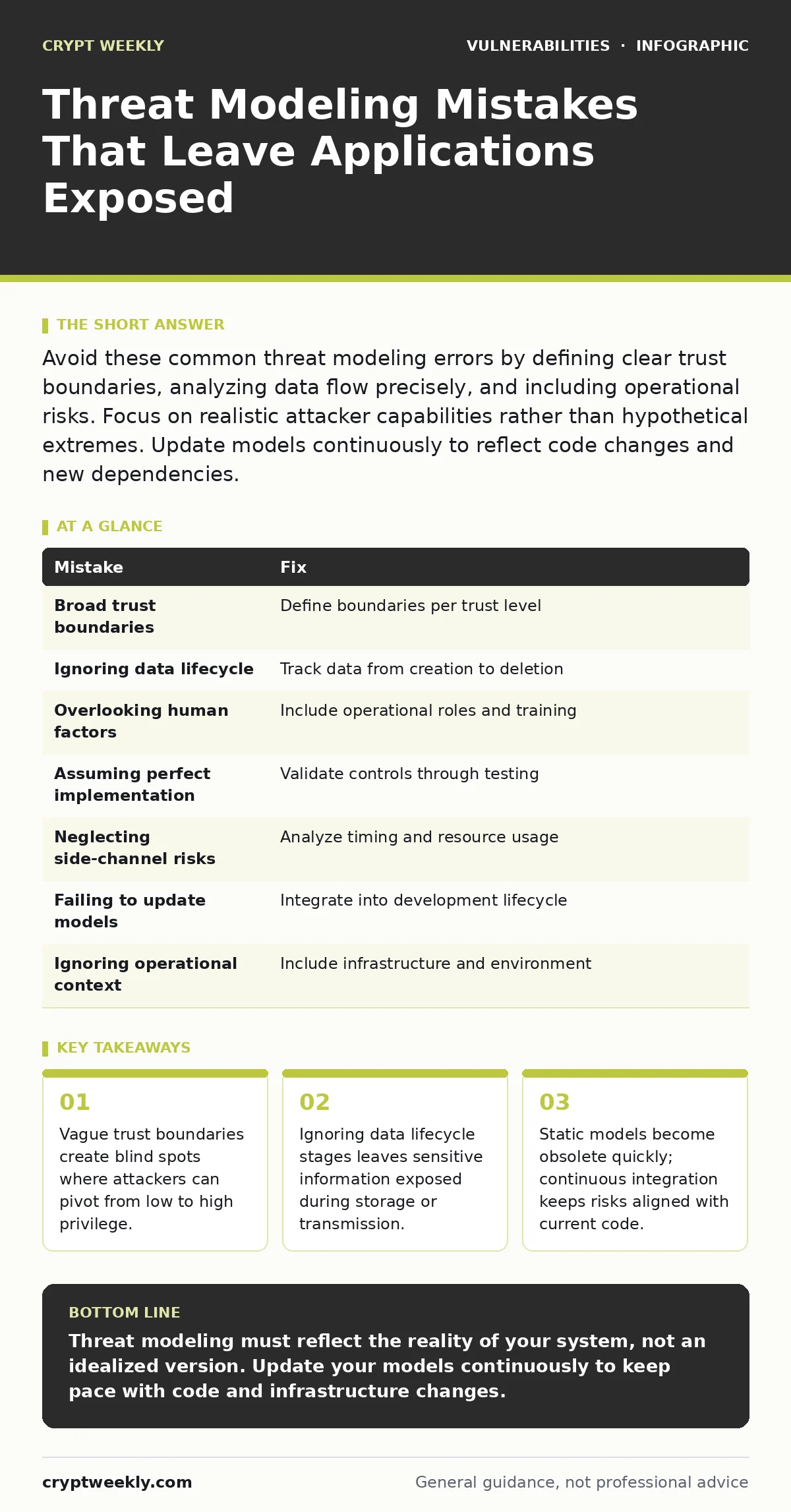
Avoid these common threat modeling errors by defining clear trust boundaries, analyzing data flow precisely, and including operational risks. Focus on realistic attacker capabilities rather than hypothetical extremes. Update models continuously to reflect code changes and new dependencies.
Mistake 1: Defining Trust Boundaries Too Broadly
Developers often draw trust boundaries around the entire application perimeter. This approach assumes everything inside the firewall is safe. Attackers exploit this assumption by compromising one component to access others. The boundary should separate components with different security requirements. Internal services often have weaker controls than external-facing ones.
Why it hurts:
Broad boundaries hide internal attack paths. An attacker who breaches a low-security logging service can move laterally to the database. You miss critical trust transitions between microservices. The model fails to identify where authentication checks are missing. Internal network traffic is often monitored less rigorously than external traffic.
The fix:
Draw boundaries around each distinct trust level. Treat internal APIs with the same scrutiny as public ones. Map every handoff between components. Verify that authentication and authorization occur at each boundary. Consider the principle of least privilege for every service account. This granularity reveals hidden lateral movement opportunities.
Mistake 2: Ignoring Data Lifecycle Stages
Many models focus only on data in transit. They neglect data at rest or in use. Sensitive information remains vulnerable when stored in logs, backups, or temporary files. Attackers target these static repositories when direct network access is blocked. Data lifecycle includes creation, storage, transmission, and deletion. Each stage presents unique risks that require specific controls.
Why it hurts:
Unencrypted databases expose credentials if storage is compromised. Log files may contain sensitive user inputs. Temporary files on disk persist after processing ends. Attackers recover data from deleted files using forensic tools. You leave valuable assets unprotected outside the application logic. The model becomes a map of network flows, not data protection.
The fix:
Track data from creation to destruction. Identify where sensitive data resides at each stage. Apply encryption for data at rest and in transit. Ensure secure deletion methods remove data permanently. Review logging practices to prevent sensitive data capture. Align controls with the sensitivity of the data. This approach addresses the full scope of data exposure.
Mistake 3: Overlooking Human Factors
Technical controls dominate most threat models. Human operators are often treated as external threats. System administrators, developers, and support staff have access to critical systems. Insider threats are not always malicious; mistakes happen. Phishing targets employees to gain initial access. Operational procedures introduce risks that technical controls cannot mitigate.
Why it hurts:
Privileged accounts are high-value targets. Social engineering bypasses technical defenses. Misconfigurations by tired staff create vulnerabilities. Lack of training leads to poor security hygiene. You ignore the weakest link in the chain. The model fails to account for realistic human behavior under pressure or fatigue.
The fix:
Include operational roles in the threat model. Map access permissions for all human users. Implement multi-factor authentication for privileged accounts. Train staff on security awareness and incident response. Review procedures for potential abuse or error. Design systems that resist misuse. Human-centric models address the reality of daily operations.
Mistake 4: Assuming Perfect Implementation
Models often assume controls work exactly as designed. Real-world implementations have flaws. Configuration errors are common. Code bugs introduce unintended behavior. Dependencies may contain known vulnerabilities. The gap between design and reality is where attacks succeed. You must account for implementation failures in your analysis.
Why it hurts:
A misconfigured firewall allows unauthorized access. A buggy authentication module leaks session tokens. Outdated libraries introduce known exploits. You waste resources defending against perfect systems. The model becomes theoretical rather than practical. Real attackers exploit implementation gaps, not design flaws.
The fix:
Validate controls through testing and review. Use automated scanning for configuration errors. Perform code reviews for security logic. Check dependencies for known issues. Assume controls will fail and plan for detection. Monitor for anomalous behavior. This pragmatic approach prepares you for real-world conditions.
Mistake 5: Neglecting Side-Channel Risks
Traditional models focus on direct attacks. They ignore side-channel leaks. Timing variations can reveal secret keys. Power consumption patterns expose cryptographic operations. Cache behavior leaks information about processed data. These indirect signals provide attackers with valuable intelligence. They are often overlooked because they do not involve direct code execution.
Why it hurts:
Cryptographic implementations can be broken without cracking the algorithm. Timing attacks recover passwords or keys. Cache attacks extract sensitive data from shared memory. You leave subtle attack vectors unaddressed. The model misses non-functional security properties. These attacks are difficult to detect and mitigate.
The fix:
Analyze timing and resource usage patterns. Use constant-time algorithms for cryptographic operations. Isolate sensitive computations from shared resources. Monitor for anomalous resource consumption. Consider hardware-level protections. This depth addresses sophisticated attack methods that bypass traditional defenses.
See also: How Container Escape Vulnerabilities Work: A Step-by-Step Breakdown
Mistake 6: Failing to Update Models Continuously
Threat models are often created once and filed away. Code changes introduce new risks. Dependencies update with new vulnerabilities. Business logic evolves over time. A static model becomes inaccurate quickly. You rely on outdated information for security decisions. The model drifts from the actual system state.
Why it hurts:
New features may bypass existing controls. Updated libraries may introduce regressions. Changed business logic alters data flow. You defend against risks that no longer exist. The model provides a false sense of security. Continuous change requires continuous analysis.
The fix:
Integrate threat modeling into the development lifecycle. Update models with every significant change. Automate risk assessment where possible. Review models regularly for accuracy. Treat the model as a living document. This ensures alignment with the current system state.
Mistake 7: Ignoring Operational Context
Models often ignore the environment where the application runs. Cloud configurations, container setups, and network topology matter. Misconfigured cloud storage exposes data publicly. Container escapes compromise the host system. Network segmentation failures allow lateral movement. The operational context defines the attack surface.
Why it hurts:
Cloud misconfigurations are a leading cause of data breaches. Container vulnerabilities allow host compromise. Network flaws enable unauthorized access. You miss environmental risks. The model focuses only on application code. Operational security is as important as application security.
The fix:
Include infrastructure components in the model. Review cloud configurations for security. Assess container and orchestration risks. Map network segmentation and access controls. Understand the deployment environment. This holistic view captures the full attack surface.
| Mistake | Fix |
|---|---|
| Broad trust boundaries | Define boundaries per trust level |
| Ignoring data lifecycle | Track data from creation to deletion |
| Overlooking human factors | Include operational roles and training |
| Assuming perfect implementation | Validate controls through testing |
| Neglecting side-channel risks | Analyze timing and resource usage |
| Failing to update models | Integrate into development lifecycle |
| Ignoring operational context | Include infrastructure and environment |
Key takeaways
- Vague trust boundaries create blind spots where attackers can pivot from low to high privilege.
- Ignoring data lifecycle stages leaves sensitive information exposed during storage or transmission.
- Static models become obsolete quickly; continuous integration keeps risks aligned with current code.
Threat modeling must reflect the reality of your system, not an idealized version. Update your models continuously to keep pace with code and infrastructure changes.
Frequently asked questions
How often should I update my threat model?
Update the model whenever you make significant changes to code, architecture, or dependencies. Regular reviews ensure accuracy.
Can automated tools replace manual threat modeling?
Automated tools help identify known vulnerabilities but cannot replace human analysis of business logic and context. Use both approaches.
What is the first step in threat modeling?
Define the scope and draw data flow diagrams. Identify trust boundaries and assets. This foundation supports deeper analysis.
How do I handle third-party dependencies?
Treat third-party code as untrusted. Verify its security posture and monitor for vulnerabilities. Use dependency scanning tools.
How this guide was produced: written by the Crypt Weekly editorial team with AI assistance, checked against the public references listed below, and reviewed when the facts change. See our editorial policy or report an error.