
Most API failures occur not during coding, but when the system accepts requests that are technically valid yet logically dangerous.
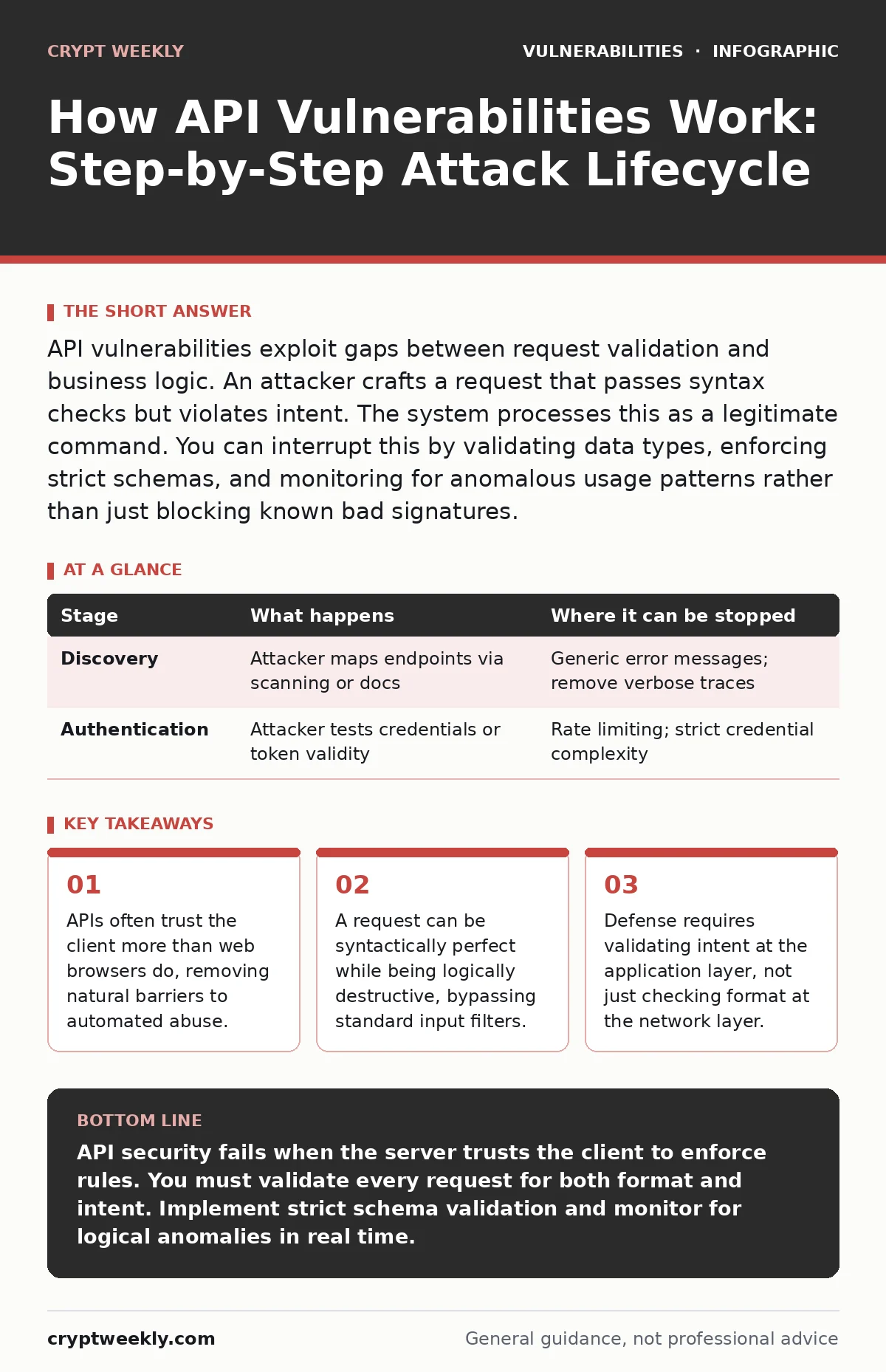
API vulnerabilities exploit gaps between request validation and business logic. An attacker crafts a request that passes syntax checks but violates intent. The system processes this as a legitimate command. You can interrupt this by validating data types, enforcing strict schemas, and monitoring for anomalous usage patterns rather than just blocking known bad signatures.
The Contract of Trust
An Application Programming Interface (API) acts as a mediator between two software systems. It defines how data moves from a client, such as a mobile app, to a server that holds the resources. This relationship relies on a contract. The client sends a request, and the server responds with data or an action confirmation.
This model differs from traditional web browsing. A browser imposes certain restrictions, like the same-origin policy, which limits how scripts interact with other domains. An API consumer usually lacks these restrictions. It speaks raw HTTP or other protocol standards directly. This openness is the primary source of risk.
The vulnerability exists in the assumption that if a request follows the correct format, it is safe. Servers are often built to be helpful. They prioritize fulfilling the request over questioning its origin or intent. This helpfulness creates a wide attack surface.
### Stage 1: Discovery and Reconnaissance
An attacker begins by mapping the API surface. They look for documentation, error messages, or network traffic that reveals endpoints. An endpoint is a specific URL path where an API accepts requests. Many organizations publish OpenAPI specifications, which serve as blueprints for attackers.
Even without documentation, attackers use tools to scan for common paths. They send requests to likely locations, such as /admin or /v1/users. The server’s response tells them if the path exists. A 404 Not Found error confirms the path is missing. A 200 OK or 401 Unauthorized status confirms it exists.
This stage relies on information leakage. If the API returns detailed error messages, it helps the attacker understand the structure. For example, a stack trace might reveal the underlying framework. This information is free intelligence.
| Stage | What happens | Where it can be stopped |
|---|---|---|
| Discovery | Attacker maps endpoints via scanning or docs | Generic error messages; remove verbose traces |
| Authentication | Attacker tests credentials or token validity | Rate limiting; strict credential complexity |
### Stage 2: Bypassing Authentication
Once endpoints are known, the attacker attempts to gain access. Authentication verifies identity. Authorization determines what that identity can do. Many APIs fail to distinguish between these two concepts.
Attackers often try to reuse tokens. A JSON Web Token (JWT) is a compact, URL-safe means of representing claims to be transferred between two parties. If the server does not validate the signature correctly, an attacker can forge a token. They might change the user_id field inside the token to impersonate another user.
Another common flaw is using predictable session identifiers. If the token is a simple integer sequence, an attacker can guess valid tokens. They do not need to break encryption. They only need to find a pattern. This is where security regression testing becomes critical. Changing one part of the authentication logic might break validation in another.
### Stage 3: Exploiting Business Logic
This is where most modern API attacks succeed. The request is authenticated. The syntax is correct. The data types match the schema. However, the action violates the intended workflow.
Imagine an e-commerce API. The checkout process requires a sequence: add to cart, apply coupon, calculate total, submit payment. The API accepts these calls individually. An attacker might skip the coupon validation step or submit a negative quantity. The server sees a valid POST request to the payment endpoint. It processes it.
This is a business logic flaw. The code does not enforce the sequence of operations. It trusts the client to follow the rules. The server lacks context. It sees a request, not a conversation. To stop this, the application must maintain state or enforce strict workflow constraints.
### Stage 4: Data Manipulation and Injection
Attackers also try to inject malicious data into the API. SQL injection remains a threat if the API passes user input directly to a database query. The attacker includes SQL commands in a search parameter. The database executes them.
Another risk is XML External Entity (XXE) injection. If the API accepts XML input, an attacker can define an external entity that points to sensitive files on the server. When the parser processes the XML, it reads the file and returns the content.
These attacks rely on improper input validation. The server must sanitize all data. It should use parameterized queries for databases. It should disable external entity processing for XML parsers. Fuzz testing helps find these gaps. It sends random, malformed data to the API to see how it breaks.
See also: PHP Application Vulnerabilities: Definition, Causes, and Risk Reduction · SQL Injection: 9 Questions Answered About Database Attacks
### Stage 5: Excessive Data Exposure
APIs often return more data than the client needs. The server fetches a full user object from the database. It includes fields like internal_id, security_question, and password_hash. The mobile app only displays the name. It ignores the rest.
The attacker receives the full JSON response. They can access the hidden fields. This happens because the API trusts the client to filter the data. The server should strip sensitive fields before sending the response. This is known as server-side filtering.
You can mitigate this by defining strict response schemas. Only send what is necessary. Do not rely on the client to hide data. This also relates to cross-site request forgery (CSRF) protection. If an API is stateless and uses tokens, CSRF is less of a risk. But if it uses cookies, you must validate the Origin and Referer headers.
### Stage 6: Abuse and Amplification
Once inside, attackers scale their actions. They use the API to scrape data, send spam, or perform distributed denial-of-service attacks. The API becomes a tool for abuse.
Rate limiting is the primary defense. It restricts the number of requests a user can make in a time window. However, attackers often distribute requests across many IP addresses. This bypasses simple IP-based limits.
You need user-based rate limiting. This ties the limit to the authenticated user ID. If the user is anonymous, you must limit by IP and use captchas or other challenges. This adds friction. It reduces legitimate usage slightly. This is a necessary trade-off.
The Hidden Cost of Complexity
APIs are often built by different teams than the front-end interfaces. This separation leads to misaligned security models. The API team focuses on availability. The app team focuses on user experience. Security falls into the gap.
This is why a software bill of materials (SBOM) is useful. It lists all components in your API. If a library has a vulnerability, you know immediately. You do not have to guess. This helps with patch testing. You can verify that the fix works without breaking the API contract.
Interrupting the Cycle
You can stop API attacks at multiple points. The most effective is during design. Define the contract clearly. Specify allowed methods, data types, and workflows. Use automated tools to validate requests against this contract.
At runtime, monitor for anomalies. Look for sequences that deviate from normal patterns. A user who checks out ten times a minute is suspicious. Block them. Review your logs regularly. Look for errors that indicate probing.
This is not a one-time task. APIs evolve. New endpoints are added. Old ones are deprecated. Buffer overflow vulnerabilities are less common in modern managed languages, but logic errors persist. You must test continuously.
Key takeaways
- APIs often trust the client more than web browsers do, removing natural barriers to automated abuse.
- A request can be syntactically perfect while being logically destructive, bypassing standard input filters.
- Defense requires validating intent at the application layer, not just checking format at the network layer.
API security fails when the server trusts the client to enforce rules. You must validate every request for both format and intent. Implement strict schema validation and monitor for logical anomalies in real time.
Frequently asked questions
Are REST APIs safer than SOAP APIs?
No. REST is simpler but often lacks built-in security standards. SOAP has WS-Security, but it is complex to configure correctly. Both are vulnerable to logic flaws.
Does HTTPS fix API vulnerabilities?
HTTPS encrypts data in transit. It prevents eavesdropping. It does not stop logic errors, injection, or excessive data exposure. You still need application-level security.
How do I know if my API has business logic flaws?
You cannot find them with standard scanners. You need manual testing and threat modeling. Review the workflows. Ask what happens if a step is skipped or repeated.
Is rate limiting enough to stop abuse?
Rate limiting slows down attacks. It does not stop them. Attackers can spread requests over time. You need user-specific limits and behavioral analysis to be effective.
How this guide was produced: written by the Crypt Weekly editorial team with AI assistance, checked against the public references listed below, and reviewed when the facts change. See our editorial policy or report an error.