
SQL injection turns your database into an open door by mixing user input with code, allowing attackers to read, change, or delete any data stored in your system.
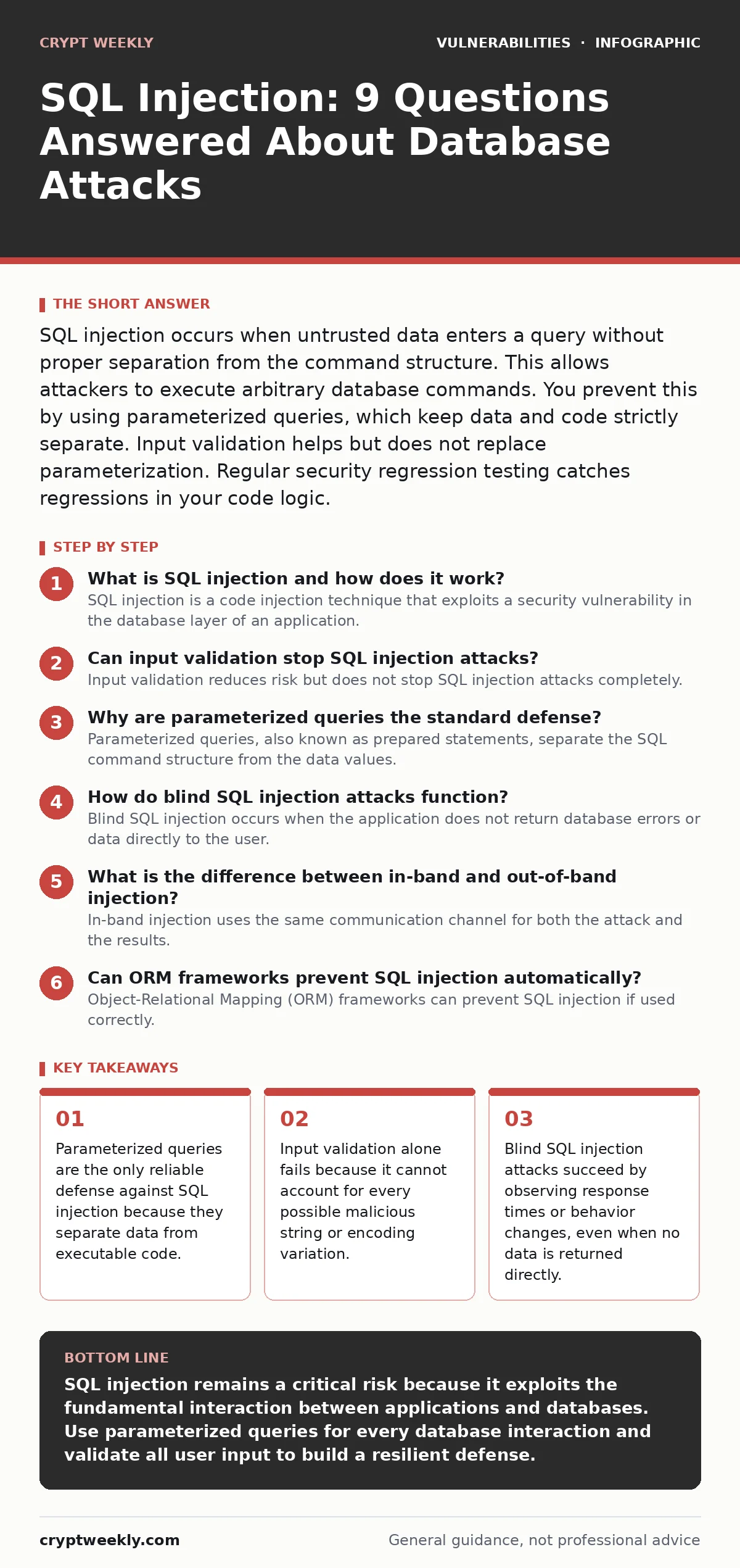
SQL injection occurs when untrusted data enters a query without proper separation from the command structure. This allows attackers to execute arbitrary database commands. You prevent this by using parameterized queries, which keep data and code strictly separate. Input validation helps but does not replace parameterization. Regular security regression testing catches regressions in your code logic.
What is SQL injection and how does it work?
SQL injection is a code injection technique that exploits a security vulnerability in the database layer of an application. The vulnerability exists when user input is incorrectly filtered for string literal escape characters embedded in SQL statements or when user input is not strongly typed and is unexpectedly executed. The attacker inserts or "injects" a SQL statement via the input data from the client program to the application. This causes the database to execute the attacker's command instead of the intended query. The database treats the injected text as part of the command structure, not as data.
Can input validation stop SQL injection attacks?
Input validation reduces risk but does not stop SQL injection attacks completely. Validation checks if input matches expected patterns, such as requiring only numbers for an age field. Attackers often bypass these checks using alternative encodings, Unicode tricks, or by finding edge cases your validation missed. Validation is a defense-in-depth measure, not a primary control. You must combine validation with parameterized queries. Relying solely on validation creates a false sense of security. See our guide on input validation for deeper strategies on filtering data before it reaches your backend.
Why are parameterized queries the standard defense?
Parameterized queries, also known as prepared statements, separate the SQL command structure from the data values. The database engine compiles the command structure first, then binds the data values as parameters. This ensures the data is never interpreted as executable code. Even if an attacker injects malicious SQL syntax, the database treats it as a literal string value. This mechanism works across all major database systems and programming languages. It eliminates the ambiguity that allows injection attacks to succeed. You should use parameterized queries for every database interaction.
How do blind SQL injection attacks function?
Blind SQL injection occurs when the application does not return database errors or data directly to the user. The attacker cannot see the results of their query in the page content. Instead, they infer information by observing changes in application behavior or response times. They might ask the database to wait for a specific number of seconds if a condition is true. This is called a time-based blind injection. The attacker builds the database structure bit by bit by asking yes-or-no questions through these timing differences. This method is slower but equally dangerous as it requires no visible output.
What is the difference between in-band and out-of-band injection?
In-band injection uses the same communication channel for both the attack and the results. The attacker sends the payload and receives the data or error messages directly in the HTTP response. Out-of-band injection uses a different channel for results. The attacker forces the database to send data to an external server they control. This might happen via DNS lookups or HTTP requests initiated by the database server. Out-of-band attacks are useful when the application filters or hides direct responses. They require the database to have network access to external systems.
Can ORM frameworks prevent SQL injection automatically?
Object-Relational Mapping (ORM) frameworks can prevent SQL injection if used correctly. ORMs generate parameterized queries behind the scenes when you use their standard query builders. However, many ORMs allow raw SQL execution for complex queries. If developers insert user input directly into these raw SQL strings, the protection is bypassed. The framework itself is not the vulnerability; the misuse of the framework is. You must audit how raw queries are constructed in your codebase. Assume the ORM provides no security unless you verify the query generation method.
How do you test for SQL injection vulnerabilities?
You test for SQL injection by sending crafted inputs to every parameter that interacts with the database. This includes URL parameters, form fields, headers, and cookies. Automated tools can scan for common patterns, but manual testing finds complex logic flaws. You should include SQL injection checks in your security regression testing suite. This ensures new code changes do not re-introduce old vulnerabilities. Penetration testing provides a deeper, expert-led assessment of your application's resilience. Regular testing catches issues before attackers do.
What are the real-world consequences of a successful attack?
A successful SQL injection attack can lead to full database compromise. Attackers can read sensitive information like credentials, personal data, and financial records. They can modify data, changing prices, balances, or user roles. In severe cases, they can delete entire tables or shut down the database service. Some databases allow operating system commands to be executed from within the database process. This turns a web vulnerability into a full system compromise. The impact extends beyond data loss to reputational damage and legal liability.
How do business logic flaws relate to SQL injection?
Business logic flaws and SQL injection are distinct but often coexist. SQL injection breaks the data boundary, while business logic flaws break the application's intended workflow. An attacker might use SQL injection to bypass authentication, which is a business logic failure. They might also exploit a logic flaw to access admin functions, then use SQL injection to exfiltrate data. You must secure both the data layer and the application logic. See our guide on business logic flaws to understand how attackers misuse intended features.
| Attack Type | Visibility | Detection Method | Primary Defense |
|---|---|---|---|
| In-band | High | Error messages or data in response | Parameterized queries |
| Blind | Low | Timing differences or behavior changes | Parameterized queries |
| Out-of-band | Medium | External server logs | Network restrictions |
What is the role of web application firewalls?
Web Application Firewalls (WAFs) act as a filter between the user and the application. They inspect incoming traffic for known attack patterns, including SQL injection signatures. A WAF can block obvious attacks before they reach your server. However, WAFs are not a complete solution. They can be bypassed by obfuscating the attack payload or using novel techniques. They also generate false positives, blocking legitimate users. Use a WAF as an additional layer, not a replacement for secure coding practices.
How do you fix legacy code with injection flaws?
Fixing legacy code requires refactoring database interactions to use parameterized queries. This can be difficult in large, older systems. Start by identifying all database query points. Replace string concatenation with parameter binding. If the framework does not support parameters, consider upgrading or wrapping the database calls in a secure layer. Document every change to prevent regression. Schedule regular code reviews focused on data handling. This process takes time but is necessary for long-term security.
What is the future of SQL injection prevention?
Static Application Security Testing (SAST) tools are becoming more accurate at detecting injection flaws in source code. These tools analyze code without executing it, finding potential vulnerabilities early in the development cycle. Developers are integrating these tools into their continuous integration pipelines. This shifts security left, catching issues before deployment. However, tools cannot replace human understanding of the application's context. You must interpret tool findings and verify them manually. The combination of automated tools and skilled developers provides the best protection.
How do you handle third-party components?
Third-party libraries and frameworks may contain SQL injection vulnerabilities. You must keep all dependencies updated to the latest secure versions. Monitor security advisories for the components you use. Conduct regular dependency audits. If a library is no longer maintained, consider replacing it. Vulnerabilities in third-party code are just as dangerous as those in your own code. Treat external dependencies with the same scrutiny as your internal logic.
Key takeaways
- Parameterized queries are the only reliable defense against SQL injection because they separate data from executable code.
- Input validation alone fails because it cannot account for every possible malicious string or encoding variation.
- Blind SQL injection attacks succeed by observing response times or behavior changes, even when no data is returned directly.
SQL injection remains a critical risk because it exploits the fundamental interaction between applications and databases. Use parameterized queries for every database interaction and validate all user input to build a resilient defense.
Frequently asked questions
Is SQL injection still common in modern applications?
Yes, SQL injection remains one of the most prevalent web application vulnerabilities. Many developers still use string concatenation for queries, and legacy systems continue to run without updates. It consistently appears in the OWASP Top 10 list of critical security risks.
Can NoSQL databases suffer from injection attacks?
Yes, NoSQL databases are vulnerable to a similar class of attacks called NoSQL injection. While the syntax differs from SQL, the core issue remains: untrusted data is executed as code. You must use parameterized queries or object mapping for NoSQL databases as well.
Does using HTTPS prevent SQL injection?
No, HTTPS encrypts data in transit but does not protect the application logic. SQL injection occurs when the application processes the decrypted data. Encryption ensures privacy during transmission, but it does not stop an attacker from sending malicious payloads to the server.
How do I report a SQL injection vulnerability responsibly?
Follow responsible disclosure practices by contacting the organization directly. Provide clear details on how to reproduce the issue without exploiting it further. Avoid public disclosure until a patch is available. This helps the organization fix the issue while protecting users from active exploitation.
How this guide was produced: written by the Crypt Weekly editorial team with AI assistance, checked against the public references listed below, and reviewed when the facts change. See our editorial policy or report an error.