
Penetration testing exposes hidden flaws by mimicking real attacks, revealing that security tools often miss logic errors that scripts cannot find.
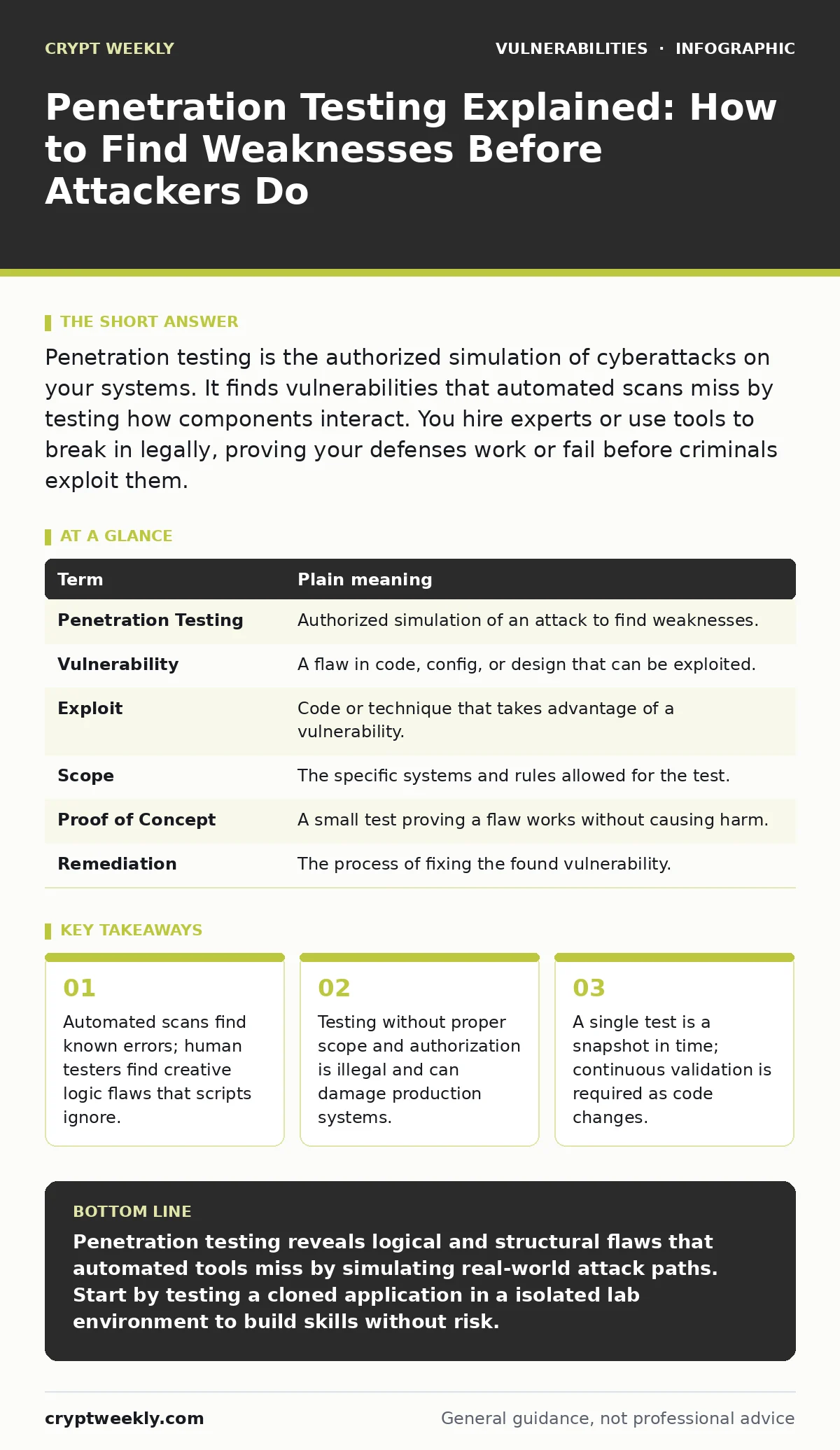
Penetration testing is the authorized simulation of cyberattacks on your systems. It finds vulnerabilities that automated scans miss by testing how components interact. You hire experts or use tools to break in legally, proving your defenses work or fail before criminals exploit them.
The Bank Vault Analogy
Imagine a bank vault. You have a heavy steel door, a complex combination lock, and armed guards. Most security checks look like a physical inspection. They verify the steel is thick and the guards are present. This is basic vulnerability scanning. It confirms the obvious defenses exist.
Penetration testing is different. It is like hiring a locksmith to try to open the vault. The locksmith does not just look at the door. They listen to the tumblers. They check if the window above the door is unlocked. They see if a guard can be distracted. They find ways in that the inspection missed. This analogy carries through every step of the process.
Defining the Core Terms
You need a shared vocabulary to understand how these tests work. The industry uses specific words that have precise meanings. Misunderstanding these terms leads to poor testing and false confidence.
| Term | Plain meaning |
|---|---|
| Penetration Testing | Authorized simulation of an attack to find weaknesses. |
| Vulnerability | A flaw in code, config, or design that can be exploited. |
| Exploit | Code or technique that takes advantage of a vulnerability. |
| Scope | The specific systems and rules allowed for the test. |
| Proof of Concept | A small test proving a flaw works without causing harm. |
| Remediation | The process of fixing the found vulnerability. |
Why Scans Fall Short
Automated tools are fast and cheap. They check for known signatures. They look for missing patches or default passwords. This is useful for basic hygiene. But they cannot understand context. They do not know if a feature is supposed to be there.
Consider a login page. A scanner sees the HTML form. It sends random characters to see if it crashes. A human tester asks why the page does not lock out after five failed attempts. This is a business logic flaw. It is not a coding error. It is a design choice. Automated tools rarely catch this. This is why you must combine scanning with manual testing.
The Hidden Cost of Testing
Testing is not free. It requires time and careful planning. If you test a live production system without permission, you might crash it. This is why scope is critical. You must define exactly what can be touched.
There is a hidden cost in trust. You are asking someone to break your system. If they fail to report a finding, or if they cause an outage, the impact is severe. You must vet testers carefully. You must have a rollback plan. Testing reveals truth, but truth can be expensive if you are not ready for it.
Practical Steps for Beginners
You do not need a huge budget to start. You can begin with small, controlled experiments. Here is how to take your first steps safely.
- Define a Narrow Scope: Choose one small application or server. Do not test your entire network. Write down exactly what is allowed and what is forbidden.
- Use a Lab Environment: Never test on live data. Clone your application to a separate machine. Break it there. This prevents accidental damage to users.
- Document Everything: Record every step you take. Note what worked and what failed. This document becomes your baseline for future tests.
See also: Public Key Cryptography Explained: How Digital Locks Work · Dependency Scanning Best Practices for Secure Software Supply Chains
Common Missteps to Avoid
Many beginners make the same errors. They focus too much on tools. They buy expensive software and think it does the work. It does not. The value is in the methodology.
Another mistake is assuming one test is enough. Your system changes daily. New code introduces new flaws. A test from six months ago is obsolete today. You must integrate testing into your development cycle. This is where patch testing and continuous integration help. You test every update before it goes live.
Beyond the Basics
As you grow, you will encounter more complex issues. You might look at API vulnerabilities. These are interfaces between software components. They often lack the security controls of the main application.
You will also see cross-site request forgery (CSRF). This tricks users into performing actions they did not intend. It is a logic flaw, not a code bug. Fuzz testing helps here. It sends random data to inputs to see if they break. This is different from standard scanning. It probes the boundaries of the system.
The Path Forward
Penetration testing is a discipline. It requires curiosity and caution. You are not just breaking things. You are learning how they work. This knowledge makes you a better defender.
Start small. Use legal targets. Document your findings. Over time, you will build a deeper understanding of security. You will move from following scripts to thinking like an attacker. This shift in mindset is the real value of the practice.
Key takeaways
- Automated scans find known errors; human testers find creative logic flaws that scripts ignore.
- Testing without proper scope and authorization is illegal and can damage production systems.
- A single test is a snapshot in time; continuous validation is required as code changes.
Penetration testing reveals logical and structural flaws that automated tools miss by simulating real-world attack paths. Start by testing a cloned application in a isolated lab environment to build skills without risk.
Frequently asked questions
Is penetration testing legal?
It is legal only with explicit, written permission from the system owner. Unauthorized testing is a criminal offense.
How often should I test?
Test after every major change or deployment. Continuous testing is better than annual reviews because threats evolve quickly.
Can I do this alone?
You can practice on your own systems or designated legal targets. For production systems, hire a qualified professional to avoid damage.
What is the difference between scanning and testing?
Scanning looks for known issues using automated tools. Testing involves manual exploration to find logic flaws and complex vulnerabilities.
How this guide was produced: written by the Crypt Weekly editorial team with AI assistance, checked against the public references listed below, and reviewed when the facts change. See our editorial policy or report an error.