
Penetration testing finds specific flaws in a limited scope, while red teaming simulates full adversary campaigns to test detection and response capabilities across the entire organization.
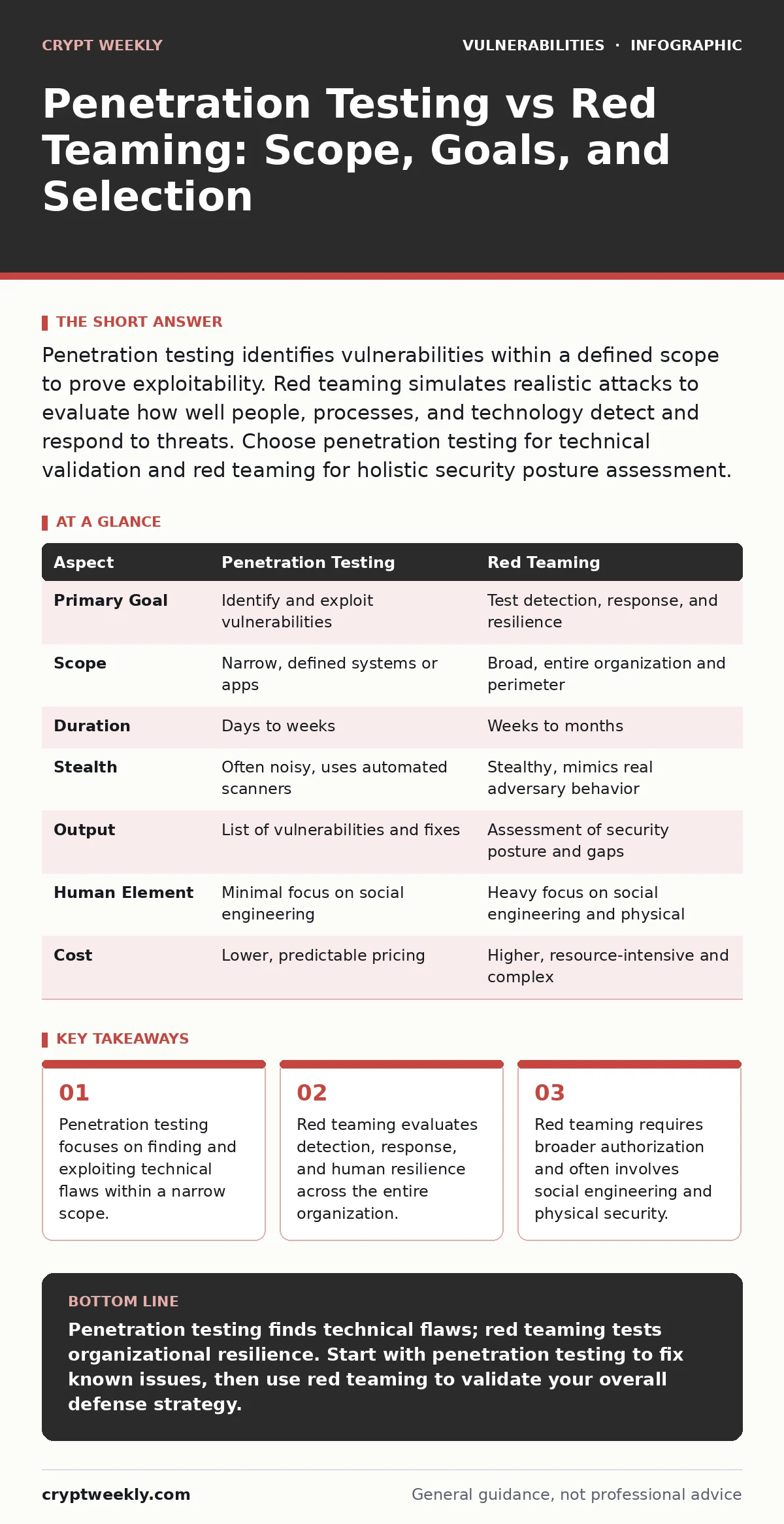
Penetration testing identifies vulnerabilities within a defined scope to prove exploitability. Red teaming simulates realistic attacks to evaluate how well people, processes, and technology detect and respond to threats. Choose penetration testing for technical validation and red teaming for holistic security posture assessment.
Penetration Testing vs Red Teaming: The Core Difference
Penetration testing vs red teaming represents a distinction between finding holes and testing the whole house. Penetration testing is a technical exercise aimed at identifying and exploiting vulnerabilities within a specific system or application. It answers whether a flaw exists and if an attacker can use it. Red teaming is a holistic simulation of an adversary campaign. It answers how well the organization detects, responds to, and recovers from an attack. One tests the lock; the other tests the alarm, the guards, and the police response.
What Is Penetration Testing?
Penetration testing, often called pentesting, involves authorized attempts to bypass security controls and gain unauthorized access. Testers use automated tools and manual techniques to find weaknesses. The scope is usually narrow, focusing on a single application, network segment, or service. The goal is to identify as many vulnerabilities as possible within the agreed timeframe.
Testers document each finding with proof of concept. They provide remediation advice for developers or system administrators. This process helps organizations prioritize fixes based on severity. It is a snapshot of security at a specific moment. It does not test how security operations center staff react to alerts. It focuses on the technical surface area defined in the rules of engagement.
What Is Red Teaming?
Red teaming simulates a realistic threat actor targeting the organization. The red team uses multiple attack vectors, including social engineering, physical intrusion, and network exploitation. The scope is broad, often covering the entire enterprise. The goal is not to find every flaw but to test the organization’s ability to detect and respond to a coordinated attack.
Red teams operate stealthily to avoid triggering alarms prematurely. They mimic the tactics, techniques, and procedures of real adversaries. This includes phishing employees to gain credentials or tailgating into secure facilities. The exercise evaluates the effectiveness of security controls, incident response plans, and employee awareness. It reveals gaps in the defense-in-depth strategy that technical scans might miss.
Point-by-Point Comparison
| Aspect | Penetration Testing | Red Teaming |
|---|---|---|
| Primary Goal | Identify and exploit vulnerabilities | Test detection, response, and resilience |
| Scope | Narrow, defined systems or apps | Broad, entire organization and perimeter |
| Duration | Days to weeks | Weeks to months |
| Stealth | Often noisy, uses automated scanners | Stealthy, mimics real adversary behavior |
| Output | List of vulnerabilities and fixes | Assessment of security posture and gaps |
| Human Element | Minimal focus on social engineering | Heavy focus on social engineering and physical |
| Cost | Lower, predictable pricing | Higher, resource-intensive and complex |
When to Choose Penetration Testing
Choose penetration testing when you need to validate the security of a specific asset. It is ideal for new application releases before deployment. It helps verify that previous fixes have resolved known issues. This approach aligns with security regression testing to ensure new code does not introduce old flaws.
You should use penetration testing to meet compliance requirements. Many standards require regular testing of critical systems. It provides a clear list of technical debts. It is cost-effective for routine checks. It helps developers understand input validation failures and other common coding errors. It is the right choice when you need a detailed technical report for remediation teams.
See also: Prevent Cisco IOS XE Vulnerabilities: A Practical Defense Plan · How Bug Bounty Programs Work: Mechanisms, Limits and Behind-the-Scenes Reality
When to Choose Red Teaming
Choose red teaming when you need to assess the overall effectiveness of your security program. It reveals how well different security layers work together. It tests the incident response team’s ability to detect and contain threats. It evaluates whether security awareness training is effective against social engineering.
Red teaming is valuable before major organizational changes. It helps identify blind spots in monitoring and logging. It simulates the persistence of advanced persistent threats. It tests physical security controls alongside digital defenses. This approach provides a realistic view of your organization’s resilience. It is the right choice when you need to improve your detection and response capabilities.
Where They Overlap
Both methods require explicit authorization. Both aim to improve security by simulating attacks. Both provide insights into weaknesses. However, they serve different purposes. Penetration testing is a tool for fixing technical flaws. Red teaming is a tool for improving organizational resilience.
Imagine you fix a door lock. Penetration testing confirms the lock is strong. Red teaming checks if someone can trick the guard into opening the door. You need both to be secure. One does not replace the other. They complement each other in a mature security program.
Related Security Practices
Understanding these tests helps contextualize other security efforts. For example, SQL injection is a common target for penetration testers. They check if applications properly sanitize database queries. API vulnerabilities are another frequent target, as APIs often expose sensitive data.
Business logic flaws are harder to find with automated tools. They require manual analysis, often during penetration testing. Responsible disclosure is the process of reporting found vulnerabilities to vendors. It is a key part of ethical hacking. OWASP Top 10 lists the most critical web application security risks. Both pentesters and red teams use this list as a reference.
Key takeaways
- Penetration testing focuses on finding and exploiting technical flaws within a narrow scope.
- Red teaming evaluates detection, response, and human resilience across the entire organization.
- Red teaming requires broader authorization and often involves social engineering and physical security.
Penetration testing finds technical flaws; red teaming tests organizational resilience. Start with penetration testing to fix known issues, then use red teaming to validate your overall defense strategy.
Frequently asked questions
Can I do penetration testing and red teaming at the same time?
It is possible but not recommended. The different goals and scopes can cause confusion and conflict. Separate them to get clear, actionable results from each exercise.
How long does a red team exercise take?
Red teaming takes longer than penetration testing. It often lasts several weeks or months to simulate a realistic attack campaign and gather sufficient data on detection and response.
Do I need a red team if I have a strong firewall?
Yes. Firewalls only protect the perimeter. Red teaming tests internal defenses, human factors, and incident response. A strong firewall does not prevent social engineering or insider threats.
Is penetration testing legal?
Yes, if you have written authorization. Unauthorized testing is illegal. Always sign a contract that defines the scope, rules of engagement, and liability before starting any test.
How this guide was produced: written by the Crypt Weekly editorial team with AI assistance, checked against the public references listed below, and reviewed when the facts change. See our editorial policy or report an error.