
Attackers bypass traditional security perimeters by exploiting logic flaws in application programming interfaces rather than brute-forcing network defenses.
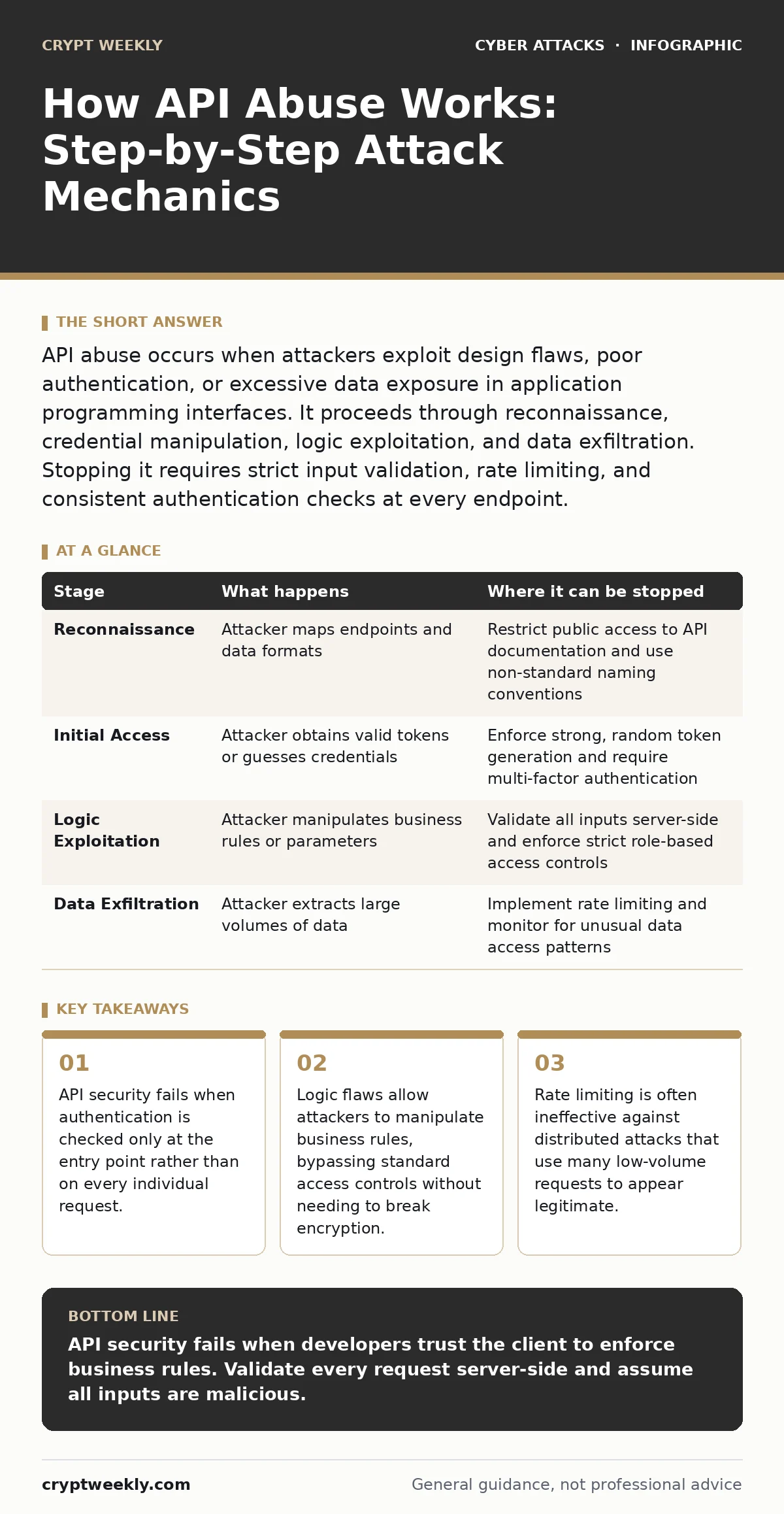
API abuse occurs when attackers exploit design flaws, poor authentication, or excessive data exposure in application programming interfaces. It proceeds through reconnaissance, credential manipulation, logic exploitation, and data exfiltration. Stopping it requires strict input validation, rate limiting, and consistent authentication checks at every endpoint.
Reconnaissance and Endpoint Discovery
Application programming interfaces, or APIs, are the bridges that allow different software systems to communicate. Unlike a website with a visible interface, an API often exposes endpoints that are not immediately obvious to casual users. Attackers begin by mapping these hidden doors. They use automated tools to scan for common API structures, such as REST or GraphQL patterns. They look for documentation that developers may have left publicly accessible. This phase relies on the assumption that obscurity provides security. It rarely does.
The attacker identifies which endpoints accept data and which return sensitive information. They note the format of the data, such as JSON or XML. They observe how the system responds to errors, which can reveal internal structure. This mapping creates a blueprint for the next phase. Without this map, the attacker is shooting in the dark. With it, they can target specific weaknesses.
Stage 1: Initial Access and Credential Manipulation
Once the endpoints are mapped, the attacker attempts to gain authorized access. They do not always need to steal a password. They may find that the API accepts authentication tokens that are weak or predictable. Suppose an API uses a session ID that increments by one for each new user. The attacker can simply guess the next valid ID. This is a logic flaw, not a cryptographic break.
Another common method is credential stuffing. The attacker takes usernames and passwords leaked from other breaches and tests them against the API. APIs often lack the multi-factor authentication barriers that web login forms have. If the API accepts a password hash instead of the raw password, the attacker can use precomputed tables to reverse them. This stage exploits the gap between how users log in and how the backend verifies identity.
| Stage | What happens | Where it can be stopped |
|---|---|---|
| Reconnaissance | Attacker maps endpoints and data formats | Restrict public access to API documentation and use non-standard naming conventions |
| Initial Access | Attacker obtains valid tokens or guesses credentials | Enforce strong, random token generation and require multi-factor authentication |
| Logic Exploitation | Attacker manipulates business rules or parameters | Validate all inputs server-side and enforce strict role-based access controls |
| Data Exfiltration | Attacker extracts large volumes of data | Implement rate limiting and monitor for unusual data access patterns |
Breaking Business Logic Rules
Most security tools focus on syntax. They check if data looks like a valid email or a safe number. They rarely check if the action makes sense in the context of the business. This is where API abuse thrives. The attacker now has valid access. They begin to manipulate the parameters of their requests.
Imagine an e-commerce API that allows a user to apply a discount code. The parameter might be discount_id=5. The API processes the request because the syntax is correct. The business logic fails to verify that the user is authorized to use that specific code. This is known as Broken Object Level Authorization. It occurs when the API trusts the client to specify the resource ID without verifying ownership.
The attacker may also manipulate quantities. They change a purchase quantity from one to negative one. The system might process this as a credit, effectively paying the attacker. These flaws exist because the developer assumed the front-end interface would prevent such changes. The API must enforce its own rules, independent of the client.
Escalation and Lateral Movement
With initial logic flaws exploited, the attacker seeks to expand their reach. They look for endpoints that allow privilege escalation. This might involve finding an endpoint that updates user roles. If the API allows a standard user to send a request that changes their own role to "admin," the game is over. The attacker now has full control.
They may also use the API to interact with other services. Suppose the API connects to a payment gateway. The attacker finds a way to bypass payment verification procedures by manipulating the status field in the response. They mark a transaction as "completed" without the payment actually clearing. This lateral movement exploits the trust between internal services. The API acts as a relay, passing malicious commands to other systems that assume the API has already validated them.
This stage is dangerous because it often leaves no trace in traditional firewalls. The traffic looks like normal business operations. The packets are encrypted. The ports are open. The only anomaly is the sequence of logic, which is hard to detect in real-time.
Data Exfiltration and Persistence
The final stage is the removal of valuable data. The attacker uses the compromised access to download customer lists, financial records, or intellectual property. They do this slowly to avoid detection. They might request one record at a time, spaced out over hours. This technique, known as low-and-slow exfiltration, mimics legitimate user behavior.
The attacker may also establish persistence. They create a new admin account that they control. This ensures that even if the original vulnerability is patched, they still have access. They might modify the API code itself if they have write access. This turns the API into a backdoor. The goal is to maintain access long enough to cause maximum damage or to sell the data.
Interrupting the Attack Chain
Stopping API abuse requires shifting focus from perimeter defense to application logic. You must assume that the network is already compromised. Every request must be treated as hostile. This means validating every parameter, every header, and every payload.
Implement strict role-based access control. Ensure that a user can only access resources they own or are explicitly permitted to view. This prevents account takeover from leading to widespread data theft. Monitor for unusual patterns in API usage. Look for users accessing data they never viewed before. Look for rapid succession of requests that differ slightly in parameters.
Use automated testing to find logic flaws. Traditional scanning tools miss business logic errors. You need tests that simulate real user workflows and then break them. Check for IDORs, mass assignment, and constraint violations. Regularly review API documentation and deprecate unused endpoints. Every open endpoint is a potential entry point.
See also: OAuth Consent Phishing: How Attackers Bypass Login Screens · Social Engineering Risks and Protection for Small Businesses
The Hidden Cost of Convenience
API abuse is often a byproduct of convenience. Developers prioritize speed and functionality over security. They assume that if the data is encrypted, it is safe. They forget that the application must decide who sees the decrypted data. This misconception leads to widespread vulnerabilities.
The cost of fixing these flaws is high because they are deeply embedded in the business logic. You cannot patch a logic flaw with a simple update. You must rewrite how the application thinks. This requires a cultural shift in how software is built. Security must be part of the design, not an afterthought.
Related threats like supply chain attacks can also introduce API vulnerabilities. If a third-party library has a flaw, your API inherits it. You must monitor your dependencies closely. Similarly, attackers may use phishing to obtain the credentials needed to start the API abuse chain. Defending against API abuse requires a holistic view of security. It is not just about the code. It is about the people and processes behind it.
Key takeaways
- API security fails when authentication is checked only at the entry point rather than on every individual request.
- Logic flaws allow attackers to manipulate business rules, bypassing standard access controls without needing to break encryption.
- Rate limiting is often ineffective against distributed attacks that use many low-volume requests to appear legitimate.
API security fails when developers trust the client to enforce business rules. Validate every request server-side and assume all inputs are malicious.
Frequently asked questions
Can a firewall stop API abuse?
No, firewalls filter network traffic based on ports and protocols. They cannot inspect the business logic or semantic meaning of API requests, allowing malicious but syntactically correct traffic to pass.
What is the difference between API abuse and a traditional hack?
Traditional hacks often exploit software bugs or brute-force passwords. API abuse exploits design flaws and logical errors in how the application processes requests, often using valid credentials.
How do I find API logic flaws?
Use dynamic application security testing tools that simulate user workflows. Manually review code for authorization checks and test parameter manipulation to see if business rules can be bypassed.
Is rate limiting enough to prevent API abuse?
No, rate limiting only controls the volume of requests. It does not validate the content or logic of those requests. Attackers can stay under rate limits while performing damaging actions.
How this guide was produced: written by the Crypt Weekly editorial team with AI assistance, checked against the public references listed below, and reviewed when the facts change. See our editorial policy or report an error.