
Verification fails when it relies on a single channel, allowing attackers to bypass security by exploiting the gap between identity and transaction.
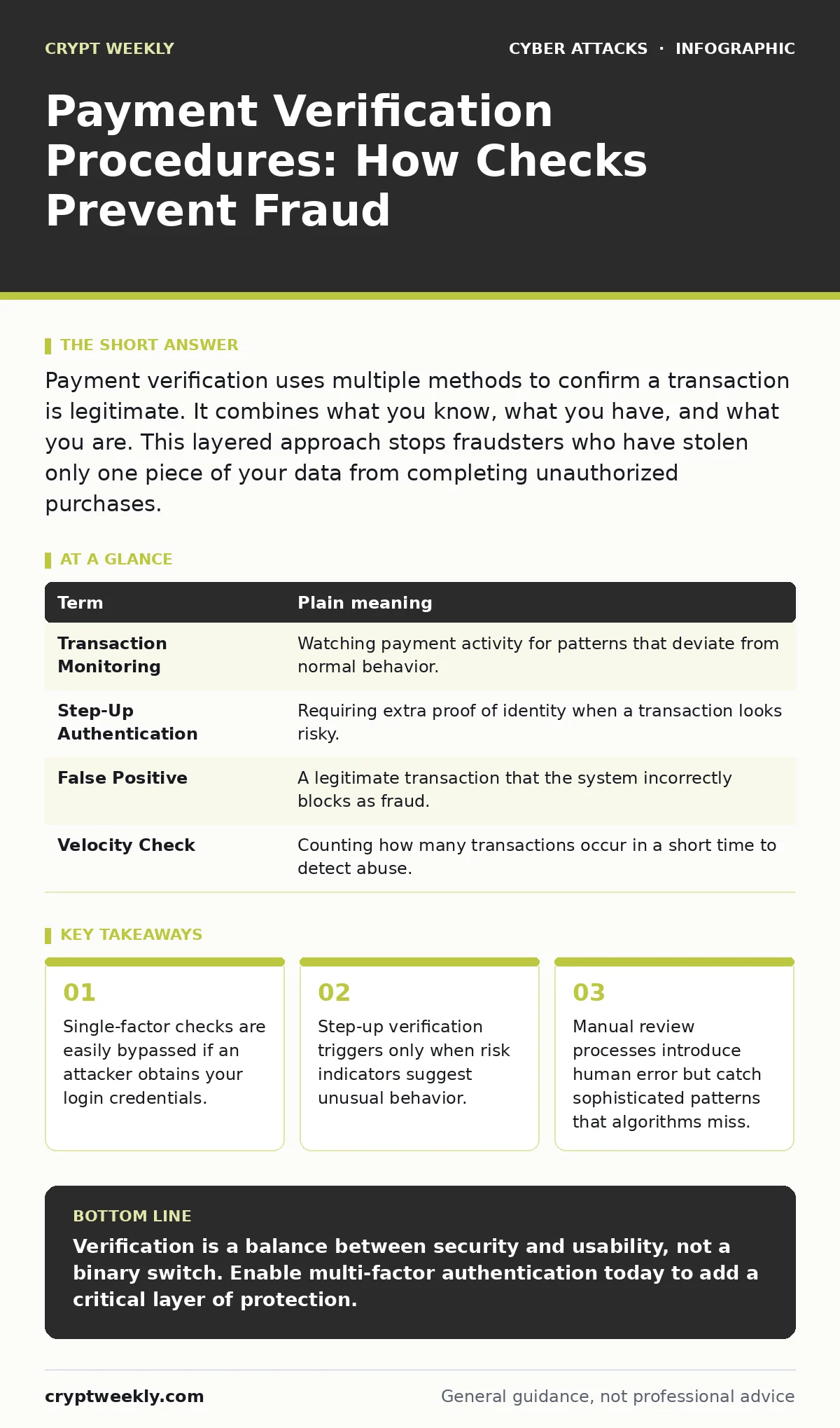
Payment verification uses multiple methods to confirm a transaction is legitimate. It combines what you know, what you have, and what you are. This layered approach stops fraudsters who have stolen only one piece of your data from completing unauthorized purchases.
The Library Book Analogy
Imagine a library that allows anyone to borrow books. The librarian checks if the person standing in front of them matches the name on the card. This is basic identification. Now imagine a thief steals a library card. They can still borrow books because the name matches. The system failed to verify that the person holding the card is the rightful owner. Payment systems face this exact problem every day. They must distinguish between a legitimate user and an impostor holding valid credentials.
The Core Mechanism of Trust
Verification is the process of confirming that a claim is true. In payments, the claim is that the person requesting money is who they say they are. Systems use factors to build this trust. Knowledge factors are secrets only you know, like a password. Possession factors are items you hold, like a phone or token. Inherence factors are biological traits, like a fingerprint. Relying on just one factor is weak. Attackers can steal knowledge through phishing or clone possession devices. Combining factors raises the difficulty for the attacker significantly.
When Automation Fails
Automated systems use rules to approve or decline transactions instantly. They check the card number, the location, and the amount. If everything looks normal, the payment goes through. If something looks odd, the system flags it. This is where account takeover becomes a risk. If an attacker changes your address and billing details before making a purchase, the automated check sees a consistent profile. The system trusts the data because it is internally consistent, even if it is fraudulent. This is why static rules are not enough.
| Term | Plain meaning |
|---|---|
| Transaction Monitoring | Watching payment activity for patterns that deviate from normal behavior. |
| Step-Up Authentication | Requiring extra proof of identity when a transaction looks risky. |
| False Positive | A legitimate transaction that the system incorrectly blocks as fraud. |
| Velocity Check | Counting how many transactions occur in a short time to detect abuse. |
The Cost of Friction
Every extra check you perform adds friction. If a system asks for too much proof too often, you will stop using it. Users abandon carts when verification is too difficult. This is the hidden cost of security. Businesses must balance protection against user experience. If they lean too far toward security, they lose customers. If they lean too far toward ease, they lose money to fraud. This balance is never static. It shifts as attackers find new ways to bypass controls.
Human Review and Error
When automation flags a transaction, a human often reviews it. This step catches complex fraud that algorithms miss. However, humans are tired, bored, and prone to bias. A reviewer might approve a fraudulent payment because it looks similar to previous legitimate ones. This is known as fatigue-based error. Shoulder surfing can also compromise this step if attackers observe the review process in physical offices. Digital reviews are safer but still subject to social engineering attacks like vishing, where callers trick staff into bypassing checks.
See also: Social Engineering Risks and Protection for Small Businesses
Detecting Pattern Drift
Attackers do not always strike randomly. They often test small amounts first. This is called card testing. They buy low-cost digital goods to see if the card works. Once confirmed, they make large purchases. Velocity checks help here by counting transactions. If you buy five items in one minute, the system pauses. But attackers use botnets to spread these tests across many cards. This mimics normal traffic. API abuse can also occur when attackers exploit the interface between systems to flood verification endpoints.
First Practical Step
You can improve your personal verification posture immediately. Do not rely on the same password for every financial account. Use a password manager to generate unique, complex passwords. This ensures that a breach in one place does not compromise your other accounts. Enable multi-factor authentication where available. Prefer app-based codes over SMS, as SMS can be intercepted through SIM swapping. This simple change adds a possession factor to your knowledge factor.
Building Resilience
No single method stops all fraud. You need layers. Firewalls block unauthorized network access, but they do not stop an attacker who has valid login credentials. DNS amplification attacks can disrupt services, causing verification systems to fail. When systems fail, fallback procedures must be in place. Ensure you know how to contact your bank directly if your card is blocked unexpectedly. Do not rely solely on the support channel provided in the transaction error message, as attackers can spoof these messages.
- Enable multi-factor authentication on all financial accounts.
- Review transaction alerts immediately to catch errors early.
- Use unique passwords for each account to limit breach impact.
Key takeaways
- Single-factor checks are easily bypassed if an attacker obtains your login credentials.
- Step-up verification triggers only when risk indicators suggest unusual behavior.
- Manual review processes introduce human error but catch sophisticated patterns that algorithms miss.
Verification is a balance between security and usability, not a binary switch. Enable multi-factor authentication today to add a critical layer of protection.
Frequently asked questions
Why does my bank ask for more details sometimes?
Your bank uses risk scoring. Unusual patterns trigger extra checks to ensure you are the account holder.
Is multi-factor authentication enough to stop all fraud?
No, it significantly reduces risk but does not stop social engineering or compromised devices.
What should I do if a payment is declined incorrectly?
Contact your bank directly through their official website or app to verify your identity and restore access.
Can attackers bypass step-up authentication?
Yes, if they have compromised your device or can answer security questions through social engineering.
How this guide was produced: written by the Crypt Weekly editorial team with AI assistance, checked against the public references listed below, and reviewed when the facts change. See our editorial policy or report an error.