
Regulatory approval does not equal security validation, and air-gapping fails when maintenance staff connect diagnostic tools to the network.
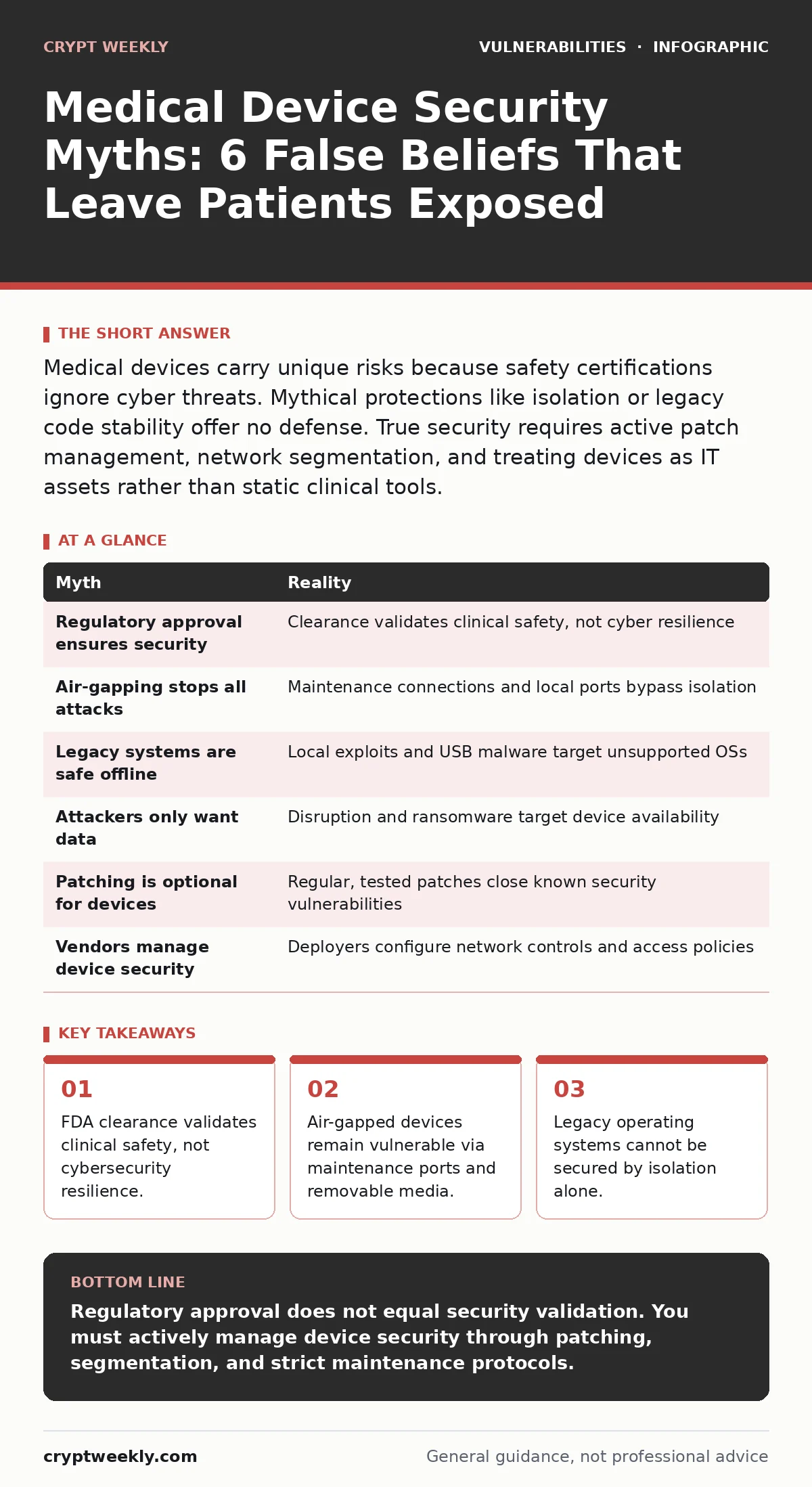
Medical devices carry unique risks because safety certifications ignore cyber threats. Mythical protections like isolation or legacy code stability offer no defense. True security requires active patch management, network segmentation, and treating devices as IT assets rather than static clinical tools.
Myth: Regulatory approval means the device is secure
Reality: Regulatory bodies like the FDA evaluate clinical safety and efficacy, not cybersecurity resilience. A device can receive clearance while containing known vulnerabilities in its embedded software. Manufacturers often submit security documentation, but regulators do not perform independent penetration testing. The approval process confirms the device works as intended for patient care.
It does not verify that the device resists unauthorized access or data exfiltration. You must assume every approved device has unpatched flaws. Treating regulatory clearance as a security badge creates a false sense of safety. The device functions correctly in a sterile lab environment, but that does not mean it survives a hostile network. You need to verify security posture independently of the approval status.
Myth: Air-gapping medical devices prevents all attacks
Reality: Physical isolation fails when maintenance personnel connect laptops for diagnostics or software updates. Attackers exploit these transient connections to bridge the gap between isolated and connected networks. Diagnostic ports often lack authentication, allowing direct code execution on the device. Suppose a technician plugs a compromised laptop into a patient monitor to check battery status.
The monitor’s firmware may trust the connection implicitly. Malware transfers silently across that single cable. The device is no longer air-gapped for the duration of the session. You cannot rely on physical separation if human workflows require external connections. Network segmentation must account for maintenance access patterns, not just permanent wiring. Isolation is a policy, not a physical state.
Myth: Legacy operating systems are safe because they are offline
Reality: Legacy systems run code that is no longer maintained or patched by vendors. Vulnerabilities in these systems remain exploitable regardless of network connectivity. Local attacks, such as USB-based malware or malicious firmware updates, bypass network defenses entirely. An attacker does not need remote access to compromise a device running an unsupported OS.
They only need physical proximity or access to the maintenance interface. The age of the operating system dictates its vulnerability surface, not its network position. You cannot secure a system by ignoring its software foundation. Running outdated code invites exploitation through any available entry point. The risk accumulates with every unpatched day.
Myth: Patient data is the only thing attackers want
Reality: Attackers target device functionality to cause physical harm or disrupt care. Ransomware groups encrypt imaging servers to halt hospital operations. They demand payment to restore access to critical equipment like ventilators or infusion pumps. Disruption creates immediate financial and reputational pressure on healthcare providers.
This motive is more urgent than data theft. You must protect the availability and integrity of the device, not just the confidentiality of the data. A compromised device can deliver incorrect doses or fail to alert staff to critical changes. The threat model includes sabotage, not just espionage. Securing the device means ensuring it continues to function correctly under attack.
Myth: Medical devices do not need regular patching
Reality: Medical devices require rigorous patch management, just like any other IT asset. Vendors release security updates to fix discovered vulnerabilities. Delaying patches leaves known flaws open to exploitation. However, patching medical devices carries higher stakes than patching a web server. A failed update can render a device unusable, impacting patient care.
You must validate patches in a test environment before deployment. This process is known as patch testing. It ensures the update does not break critical functionality. Skipping patches saves time but increases risk exponentially. You balance operational stability against security exposure. Regular, tested updates are the only way to close known security gaps.
See also: Patch Testing: How to Verify Fixes Without Breaking Your Systems
Myth: Third-party vendors handle all security responsibilities
Reality: Manufacturers provide the device, but the deploying organization manages its operational security. Vendors cannot control how the device is configured on your network. They cannot enforce network segmentation or monitor for anomalous traffic. You are responsible for configuring access controls, segmenting the device from general IT, and monitoring its behavior.
The vendor’s security model assumes a baseline of operational hygiene that you must provide. Shifting blame to the manufacturer is a common but dangerous mistake. You must define security boundaries in your environment. The device is a component of your larger infrastructure. Its security depends on your configuration choices.
| Myth | Reality |
|---|---|
| Regulatory approval ensures security | Clearance validates clinical safety, not cyber resilience |
| Air-gapping stops all attacks | Maintenance connections and local ports bypass isolation |
| Legacy systems are safe offline | Local exploits and USB malware target unsupported OSs |
| Attackers only want data | Disruption and ransomware target device availability |
| Patching is optional for devices | Regular, tested patches close known security vulnerabilities |
| Vendors manage device security | Deployers configure network controls and access policies |
Key takeaways
- FDA clearance validates clinical safety, not cybersecurity resilience.
- Air-gapped devices remain vulnerable via maintenance ports and removable media.
- Legacy operating systems cannot be secured by isolation alone.
Regulatory approval does not equal security validation. You must actively manage device security through patching, segmentation, and strict maintenance protocols.
Frequently asked questions
How do I test patches for medical devices safely?
Use a dedicated test environment that mirrors production. Apply patches and verify clinical functionality before deploying to live devices. This process is similar to security regression testing.
Can side-channel attacks affect medical devices?
Yes, devices with cryptographic modules can leak information through power consumption or timing. These physical leaks bypass traditional software defenses.
What is responsible disclosure in this context?
It is the practice of reporting vulnerabilities to vendors privately before public release. This allows them to issue patches without exposing users to immediate risk.
Do container escape vulnerabilities apply to medical devices?
Some modern devices use containerized applications. If the container runtime is misconfigured, attackers can escape to the host OS, gaining full control.
How this guide was produced: written by the Crypt Weekly editorial team with AI assistance, checked against the public references listed below, and reviewed when the facts change. See our editorial policy or report an error.