
Compiler flags and static analysis catch most null pointer dereferences before runtime, but they miss logic errors that require defensive programming patterns.
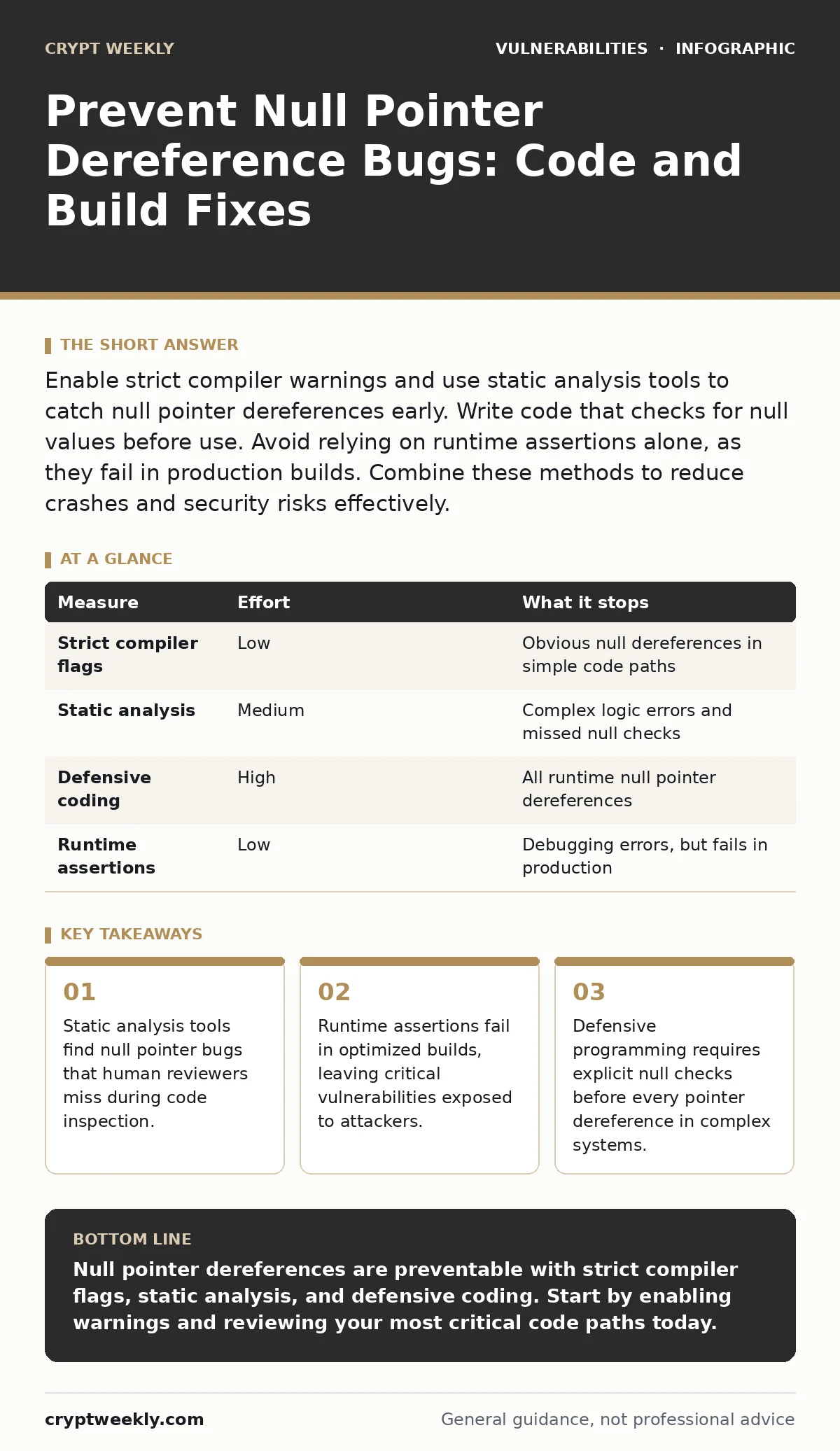
Enable strict compiler warnings and use static analysis tools to catch null pointer dereferences early. Write code that checks for null values before use. Avoid relying on runtime assertions alone, as they fail in production builds. Combine these methods to reduce crashes and security risks effectively.
Why Null Pointer Dereferences Matter
Null pointer dereference occurs when code tries to access memory through a pointer that holds no valid address. This usually happens when a function returns null to indicate failure, but the calling code ignores that signal. The result is a crash or undefined behavior. Attackers exploit this to execute arbitrary code or cause denial of service. You must treat every pointer as potentially null until proven otherwise.
Imagine a web server that loads user data. If the database query fails, it returns null. The server then tries to read the user ID from that null object. The server crashes. An attacker can trigger this crash repeatedly to make the service unavailable. This is a common vector for denial of service attacks.
Priority One: Compiler Warnings and Flags
Your first line of defense is your compiler. Modern compilers can detect many null pointer dereferences at compile time. You must enable strict warning flags. For C and C++, enable all warnings and treat warnings as errors. This stops the build if the compiler suspects a null dereference. It forces you to fix the issue immediately.
This method catches obvious mistakes, like dereferencing a variable immediately after checking it for null. It does not catch logical errors where null is possible later in the execution flow. You still need to write careful code. But this removes the low-hanging fruit with zero runtime cost. It is the easiest win for any development team.
| Measure | Effort | What it stops |
|---|---|---|
| Strict compiler flags | Low | Obvious null dereferences in simple code paths |
| Static analysis | Medium | Complex logic errors and missed null checks |
| Defensive coding | High | All runtime null pointer dereferences |
| Runtime assertions | Low | Debugging errors, but fails in production |
Priority Two: Static Analysis Tools
Static analysis tools examine your code without running it. They model the flow of data and check for potential null dereferences. These tools are better than compilers at understanding complex logic. They can trace a null value from a function return through multiple layers of abstraction. You should integrate these tools into your continuous integration pipeline.
These tools reduce false positives over time as you tune them. They catch bugs that human reviewers miss because they are tedious to find. They also enforce consistency across large codebases. You do not need to trust every developer to remember every null check. The tool reminds you. This is especially useful for large teams or legacy codebases where documentation is sparse.
Priority Three: Defensive Programming Patterns
Defensive programming means assuming failure. You must check for null before every pointer dereference. This is the only way to guarantee safety in production. Write code that handles the null case gracefully. Return an error code or a default value. Do not crash. This requires discipline and consistent coding standards.
Consider a function that parses a configuration file. If the file is missing, the parser returns null. The calling function must check for null before accessing the configuration fields. If it does not, the program crashes. By adding a null check, you turn a crash into a handled error. This prevents denial of service and makes debugging easier. It also clarifies the contract between functions.
What Does Not Work: Runtime Assertions
Many developers use runtime assertions to catch null pointers. An assertion checks a condition and aborts the program if it is false. This works in debug builds. It fails in production builds. Optimized builds often disable assertions to improve performance. This leaves your production code vulnerable to null dereferences.
Assertions are for catching programming errors during development. They are not for handling runtime failures. You should not use assertions to validate input from users or external systems. Those inputs are unpredictable. You must use explicit null checks for those cases. Assertions give a false sense of security. They do not prevent crashes in production.
See also: How Container Escape Vulnerabilities Work: A Step-by-Step Breakdown
Edge Cases and Hidden Costs
Null pointer dereferences are not just about crashes. They can lead to security vulnerabilities. An attacker might control the null pointer to redirect execution. This is rare but possible in complex systems. You must consider the security implications of every null check.
Imagine a system that uses function pointers. If a function pointer is null, calling it crashes. But if an attacker can set that pointer to a valid but malicious address, they can execute arbitrary code. This is a type of control flow hijacking. You must validate function pointers just like data pointers. This adds complexity but prevents severe security breaches.
Another hidden cost is performance. Checking every pointer for null adds overhead. In tight loops, this can be significant. You must balance safety and performance. Use compiler hints to tell the optimizer that certain pointers are never null. This allows the compiler to remove redundant checks. But you must be certain of the assumption. Incorrect assumptions lead to bugs.
Integrating with Other Security Practices
Preventing null pointer dereferences is part of a broader security strategy. You should combine these measures with other practices. For example, dependency scanning helps identify libraries with known null pointer bugs. You cannot fix bugs in third-party code, but you can avoid using vulnerable versions. This reduces your attack surface.
Similarly, responsible disclosure helps you learn about new vulnerabilities. When a researcher finds a null pointer bug in your software, they report it. You patch it before attackers exploit it. This requires a clear process for handling reports. You must have a way to receive, triage, and fix vulnerabilities quickly. This is especially important for widely used software.
Closing Checklist for Today
You can start preventing null pointer dereferences today. Follow these three steps. First, enable strict compiler warnings and treat them as errors. Second, integrate a static analysis tool into your build process. Third, review your critical code paths for missing null checks. Fix any you find. This simple routine reduces your risk significantly.
- Enable strict compiler warnings and treat them as errors.
- Integrate a static analysis tool into your continuous integration pipeline.
- Review critical code paths and add explicit null checks where missing.
Key takeaways
- Static analysis tools find null pointer bugs that human reviewers miss during code inspection.
- Runtime assertions fail in optimized builds, leaving critical vulnerabilities exposed to attackers.
- Defensive programming requires explicit null checks before every pointer dereference in complex systems.
Null pointer dereferences are preventable with strict compiler flags, static analysis, and defensive coding. Start by enabling warnings and reviewing your most critical code paths today.
Frequently asked questions
Do modern languages like Java prevent null pointer exceptions?
Modern languages catch null pointer exceptions at runtime, but they do not prevent the logic error. You still need to check for null to avoid crashes and security issues.
Can static analysis tools replace code reviews?
No, static analysis tools complement code reviews. They catch technical errors, but humans understand intent and design. Both are necessary for high-quality software.
How do I handle null pointers in C++?
Use explicit null checks before dereferencing. Consider using smart pointers like unique_ptr or shared_ptr to manage memory and reduce null pointer risks.
Is it safe to ignore null pointer warnings?
No, ignoring null pointer warnings increases the risk of crashes and security vulnerabilities. You should fix every warning to ensure code reliability.
How this guide was produced: written by the Crypt Weekly editorial team with AI assistance, checked against the public references listed below, and reviewed when the facts change. See our editorial policy or report an error.