
A logic bomb sits dormant in your system until a specific condition triggers it, bypassing traditional defenses that scan for active threats rather than waiting for conditions.
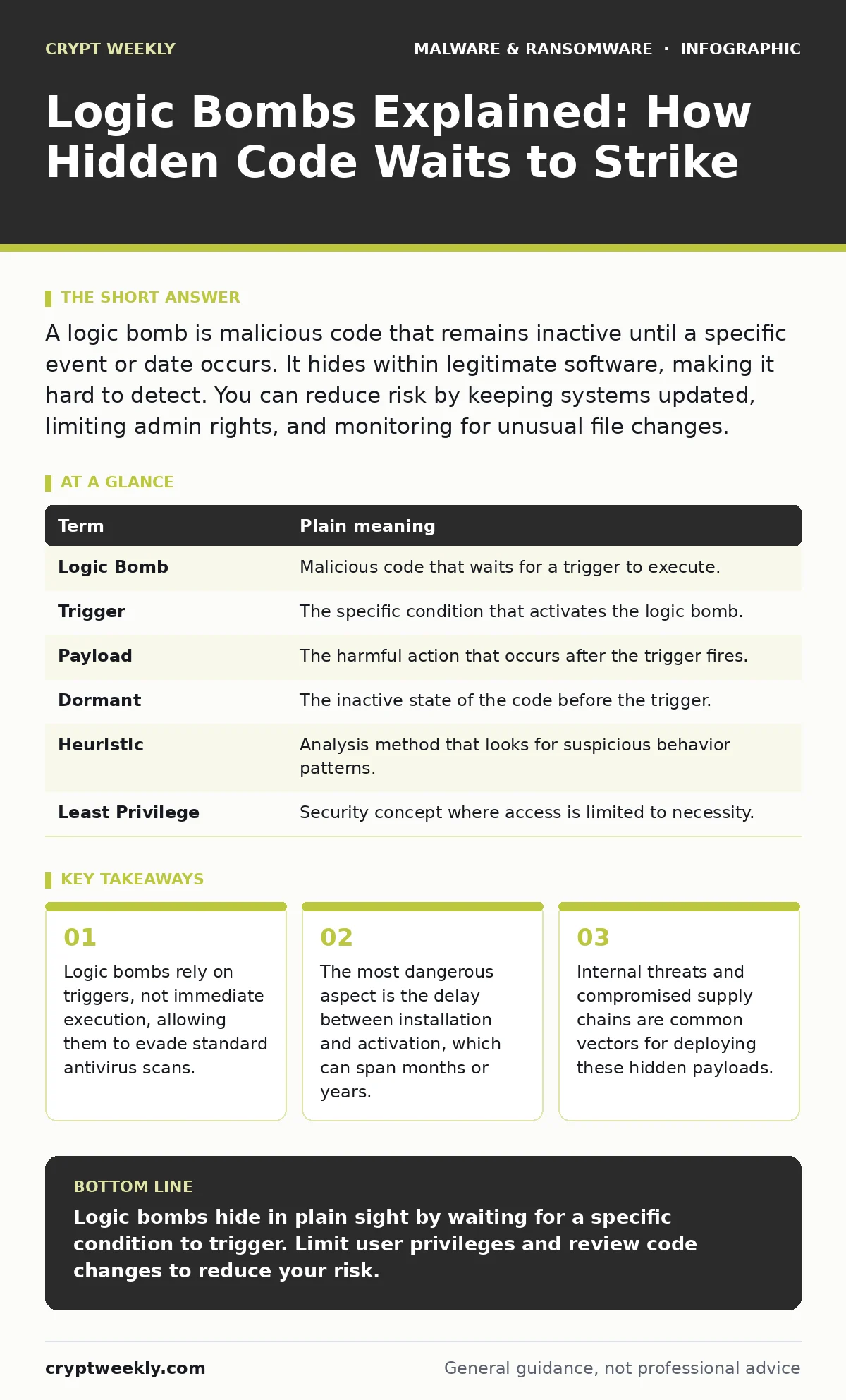
A logic bomb is malicious code that remains inactive until a specific event or date occurs. It hides within legitimate software, making it hard to detect. You can reduce risk by keeping systems updated, limiting admin rights, and monitoring for unusual file changes.
The Time Bomb in Your Software
Imagine you find a vending machine that works perfectly. You insert coins, press buttons, and receive snacks. One day, the machine stops giving snacks and starts eating your coins. You did not break it. It was built that way from the start, programmed to change behavior only after a certain number of sales.
A logic bomb operates on this exact principle. It is a piece of code inserted into a software program that lies dormant until a specific condition is met. Unlike a virus that spreads immediately, a logic bomb waits. It might wait for a specific date, a particular user login, or the deletion of a file.
This delay is its greatest strength. Security tools often look for active malicious behavior. If the code is sleeping, it looks like normal data. By the time the trigger fires, the damage is already done.
How the Trigger Mechanism Works
The core of a logic bomb is the trigger. This is the "if" statement in the code. The developer defines a condition that must be true before the payload executes. Common triggers include dates, times, or system states.
Suppose an employee is disgruntled. They insert code that checks the system date. If the date is after their termination date, the code deletes a specific database table. Until that day arrives, the code sits quietly in the application.
Another example involves system resources. A bomb might activate only when CPU usage drops below a certain threshold, ensuring it runs when no one is actively using the system. This stealth approach makes detection difficult because the code performs no harmful actions during its dormant phase.
The Role of Internal Access
Logic bombs rarely come from external hackers breaking through firewalls. They usually require someone with the ability to modify code or system configurations. This makes internal access a primary vector.
Developers, system administrators, or even contractors with write access can insert these triggers. They have the credentials to embed the code into legitimate updates or maintenance scripts. Because they have authorized access, their actions often bypass standard security alerts.
This is why trust is a security vulnerability. Just because someone has a badge or an account does not mean their intentions are benign. The threat often comes from people who already have the keys to the kingdom.
Supply Chain as a Vector
You do not need to trust the person writing the code. You only need to trust the package manager you use. If a developer includes a third-party library in their project, they inherit that library’s code.
If a malicious actor compromises a popular library, they can insert a logic bomb. Every application that uses that library now contains the bomb. The bomb might trigger when the application reaches a certain number of users or when a specific server responds.
This is why understanding the ransomware attack chain is relevant. The initial compromise might happen far upstream, in a repository you never directly interact with. The bomb travels through the supply chain, hidden in plain sight.
Detection Challenges and Limits
Traditional antivirus software scans for known signatures of malware. A logic bomb often lacks these signatures because the code is custom-written for a specific target. It looks like standard programming logic until the trigger fires.
Heuristic analysis, which looks for suspicious behavior, also struggles. The code is not behaving suspiciously; it is waiting. It does not connect to command-and-control servers or encrypt files until the condition is met.
This is where application allowlisting becomes valuable. By only allowing approved applications to run, you reduce the surface area for unauthorized code execution. However, if the logic bomb is inside an allowed application, allowlisting alone will not stop it.
See also: 7 Mistakes That Leave You Open to Malware Droppers and Loaders · Sandboxing Misconceptions: What Static Analysis Actually Misses
Simple Safety Habits
You cannot scan for intent, but you can limit the damage. Start by enforcing the principle of least privilege. Users and processes should only have the access they strictly need. If a logic bomb triggers, it can only do what the user account is allowed to do.
Second, implement strict change management. Every change to production code or system configurations should be reviewed. This includes updates from third parties. Do not assume malicious npm packages are the only risk; any dependency can carry a bomb.
Third, monitor for anomalies. Look for files that change unexpectedly or processes that run at odd times. While you might not catch the bomb before it triggers, you can catch the aftermath faster.
| Term | Plain meaning |
|---|---|
| Logic Bomb | Malicious code that waits for a trigger to execute. |
| Trigger | The specific condition that activates the logic bomb. |
| Payload | The harmful action that occurs after the trigger fires. |
| Dormant | The inactive state of the code before the trigger. |
| Heuristic | Analysis method that looks for suspicious behavior patterns. |
| Least Privilege | Security concept where access is limited to necessity. |
Practical Steps for Protection
- Audit Dependencies: Regularly review the third-party libraries and tools your systems use. Remove anything that is no longer needed.
- Restrict Admin Rights: Ensure that only a small number of trusted individuals have administrative access. This limits who can plant a bomb in the first place.
- Monitor File Integrity: Use tools that alert you when critical system files are changed. This helps detect the planting of the code, not just its execution.
Consider how macro security settings protect you from immediate threats in documents. A logic bomb is the opposite: it waits. Your defenses must account for both immediate execution and delayed triggers.
Key takeaways
- Logic bombs rely on triggers, not immediate execution, allowing them to evade standard antivirus scans.
- The most dangerous aspect is the delay between installation and activation, which can span months or years.
- Internal threats and compromised supply chains are common vectors for deploying these hidden payloads.
Logic bombs hide in plain sight by waiting for a specific condition to trigger. Limit user privileges and review code changes to reduce your risk.
Frequently asked questions
Can antivirus software detect a logic bomb?
Standard antivirus often misses logic bombs because they appear as normal code until the trigger fires. Specialized behavior monitoring is more effective.
How do I know if my system has a logic bomb?
You usually do not know until the trigger fires. Look for unexplained file changes or code that performs no visible function.
Are logic bombs only used by hackers?
No, disgruntled employees or insiders are common sources. Anyone with write access to code can insert a trigger.
Does deleting unused files help?
Yes, reducing the amount of code and files on your system reduces the places a logic bomb can hide.
How this guide was produced: written by the Crypt Weekly editorial team with AI assistance, checked against the public references listed below, and reviewed when the facts change. See our editorial policy or report an error.