
Endpoint detection stops threats that traditional signature scanning misses, but it requires configuration changes that most small teams overlook during deployment.
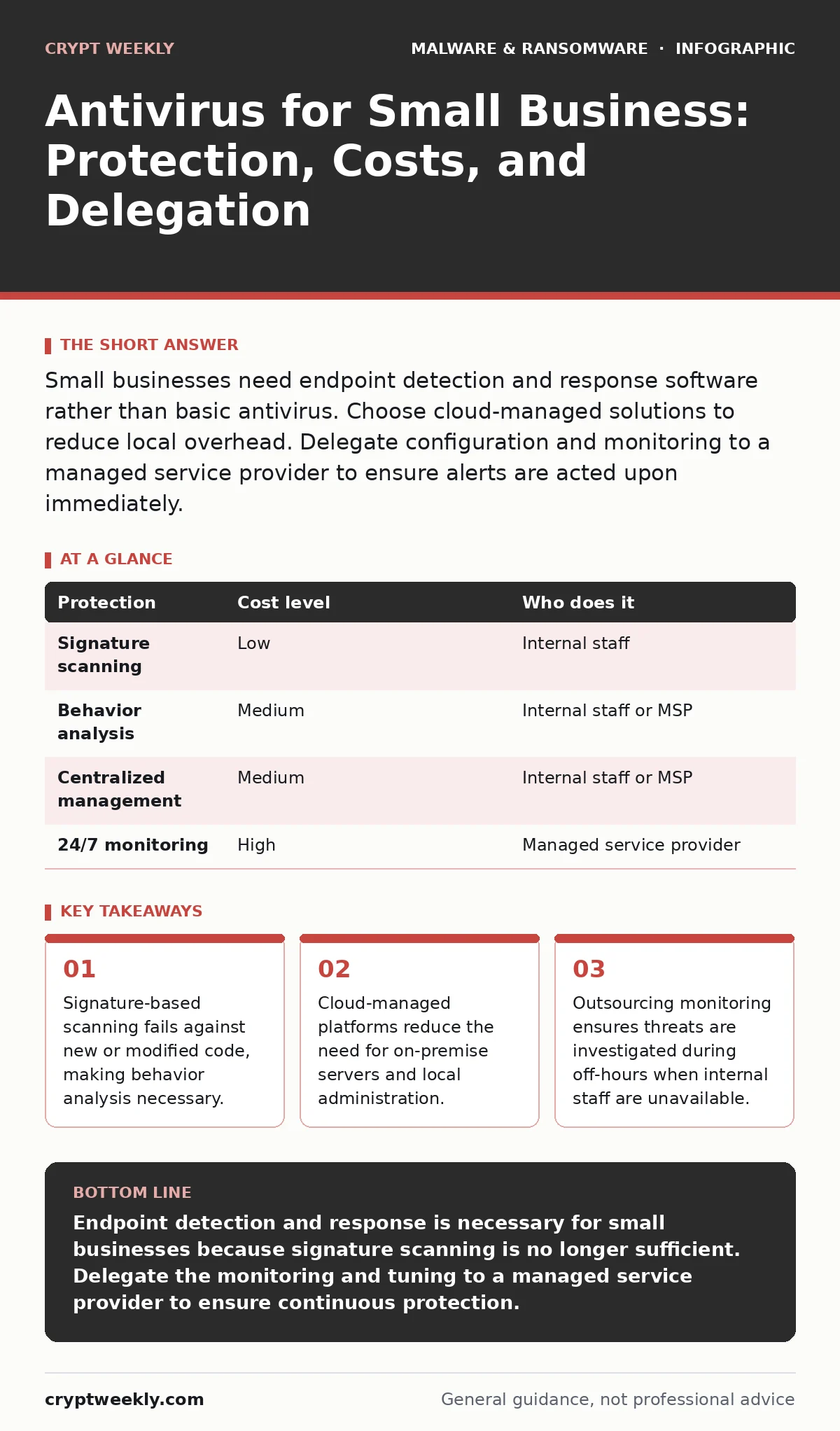
Small businesses need endpoint detection and response software rather than basic antivirus. Choose cloud-managed solutions to reduce local overhead. Delegate configuration and monitoring to a managed service provider to ensure alerts are acted upon immediately.
The Limit of Traditional Scanning
Traditional antivirus software works by comparing files against a database of known bad signatures. This method is fast but reactive. It only catches threats that have already been identified and cataloged. For a small business, this creates a dangerous blind spot. Attackers often modify their code slightly to create a variant that does not match any existing signature. This technique allows the malware to bypass the scanner entirely.
You need a solution that looks at behavior rather than just identity. Endpoint detection and response monitors system actions for suspicious patterns. It checks if a process is trying to encrypt files rapidly or if a script is executing unusual commands. This approach catches new threats that have no historical signature. It also identifies legitimate software that has been compromised or used in an unexpected way.
Cost Structures for Small Teams
Budget constraints often lead small businesses to choose free or cheap consumer-grade antivirus. This is a false economy. Consumer products lack centralized management, meaning you must update and configure each device individually. They also lack the logging depth needed to investigate an incident. The cost of a single hour of downtime or data loss far exceeds the price of professional software.
Affordable professional solutions often use a subscription model based on the number of devices. This spreads the cost predictably. Cloud-managed platforms are particularly effective for small teams. They host the management console online, removing the need for expensive on-premise servers. This reduces both hardware costs and the maintenance burden on your IT staff.
| Protection | Cost level | Who does it |
|---|---|---|
| Signature scanning | Low | Internal staff |
| Behavior analysis | Medium | Internal staff or MSP |
| Centralized management | Medium | Internal staff or MSP |
| 24/7 monitoring | High | Managed service provider |
The Hidden Cost of Management
Installing the software is only the first step. The real work lies in tuning the system. Every endpoint detection tool generates alerts. Many of these are false positives, where normal activity looks suspicious. If you do not tune the system, your team will ignore all alerts due to fatigue. This is known as alert fatigue. It renders the security tool useless because real threats get buried in noise.
Tuning requires time and expertise. You must review logs to distinguish between a software update and a malicious script. For a small business without a dedicated security analyst, this is nearly impossible. The hidden cost is not the software license; it is the labor required to make the software effective. Ignoring this leads to a false sense of security. You have the tool, but you do not have the insight.
Delegating to Managed Providers
Most small businesses should delegate the monitoring and tuning of endpoint detection to a managed service provider. These providers specialize in security operations. They have analysts who review alerts around the clock. They also have the expertise to tune the system for your specific environment, reducing false positives. This allows your internal staff to focus on core business tasks rather than chasing false alarms.
When selecting a provider, look for one that uses a standardized framework. This ensures their processes are consistent and auditable. Ask about their response time for critical alerts. Do not accept vague promises of "prompt" action. You need specific timeframes for containment and remediation. This clarity ensures that a threat is neutralized before it can spread across your network.
- Does the provider offer 24/7 monitoring?
- What is the average response time for critical incidents?
- How do they handle false positive tuning?
- Do they provide regular reports on threat activity?
- What is the process for off-hours emergencies?
Integrating with Other Defenses
Endpoint detection does not work in isolation. It must be part of a broader security strategy. For example, if an employee clicks a link in a malicious document, the endpoint tool may catch the resulting payload. However, preventing the click in the first place is more effective. Understanding macro security settings helps reduce the risk of initial infection. Similarly, awareness of the ransomware attack chain helps you identify where your defenses are weakest.
You should also consider the source of your software. If you use development tools, you must be aware of risks like malicious npm packages. These can introduce vulnerabilities before your endpoint tools even engage. A layered approach ensures that if one defense fails, another catches the threat. This redundancy is critical for maintaining business continuity.
See also: Application Allowlisting Best Practices for Secure Systems · Family Password Managers for Small Business Teams and Safety
Preparing for the Inevitable Breach
No security measure is perfect. You must assume that some threats will bypass your defenses. This is why ransomware backups are a non-negotiable requirement. Backups must be offline or immutable, meaning they cannot be altered or deleted by ransomware. Regular testing of your ransomware recovery plans ensures that you can restore data quickly. Without this preparation, even the best endpoint detection cannot save your business from a catastrophic loss.
The Role of User Behavior
Technology alone cannot stop every attack. Social engineering remains a primary vector for malware. Users who understand the risks can act as an additional layer of defense. Training should focus on recognizing suspicious emails and links. It should also cover the proper handling of unexpected files. However, training is not a substitute for technical controls. It reduces risk but does not eliminate it.
Browser hijackers and SEO poisoning are other vectors that target users directly. These attacks manipulate search results to lead users to malicious sites. Endpoint tools may not catch the initial navigation, but they can detect the malicious scripts that load on the page. Combining user education with technical controls provides the best protection against these evolving threats.
Key takeaways
- Signature-based scanning fails against new or modified code, making behavior analysis necessary.
- Cloud-managed platforms reduce the need for on-premise servers and local administration.
- Outsourcing monitoring ensures threats are investigated during off-hours when internal staff are unavailable.
Endpoint detection and response is necessary for small businesses because signature scanning is no longer sufficient. Delegate the monitoring and tuning to a managed service provider to ensure continuous protection.
Frequently asked questions
Can I use free antivirus for my small business?
No, free antivirus lacks centralized management and advanced behavior analysis. It leaves your business vulnerable to new and targeted threats.
How do I know if my endpoint detection is working?
Review your alert logs and run simulated tests. If you are not receiving alerts for known malicious behavior, the system is misconfigured.
What is the difference between antivirus and EDR?
Antivirus uses signatures to block known threats. EDR uses behavior analysis to detect and respond to unknown or modified threats in real time.
Do I need an on-premise server for endpoint management?
No, cloud-managed platforms allow you to monitor and manage devices from anywhere without maintaining local server infrastructure.
How this guide was produced: written by the Crypt Weekly editorial team with AI assistance, checked against the public references listed below, and reviewed when the facts change. See our editorial policy or report an error.