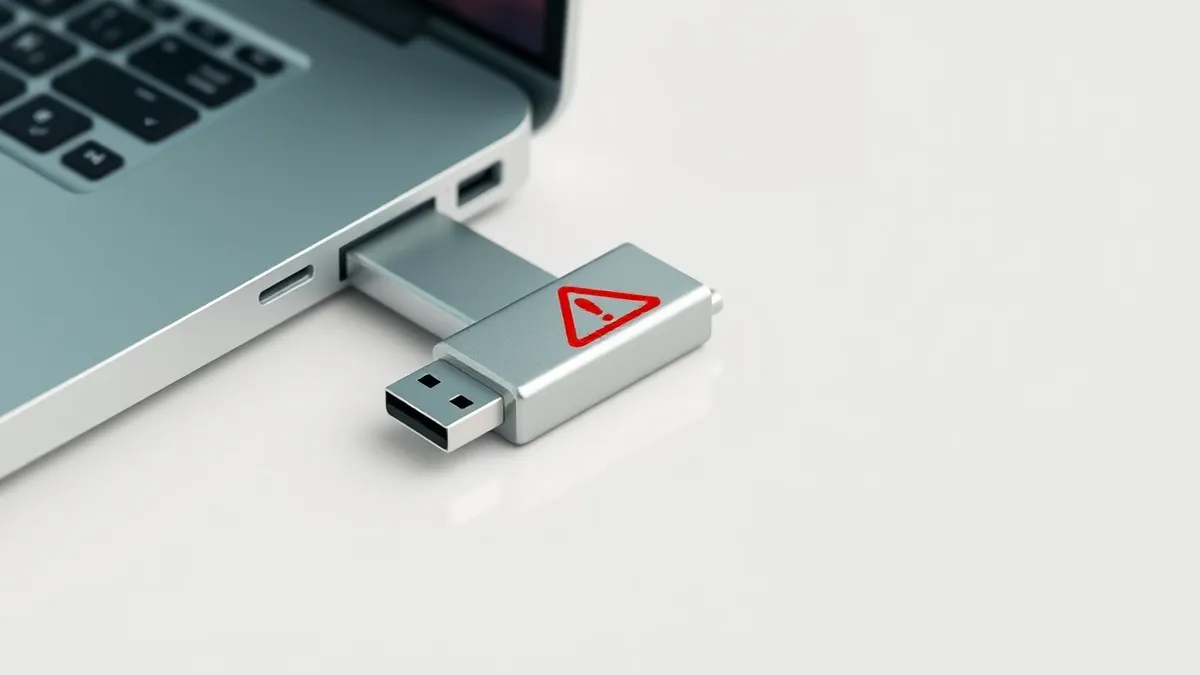
Universal Serial Bus thumb drives bypass network perimeter defenses by executing code directly on host operating systems.
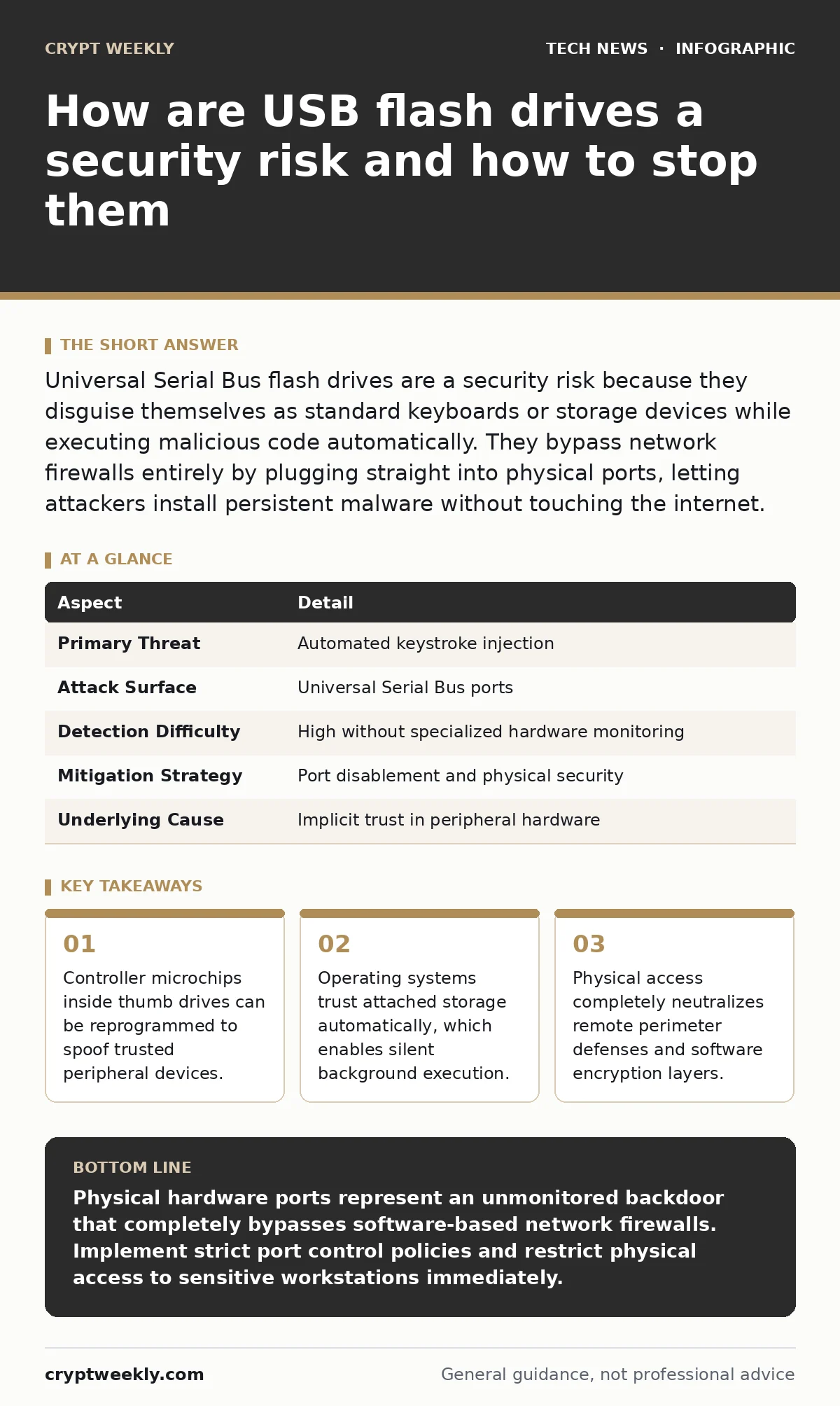
Universal Serial Bus flash drives are a security risk because they disguise themselves as standard keyboards or storage devices while executing malicious code automatically. They bypass network firewalls entirely by plugging straight into physical ports, letting attackers install persistent malware without touching the internet.
How USB flash drives bridge the air gap
Universal Serial Bus flash drives are portable storage devices that connect computers to removable memory chips. They pose a security risk because they operate on a universal plug-and-play standard that automatically trusts connected hardware.
Imagine an adversary leaving a branded thumb drive in a corporate parking lot hoping an employee plugs it into a workstation.
Hardware trust is the core vulnerability of every physical port on a modern computer. Host operating systems assume that any device plugged into a Universal Serial Bus port is safe to interact with.
Firmware residing on the thumb drive controller chip dictates how the device identifies itself to the host computer. A malicious controller can lie to the operating system, claiming to be a keyboard instead of a storage unit.
Typing speed generated by a rogue keyboard device happens faster than human capability, entering complex command strings in milliseconds.
This automatic execution bypasses traditional network monitoring tools because no malicious data packets cross an external network connection.
At a glance: The physical vector
| Aspect | Detail |
|---|---|
| Primary Threat | Automated keystroke injection |
| Attack Surface | Universal Serial Bus ports |
| Detection Difficulty | High without specialized hardware monitoring |
| Mitigation Strategy | Port disablement and physical security |
| Underlying Cause | Implicit trust in peripheral hardware |
How bad actors weaponize thumb memory
Adversaries rewrite the internal firmware of cheap flash memory chips to change device enumeration profiles. Enumeration is the initial negotiation process where a host computer asks an attached peripheral what capabilities it possesses.
Once the computer believes a trusted keyboard is attached, the device floods the active terminal session with administrative commands. These commands download secondary payloads from external servers or disable local defense mechanisms.
Physical insertion requires zero exploitation of software bugs or memory corruption vulnerabilities. The operating system performs the exact actions the malicious hardware requests because the protocol demands obedience from attached peripherals.
Users often assume that formatting a drive or deleting visible files removes all malicious potential from the hardware.
Hidden partitions and altered controller firmware persist long past simple file deletions or quick disk formatting procedures.
Who gets affected by removable media attacks
Office workers, industrial control operators, and traveling professionals face constant exposure to compromised portable media left in public spaces. Critical infrastructure environments face severe danger because isolated control systems rely heavily on physical media for routine software updates.
When a machine lacks an internet connection, technicians frequently use thumb drives to transfer configuration files and diagnostic patches.
This operational necessity creates an inviting bridge across isolation boundaries that would otherwise protect sensitive industrial hardware from external interference.
Supply chain compromises occur long before an employee finds a drive in a parking lot or receives one at a trade show.
Manufacturing facilities that produce cheap promotional storage devices can have malicious payloads injected directly into controller chips during assembly.
What people usually get wrong about USB security
Many administrators rely on endpoint detection software to catch malicious files moving through removable storage interfaces. This defense fails completely when hardware emulates a human interface device instead of presenting a traditional file system.
Antivirus scanners look for malicious binary files stored on the memory sectors of a thumb drive.
Keystroke injection attacks contain zero files to scan because the commands are typed directly into the active graphical user interface.
Another frequent misunderstanding involves trusting drives purchased brand new from mainstream consumer retail storefronts rather than unverified sources.
See also: Application Allowlisting Best Practices for Secure Systems · Antivirus for Small Business: Protection, Costs, and Delegation
What to do about hardware risk
Disabling physical ports via group policy or hardware modifications remains the single most effective defense against unauthorized media. Modern endpoint management platforms let administrators restrict port usage to authorized enterprise devices while blocking unapproved storage.
When physical transfer of data is unavoidable, dedicated kiosk stations should scan media in an isolated environment before connection to production networks.
These inspection stations verify file integrity and check for anomalous controller behavior before granting access to internal resources.
Proper device management often intersects with broader infrastructure hardening efforts, much like maintaining strict control over Domain Name System integrity across an enterprise network.
Organizations must treat every external hardware interface as an untrusted boundary requiring explicit verification.
Key takeaways
- Controller microchips inside thumb drives can be reprogrammed to spoof trusted peripheral devices.
- Operating systems trust attached storage automatically, which enables silent background execution.
- Physical access completely neutralizes remote perimeter defenses and software encryption layers.
Physical hardware ports represent an unmonitored backdoor that completely bypasses software-based network firewalls. Implement strict port control policies and restrict physical access to sensitive workstations immediately.
Frequently asked questions
Can antivirus software block a bad USB attack?
Traditional antivirus software cannot block these attacks because keyboard emulation tools do not store malicious files on the disk for scanners to analyze.
Why do operating systems trust external thumb drives automatically?
Operating systems are designed for universal plug-and-play compatibility, requiring immediate hardware functionality without user friction.
How do forensic investigators detect modified controller chips?
Investigators inspect device enumeration logs and use specialized hardware analysis tools to compare actual controller firmware against factory specifications.
Are enterprise-grade encrypted thumb drives completely safe to use?
Hardware encryption protects the confidentiality of stored data files, but it does not prevent a modified controller from executing keystroke injection attacks.
How this guide was produced: written by the Crypt Weekly editorial team with AI assistance, checked against the public references listed below, and reviewed when the facts change. See our editorial policy or report an error.