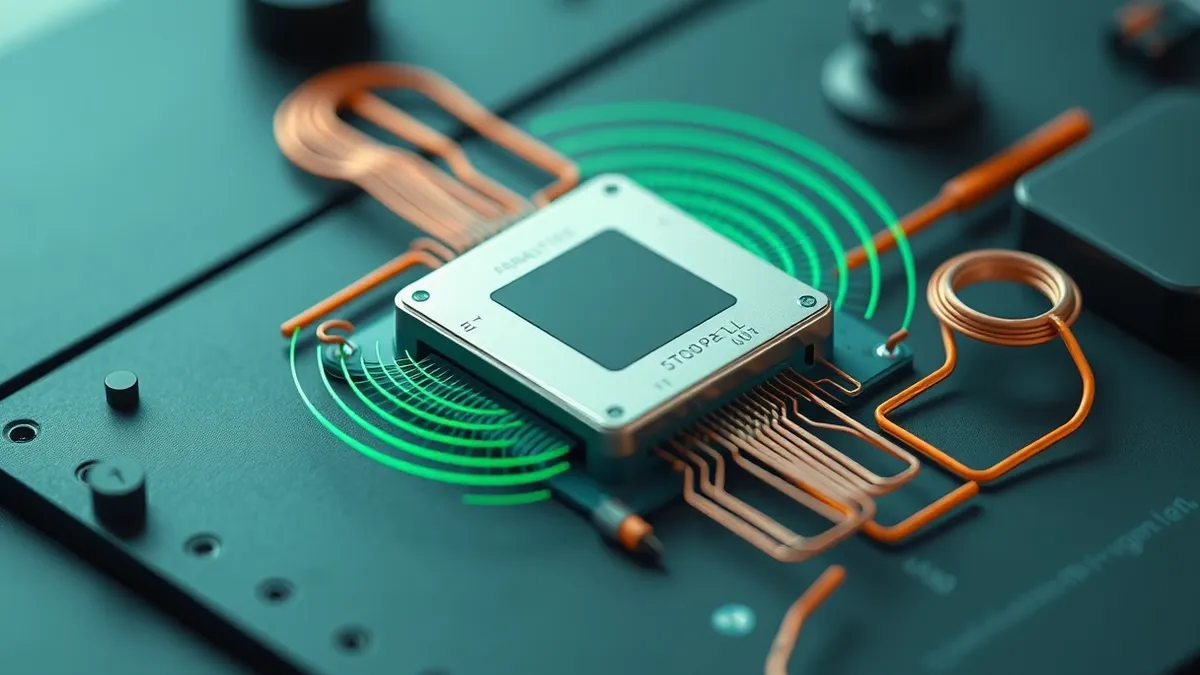
Side channels bypass mathematical cryptography by measuring physical emissions like power draw, heat, or electromagnetic radiation during data processing.
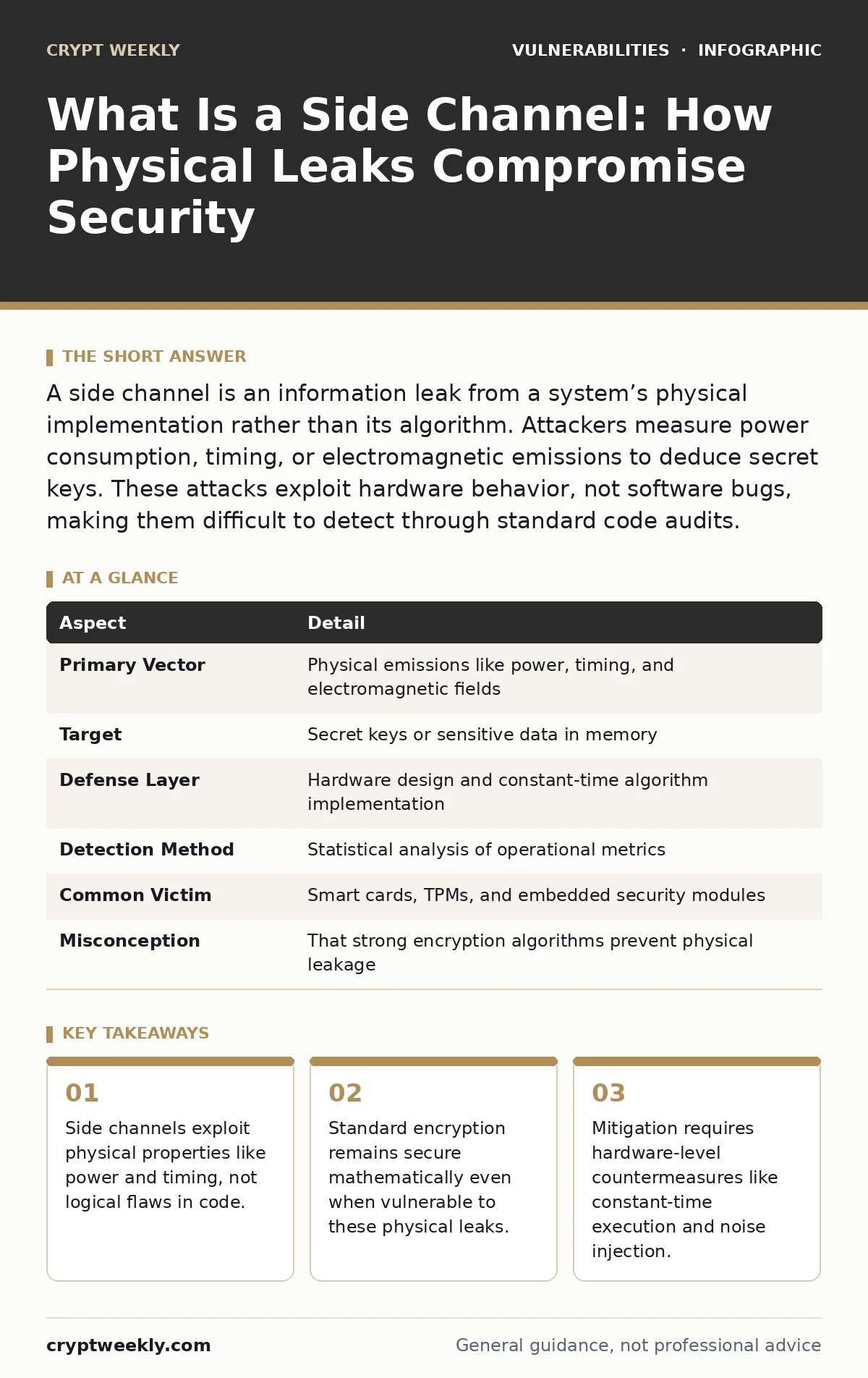
A side channel is an information leak from a system’s physical implementation rather than its algorithm. Attackers measure power consumption, timing, or electromagnetic emissions to deduce secret keys. These attacks exploit hardware behavior, not software bugs, making them difficult to detect through standard code audits.
What Is a Side Channel
A side channel is a covert path through which information leaks from a cryptographic system via its physical implementation. This concept answers the search query "what is a side channel" by shifting focus from the code to the hardware. The algorithm itself may be mathematically perfect, but the device executing it emits measurable signals. These signals correlate with the data being processed. An observer can analyze these patterns to reconstruct secret keys without ever breaking the encryption logic. The attack targets the machine, not the message.
Power consumption varies depending on the operations performed. Complex calculations draw more current than simple ones. Electromagnetic radiation changes based on transistor switching activity. Timing differences reveal how many iterations a loop required. These physical traits are unavoidable bylaws of digital electronics. They exist in every processor, smart card, and secure element. Ignoring them leaves a gap that traditional security models do not address.
| Aspect | Detail |
|---|---|
| Primary Vector | Physical emissions like power, timing, and electromagnetic fields |
| Target | Secret keys or sensitive data in memory |
| Defense Layer | Hardware design and constant-time algorithm implementation |
| Detection Method | Statistical analysis of operational metrics |
| Common Victim | Smart cards, TPMs, and embedded security modules |
| Misconception | That strong encryption algorithms prevent physical leakage |
How Physical Leaks Occur
Digital systems consume energy when transistors switch states. This consumption is not uniform. A logical AND operation uses different current than a logical XOR. If an attacker measures the power trace while a device decrypts data, they can map spikes to specific bit patterns. This is known as power analysis. The attacker does not need to know the input data. They only need to observe the output and the corresponding power draw. By correlating thousands of traces, they isolate the key bits.
Timing attacks exploit variations in execution speed. Some cryptographic functions take longer to process certain inputs. If an attacker sends known inputs and measures the response time, they can infer the secret key. This works because conditional branches in code execute at different speeds. A comparison that fails early returns quickly. A comparison that succeeds runs to completion. These microsecond differences are enough to leak information. The software logic remains sound, but the timing reveals the state.
Electromagnetic analysis captures radio frequency emissions from the circuit board. Every electrical component radiates a faint signal. These signals carry the same information as power traces but can be captured from a distance. An attacker uses a specialized antenna to record these emissions. They then apply signal processing techniques to filter out noise. The resulting data allows them to reconstruct the internal state of the processor. This method works even on shielded devices if the shielding is imperfect.
Who Is Affected
Embedded systems are the primary targets for these attacks. Smart cards, USB tokens, and hardware security modules store keys in isolated environments. These devices are physically accessible to potential attackers. A lost or stolen card can be analyzed offline. The attacker has unlimited time to capture traces and process data. They do not need network access or user interaction. This makes physical theft a high-value vector for extracting credentials.
Cloud infrastructure faces a different variant. Shared hardware resources allow one tenant to influence another. A noisy neighbor can induce cache state changes that affect performance. By measuring these performance shifts, an attacker can infer data from adjacent processes. This is a form of cross-tenant side-channel leakage. It affects multi-tenant environments where isolation is logical rather than physical. The risk exists whenever multiple untrusted parties share the same CPU cache.
Mobile devices are also vulnerable. Sensors and processors in smartphones generate measurable signals. Applications can access these sensors to gather timing or acoustic data. This allows for fingerprinting or key extraction on the device itself. The proximity of the attacker to the device lowers the barrier to entry. Anyone with the right software and a standard phone can attempt these measurements.
Common Misconceptions
People often assume that strong encryption prevents all attacks. This belief ignores the physical reality of hardware. An algorithm can be unbreakable in theory while being trivial to extract in practice. The security model fails when it assumes the computer is a black box. It is not. It is a collection of physical components that emit signals. Treating the hardware as transparent to security review leaves a critical gap.
Another error is focusing only on software patches. Updating an operating system does not fix hardware leakage. The processor still consumes power differently for different operations. The timing characteristics remain unchanged. No software update can alter the physics of silicon. Developers must design countermeasures into the hardware or the low-level firmware. Relying on higher-level abstractions provides a false sense of safety.
Some believe that remote attacks are more dangerous than physical ones. While remote exploits are more common, side channels often require physical access. This perception leads to underinvestment in hardware security. It assumes that if an attacker cannot touch the device, they cannot leak data. This view is outdated. Acoustic and electromagnetic variants can operate at a distance. The threat model must include physical proximity as a viable attack surface.
Mitigation Strategies
Constant-time implementation is the primary software defense. This technique ensures that execution time does not depend on secret data. Developers must avoid conditional branches that leak timing information. They use bitwise operations instead of logical comparisons. This makes all code paths take the same amount of time. The attacker gains no information from measuring duration. This requires rigorous code review and specialized testing.
Hardware countermeasures add noise to physical signals. Random masking injects dummy operations into the processing stream. This obscures the correlation between power draw and data. The attacker sees a chaotic signal rather than a clear pattern. Shielding reduces electromagnetic leakage. It contains radiation within the device chassis. These measures increase cost and complexity. They are necessary for high-security applications like government or financial systems.
Regular security regression testing checks for new leaks. As code evolves, developers may introduce timing variations. Automated tests must verify that constant-time properties hold. This prevents accidental regression into vulnerable states. Teams should also review patch testing procedures to ensure hardware interactions are validated. Ignoring these checks during updates can reintroduce side-channel vulnerabilities.
See also: Dependency Scanning Best Practices for Secure Software Supply Chains
Understanding the Trade-offs
Implementing countermeasures introduces performance overhead. Constant-time algorithms are often slower than optimized versions. They avoid shortcuts that would leak timing data. Masking adds computational steps that consume power and time. These costs are acceptable for security but impact user experience. Developers must balance speed against secrecy. Choosing the wrong balance leaves the system vulnerable or unusable.
Debugging side-channel issues is difficult. The leaks are statistical and noisy. They do not appear as clear errors in logs. You need specialized equipment to observe them. This raises the barrier for entry. Many teams lack the tools or expertise to test for these flaws. This leads to unverified assumptions about security. The hidden cost is the time and money spent on specialized hardware and training.
Next Steps for Developers
Start by auditing your cryptographic implementations. Look for conditional branches that depend on secret keys. Replace them with constant-time equivalents. Review your use of API vulnerabilities to ensure data flows are controlled. Ensure that your security regression testing includes timing checks. Do not rely on standard unit tests. They will not catch physical leakage.
Collaborate with hardware engineers early. Discuss power and timing constraints during design. Do not treat security as an afterthought. Integrate countermeasures from the start. This reduces the cost of remediation later. Stay informed about new attack vectors. The field evolves as measurement techniques improve. Continuous learning is required to stay ahead of physical leaks.
Key takeaways
- Side channels exploit physical properties like power and timing, not logical flaws in code.
- Standard encryption remains secure mathematically even when vulnerable to these physical leaks.
- Mitigation requires hardware-level countermeasures like constant-time execution and noise injection.
Frequently asked questions
Can side-channel attacks happen over the internet?
Yes, cache-timing attacks allow remote exploitation on shared servers. These attacks measure how long operations take to infer data from other processes.
Do firewalls protect against side-channel attacks?
No, firewalls filter network traffic. They cannot monitor physical emissions like power or heat from the server hardware.
Is my laptop vulnerable to these attacks?
Yes, any device with a processor is theoretically vulnerable. The risk depends on whether an attacker can measure your system's physical outputs.
How do I test for timing leaks?
Use specialized profilers that measure execution time with high precision. Compare runtimes for different inputs to find statistical variations.
How this guide was produced: written by the Crypt Weekly editorial team with AI assistance, checked against the public references listed below, and reviewed when the facts change. See our editorial policy or report an error.