
Public key cryptography replaces shared secrets with mathematically linked key pairs, allowing you to prove identity without ever transmitting a secret password across a network.
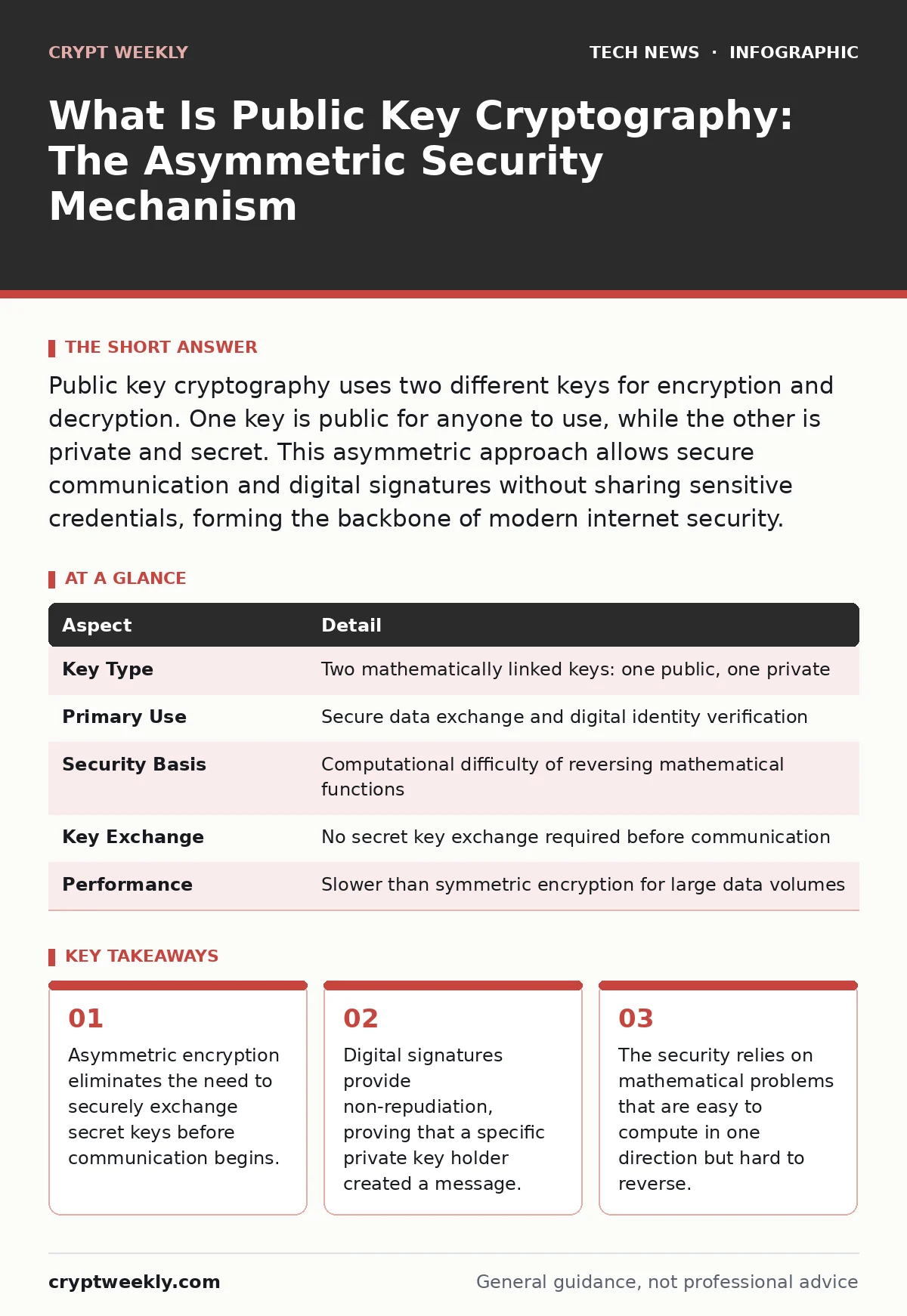
Public key cryptography uses two different keys for encryption and decryption. One key is public for anyone to use, while the other is private and secret. This asymmetric approach allows secure communication and digital signatures without sharing sensitive credentials, forming the backbone of modern internet security.
How Public Key Cryptography Works
Public key cryptography, often called asymmetric encryption, solves a fundamental problem in secure communication. Traditional symmetric encryption requires both parties to share the same secret key. Sharing that key securely over a public network is difficult and risky. Asymmetric systems use a pair of keys that are mathematically linked but distinct. You generate these keys together, but they serve opposite purposes.
The public key is designed to be shared openly. Anyone can use it to encrypt data or verify a signature. The private key must remain secret. Only the owner can use it to decrypt data or create a signature. If you encrypt a message with someone’s public key, only their private key can unlock it. This ensures confidentiality because no one else has the private key.
If you sign a message with your private key, anyone with your public key can verify that you sent it. This ensures authenticity and integrity. The system does not rely on secrecy of the algorithm. It relies on the computational difficulty of deriving the private key from the public key. This mathematical asymmetry is what makes the system secure.
| Aspect | Detail |
|---|---|
| Key Type | Two mathematically linked keys: one public, one private |
| Primary Use | Secure data exchange and digital identity verification |
| Security Basis | Computational difficulty of reversing mathematical functions |
| Key Exchange | No secret key exchange required before communication |
| Performance | Slower than symmetric encryption for large data volumes |
What Is Public Key Cryptography in Practice
Imagine you want to send a locked box to a friend. In symmetric encryption, you both need the same key. You would have to send them the key first, which is risky. In public key cryptography, your friend gives you a special padlock. This padlock has no key. Once you lock the box with it, it cannot be opened by anyone else. Your friend has the only key that opens this specific padlock. You send the locked box through the mail. Anyone can handle the box, but only your friend can open it.
This mechanism allows strangers to communicate securely without prior contact. You do not need to meet your friend to exchange a secret code. You only need their public padlock. This is how websites secure your browser traffic. When you visit a secure site, your browser uses the site’s public key to establish a secure session. The site uses its private key to prove it is who it says it is.
This system also enables digital signatures. Suppose you send a contract to a business partner. You sign it with your private key. The partner uses your public key to verify the signature. If the signature matches, they know the contract came from you and was not altered in transit. This provides non-repudiation, meaning you cannot later deny sending the message.
Common Misconceptions About Asymmetric Security
People often misunderstand how asymmetric systems protect data. One common error is thinking that public key cryptography encrypts all data in a session. It does not. Asymmetric encryption is computationally expensive. It is slow compared to symmetric encryption. Systems use it only for the initial handshake. Once the identity is verified, the parties generate a temporary symmetric key. They use this faster key for the actual data transfer. This hybrid approach balances security and performance.
Another misconception is that the public key is secure because it is public. The public key is not secret, but its integrity is critical. If an attacker replaces your public key with their own, they can impersonate you. This is called a man-in-the-middle attack. The victim thinks they are communicating with you, but they are actually communicating with the attacker. The attacker can decrypt and read all messages.
To prevent this, systems use certificate management. A trusted third party, called a Certificate Authority, verifies your identity and signs your public key. This creates a digital certificate. Your browser trusts the Certificate Authority. When it sees a certificate signed by that authority, it trusts the public key inside. This chain of trust is what makes the web secure.
Who Is Affected by This Technology
Public key cryptography affects anyone who uses the internet. It is the foundation of secure web browsing. Every time you see a padlock icon in your browser address bar, asymmetric encryption is at work. It protects your passwords, credit card numbers, and personal messages. Without it, online banking and e-commerce would be impossible.
It also affects software developers and system administrators. They use digital signatures to prove that software updates are genuine. This prevents malware from masquerading as legitimate updates. System administrators use it to secure remote server access. Instead of sending passwords over the network, they use key-based authentication. This is more secure because the private key never leaves the user’s device.
The technology also impacts hardware manufacturers. Secure boot processes use cryptographic signatures to ensure that only trusted firmware loads during startup. This prevents attackers from installing rootkits or other persistent malware. As the Internet of Things expands, this technology becomes even more critical. Devices must authenticate each other without human intervention.
The Hidden Costs and Trade-offs
Using asymmetric encryption comes with computational costs. Generating key pairs requires significant processing power. This is a concern for low-power devices like sensors or smart home gadgets. These devices may struggle to perform the necessary mathematical operations. Engineers must optimize algorithms to run on limited hardware. This often involves using smaller key sizes, which can reduce security margins.
Key management is another hidden cost. You must protect your private key. If it is lost, you cannot decrypt old messages or sign new ones. If it is stolen, your identity is compromised. You must revoke the old key and issue a new one. This process disrupts communication and requires updating certificates across all systems. Poor key management can render the entire security model useless.
Quantum computing poses a future threat. Current asymmetric algorithms rely on mathematical problems that quantum computers could solve quickly. If large-scale quantum computers become available, they could break current encryption standards. Organizations are already researching post-quantum cryptography to prepare for this shift. This transition will require significant updates to infrastructure and protocols.
See also: How API Key Security Works: The Hidden Lifecycle of Tokens
What To Do About It
You should verify certificates before trusting a website. Check the padlock icon and the certificate details in your browser. Ensure the certificate is issued by a trusted authority and matches the domain name. Do not ignore browser warnings about invalid certificates. These warnings often indicate a potential man-in-the-middle attack or a misconfigured server.
Protect your private keys with strong passphrases. Store them in secure hardware modules if possible. Hardware security modules provide physical protection against theft and tampering. Do not share your private key with anyone. Never upload it to public repositories or cloud storage. If you suspect your key has been compromised, revoke it immediately and generate a new pair.
Stay updated on cryptographic standards. Algorithms that were secure years ago may now be vulnerable. Follow industry recommendations for key lengths and algorithm choices. Use established libraries for cryptographic operations. Do not implement your own cryptographic algorithms. Custom implementations often contain subtle flaws that attackers can exploit. Rely on proven, audited code.
Integrating With Other Security Layers
Public key cryptography does not work in isolation. It integrates with other security mechanisms to provide defense in depth. For example, SAML uses digital signatures to authenticate users across different domains. This allows single sign-on without sharing passwords between services. The signature proves that the authentication request came from a trusted identity provider.
Network monitoring tools can detect anomalies in cryptographic traffic. Unusual patterns in key exchanges or certificate usage may indicate an attack. Monitoring helps identify compromised keys or unauthorized access attempts. Combining cryptographic security with active monitoring creates a more resilient defense.
Virtual machines and cloud environments also rely on these principles. They use certificates to secure virtual networks and manage access controls. Proper certificate management ensures that only authorized instances can communicate. This prevents lateral movement by attackers who breach one part of the system.
Key takeaways
- Asymmetric encryption eliminates the need to securely exchange secret keys before communication begins.
- Digital signatures provide non-repudiation, proving that a specific private key holder created a message.
- The security relies on mathematical problems that are easy to compute in one direction but hard to reverse.
Frequently asked questions
Can I use the same key pair for encryption and signing?
Yes, but it is generally recommended to use separate key pairs. Separating duties limits the damage if one key is compromised and simplifies key rotation procedures.
How long should my cryptographic keys be?
Key length depends on the algorithm used. Current standards recommend minimum lengths to resist modern computing attacks. Consult current industry guidelines for specific algorithm requirements.
What happens if I lose my private key?
You lose access to data encrypted with the corresponding public key. You also cannot create valid digital signatures. You must revoke the compromised key pair and issue a new one.
Is public key cryptography faster than symmetric encryption?
No, it is significantly slower. Asymmetric operations are computationally intensive. Systems use asymmetric encryption only for initial key exchange and then switch to symmetric encryption for data transfer.
How this guide was produced: written by the Crypt Weekly editorial team with AI assistance, checked against the public references listed below, and reviewed when the facts change. See our editorial policy or report an error.