
SAML shifts identity verification from password storage to cryptographic assertions, removing the need for shared secrets between distinct systems.
SAML allows users to log in once and access multiple applications without sharing passwords. It uses XML-based assertions signed with digital certificates to prove identity. This reduces credential theft risks and simplifies user management across complex network environments.
The Problem with Shared Secrets
Most organizations struggle with identity because they treat every application as a separate island. Each island demands its own username and password. You create these credentials, store them in a password manager, and hope the application stores them securely. This model forces you to remember dozens of secrets. It also forces every application to validate and store those secrets. If one application is compromised, your credentials may be exposed to every other service where you reused them.
SAML, which stands for Security Assertion Markup Language, changes this dynamic. It is an open standard that allows one system to share authentication data with another. Instead of storing passwords, applications trust a central identity provider. This provider verifies your identity once. It then issues a signed statement, called an assertion, that says you are who you claim to be. The application reads this statement and grants access. You never send your password to the application.
How Assertions Replace Passwords
An assertion is an XML document that contains claims about a user. These claims might include your name, your role, or your group membership. The identity provider signs this document using a private key. The application verifies the signature using the provider’s public key. This process proves the assertion came from the trusted provider and was not tampered with in transit.
This mechanism removes the need for applications to handle sensitive password data. If an attacker compromises an application database, they find no passwords to steal. They only find session tokens or user profiles. The actual secret—the private key used to sign assertions—remains in the identity provider. This separation of duties is the core security benefit of SAML. It limits the blast radius of any single breach.
Decisions Informed by SAML Adoption
Adopting SAML changes how you design security controls. It shifts the focus from protecting credentials to protecting the identity provider. You must decide which attributes to share. You must determine how long an assertion remains valid. You must choose how to handle session timeouts. These decisions inform your overall risk posture.
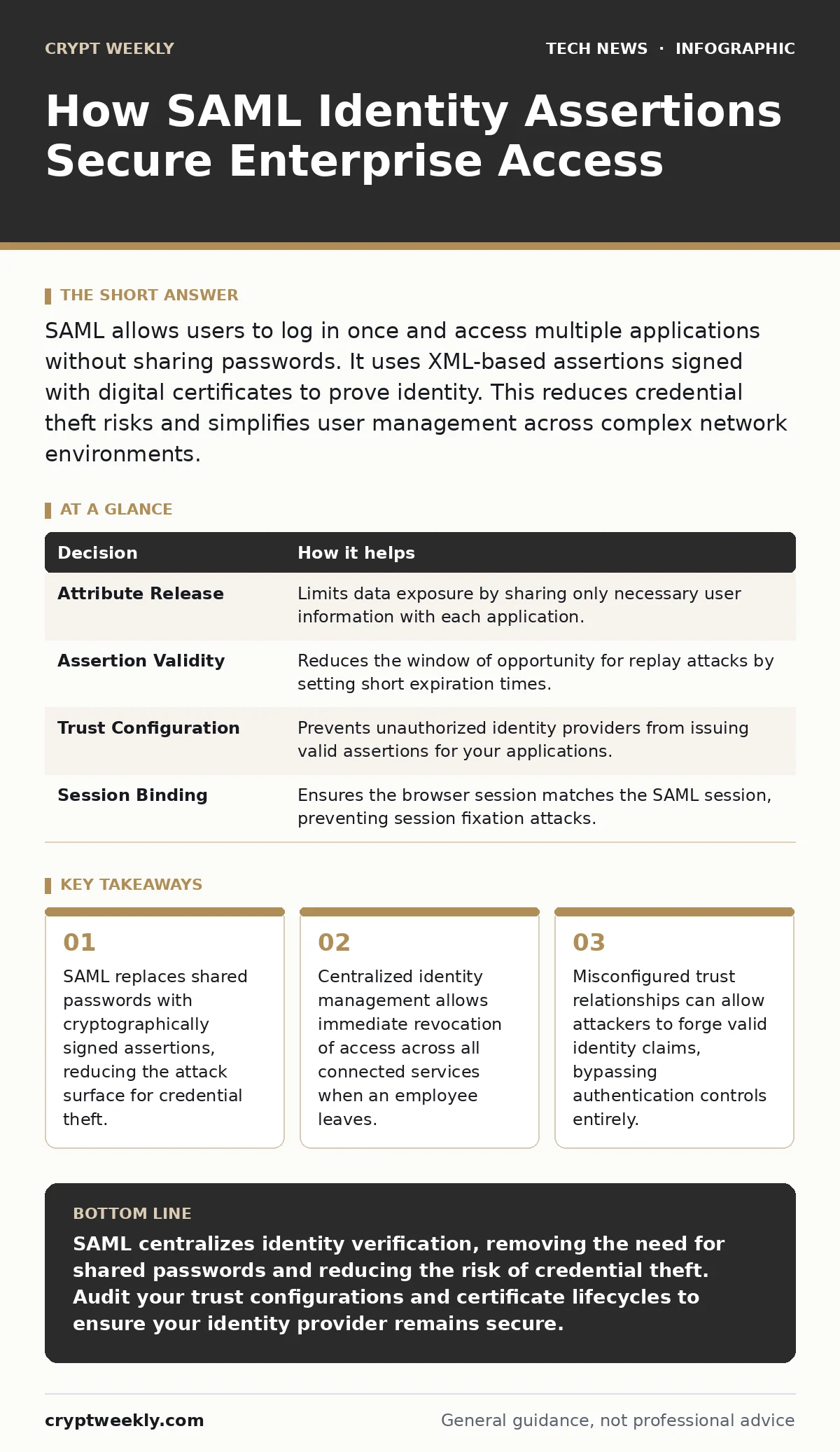
| Decision | How it helps |
|---|---|
| Attribute Release | Limits data exposure by sharing only necessary user information with each application. |
| Assertion Validity | Reduces the window of opportunity for replay attacks by setting short expiration times. |
| Trust Configuration | Prevents unauthorized identity providers from issuing valid assertions for your applications. |
| Session Binding | Ensures the browser session matches the SAML session, preventing session fixation attacks. |
What Goes Wrong Without It
Without a centralized identity protocol, teams rely on federated password resets or shared service accounts. Shared accounts are particularly dangerous. They create audit gaps. You cannot tell which individual performed which action. This violates non-repudiation, a core security principle. It also makes incident response difficult. When a breach occurs, you cannot isolate the compromised user. You must rotate credentials for the entire group, causing operational disruption.
SAML provides audit trails. Each assertion includes a unique identifier. Applications can log these identifiers. This creates a clear link between a user action and a specific identity verification event. You can trace activity back to the identity provider. This visibility is critical for compliance and forensic analysis. It allows you to detect anomalies, such as a user accessing resources from an unusual location or at an odd time.
Hidden Costs and Edge Cases
SAML is not a magic bullet. It introduces complexity. You must manage digital certificates. If a certificate expires, authentication fails. Users cannot log in. This is why certificate management is a continuous operational task. You must monitor expiration dates and renew keys before they lapse. Failure to do so causes outages that appear as security incidents but are actually administrative oversights.
Another edge case involves cross-origin request forgery. SAML relies on browser redirects. If an attacker can trick a user into clicking a malicious link, they might force the browser to send a SAML request. While SAML includes protections like binding constraints, misconfigurations can weaken these defenses. You must ensure your identity provider enforces strict binding rules. This prevents attackers from hijacking the authentication flow.
See also: Why Biometric Data Matters for Security Decisions and Risk · Network Access Control System: How It Works and What It Checks
How Teams Use SAML in Practice
Teams use SAML to integrate cloud applications with on-premises directories. This is common in hybrid environments. The identity provider often sits on-premises, connected to the corporate directory. The applications reside in the cloud. SAML bridges this gap. It allows the cloud application to trust the on-premises identity store.
This setup requires careful network design. You must ensure the identity provider is accessible to users. You must also protect it from external attacks. This often involves placing the provider behind a reverse proxy or a web application firewall. You must also consider IP addresses when configuring trust. Some teams restrict SAML requests to known IP ranges. This adds a layer of defense but can break access for remote users. You must balance security with usability.
The Role of Standards in Security
SAML is part of a broader ecosystem of identity standards. It works alongside other protocols to provide a complete identity strategy. For example, API key security often complements SAML. While SAML handles human users, API keys handle machine-to-machine communication. You must secure both channels. A breach in one can expose the other.
Understanding the limitations of SAML is key. It does not encrypt the payload by default. It relies on TLS for transport security. You must ensure all SAML communications occur over HTTPS. This prevents eavesdropping on the assertions. You must also consider Domain Name System security. If an attacker can hijack DNS, they can redirect users to a malicious identity provider. This man-in-the-middle attack can capture credentials or forge assertions. Secure your DNS infrastructure to protect the identity flow.
Moving Beyond Basic Authentication
SAML is a mature standard. It has been widely adopted for over a decade. Its strength lies in its flexibility and interoperability. However, it requires careful implementation. You must understand the mechanics of assertions, signatures, and bindings. You must manage certificates and trust relationships. You must monitor for misconfigurations.
By centralizing identity, you reduce the complexity of access management. You eliminate the need for shared secrets between systems. You gain visibility into user activity. You improve the security posture of your organization. But you also take on new responsibilities. You must protect the identity provider. You must manage the trust chain. You must ensure that the benefits of centralization outweigh the risks of a single point of failure.
Key takeaways
- SAML replaces shared passwords with cryptographically signed assertions, reducing the attack surface for credential theft.
- Centralized identity management allows immediate revocation of access across all connected services when an employee leaves.
- Misconfigured trust relationships can allow attackers to forge valid identity claims, bypassing authentication controls entirely.
SAML centralizes identity verification, removing the need for shared passwords and reducing the risk of credential theft. Audit your trust configurations and certificate lifecycles to ensure your identity provider remains secure.
Frequently asked questions
Can SAML be used for mobile applications?
Yes, but mobile apps often use OAuth 2.0 or OpenID Connect instead. These protocols are designed for lightweight, mobile-friendly flows. SAML can work, but it requires a web view or a custom integration.
What happens if the identity provider goes down?
Users cannot authenticate to any SAML-connected application. You must have a disaster recovery plan. This includes redundant identity provider instances and a clear failover process.
Is SAML encrypted by default?
No, SAML assertions are signed, not encrypted. The signature ensures integrity. You must use TLS to encrypt the transport layer. This prevents eavesdropping on the assertions during transmission.
How do I know if my SAML implementation is secure?
Regularly review your trust configurations. Verify that assertions are signed and validated. Check for expired certificates. Monitor for unusual authentication patterns. Conduct periodic penetration tests.
How this guide was produced: written by the Crypt Weekly editorial team with AI assistance, checked against the public references listed below, and reviewed when the facts change. See our editorial policy or report an error.