
Whaling attacks rarely rely on technical exploits. They succeed because attackers exploit the social authority and isolation of senior leaders.
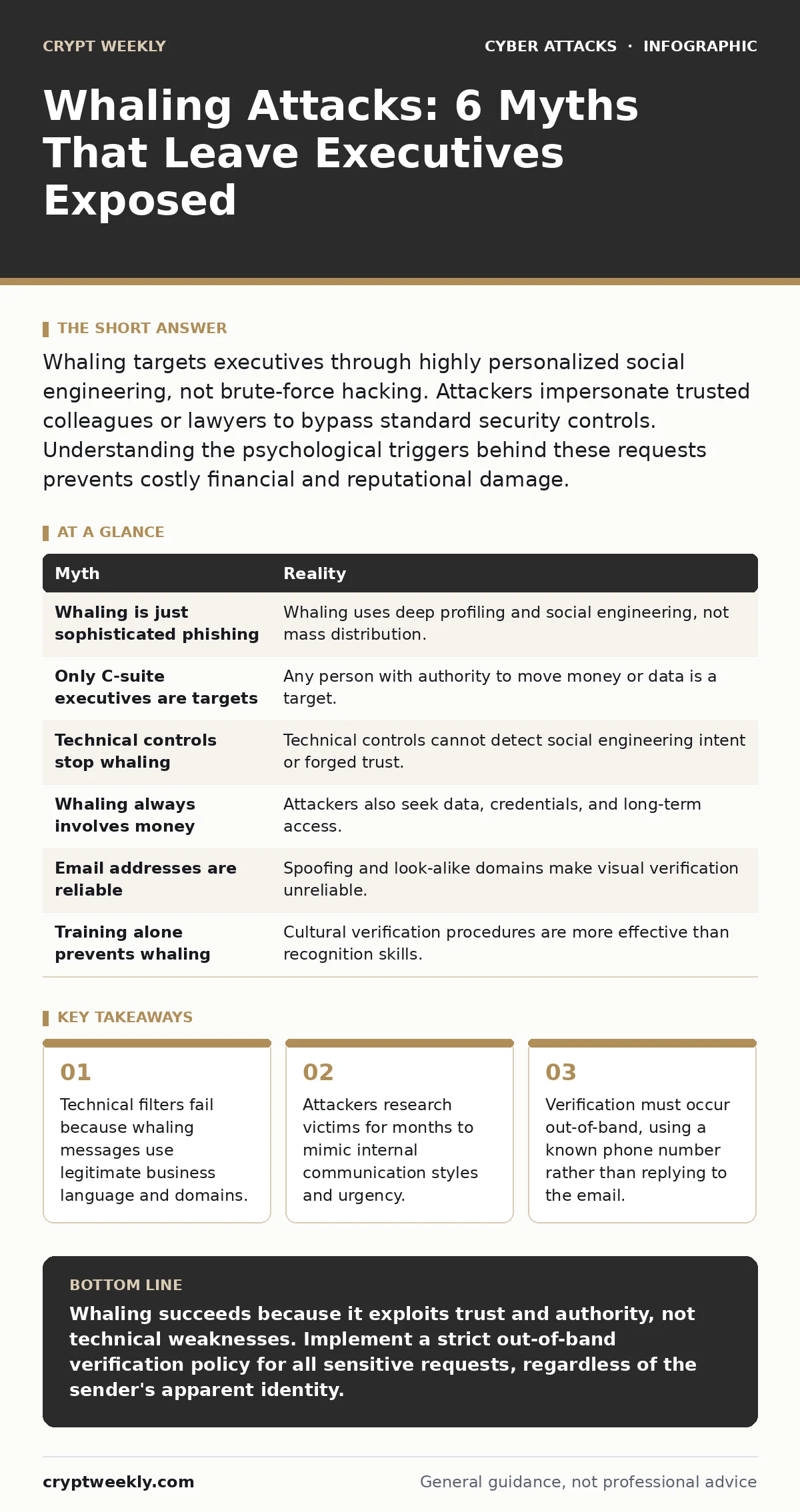
Whaling targets executives through highly personalized social engineering, not brute-force hacking. Attackers impersonate trusted colleagues or lawyers to bypass standard security controls. Understanding the psychological triggers behind these requests prevents costly financial and reputational damage.
Myth: Whaling is just sophisticated phishing
Reality: Whaling is distinct from standard phishing because it relies on deep psychological profiling rather than mass distribution. Standard phishing casts a wide net with generic templates hoping for a few clicks. Whaling is a sniper approach. The attacker identifies a specific high-value target and spends weeks or months gathering intelligence. They study the executive’s public speeches, recent press releases, and organizational chart.
The resulting message contains specific project names, correct internal jargon, and accurate references to recent business decisions. This level of detail makes the request appear to originate from a trusted colleague or superior. The attacker does not need to bypass technical security controls if the victim willingly hands over credentials or authorizes a payment. The deception succeeds because the content matches the victim’s current operational reality.
Myth: Only C-suite executives are targets
Reality: Whaling targets anyone with the authority to move money, access sensitive data, or approve critical system changes. The term "whale" refers to the high value of the target, not their specific job title. A mid-level finance manager who can approve vendor payments is a viable target. A senior engineer with administrative access to the corporate network is a viable target. An HR director with access to employee social security numbers is a viable target.
Attackers map the organization’s decision-making hierarchy to find the lowest possible point of authorization that still yields high rewards. They often target individuals who report to C-suite leaders because these managers are less likely to have dedicated security detail or rigorous verification protocols. The goal is to find a person with enough power to cause damage but not enough scrutiny to detect the fraud.
Myth: Technical security controls stop whaling attacks
Reality: Firewalls and spam filters cannot read intent. These tools block known malicious domains and obvious spam keywords. Whaling messages are crafted to bypass these automated checks. The attacker uses a domain that looks similar to a legitimate vendor or a newly registered domain that has not yet been flagged. The email content contains no links to known malware sites. It contains no attachments with executable code.
It is simply a text request for information or action. Because the message is technically clean, it passes through email security gateways. The threat is social, not technical. Relying on perimeter defenses gives a false sense of security. The breach occurs at the human level, where judgment replaces algorithmic filtering. You must assume that the attacker has already bypassed your technical controls.
Myth: Whaling always involves urgent financial requests
Reality: Financial fraud is the most publicized outcome, but it is not the only objective. Attackers often seek intellectual property, strategic plans, or access credentials. A request for "confidential merger details" or "Q3 strategic projections" may seem harmless to an executive. The attacker wants this information to sell to competitors or to craft even more convincing future attacks. Some whaling campaigns aim for account takeover rather than immediate theft.
The attacker asks for a password reset or multi-factor authentication code to gain persistent access to the executive’s email. Once inside, they can monitor communications, impersonate the executive to subordinates, and slowly exfiltrate data over time. This approach is quieter and harder to detect than a sudden wire transfer. The urgency is manufactured by referencing a deadline or a legal obligation, not just a bank transfer.
Myth: You can verify the sender by checking the email address
Reality: Email spoofing allows attackers to forge the "From" address to display any name and address they choose. The attacker makes the message appear to come from the CEO, a board member, or a known legal counsel. Even if you see "[email protected]" in your inbox, the message may have originated from a server in a different country. Domain-based Message Authentication, Reporting, and Conformance (DMARC) helps, but it is not foolproof against all techniques.
Attackers use look-alike domains that differ by only one character. They use free email providers with names that match the executive’s name. Visual inspection is unreliable. The human eye misses subtle typos in domain names. You cannot trust the display name or the visible email address alone. You must verify the request through a separate communication channel that you control.
See also: Email Spoofing Example: How Attackers Forge Sender Identities
Myth: Training alone prevents whaling
Reality: General security awareness training teaches employees to spot obvious phishing signs. Whaling messages do not have obvious signs. They are grammatically correct, professionally formatted, and contextually accurate. Training that focuses on "look for typos" or "check the URL" fails against whaling. The attacker has already addressed these points. Effective defense requires a verification culture, not just recognition skills.
Employees must be empowered to pause and verify without fear of offending a superior. This requires clear, documented procedures for handling sensitive requests. It requires leadership to model this behavior. When an executive verifies a request from a subordinate, it signals that verification is standard practice, not a sign of distrust. Without this cultural shift, employees will comply with requests out of fear or habit, regardless of their training.
Myth: Whaling is a rare, one-off event
Reality: Whaling is a continuous, adaptive process. Attackers monitor public news, social media, and job postings to identify new targets and opportunities. They adjust their tactics based on what works. If financial requests are blocked, they shift to data theft. If email is heavily monitored, they switch to vishing or angler phishing. The attack surface grows as organizations adopt new technologies and restructure teams.
There is no "finished" state for whaling defense. It requires ongoing monitoring and updating of verification procedures. You must assume that attackers are actively researching your organization right now. They are building a profile of your key personnel. They are waiting for the right moment to strike. Passive defense is insufficient. You must actively manage the risk by regularly testing your verification processes and updating your threat models.
| Myth | Reality |
|---|---|
| Whaling is just sophisticated phishing | Whaling uses deep profiling and social engineering, not mass distribution. |
| Only C-suite executives are targets | Any person with authority to move money or data is a target. |
| Technical controls stop whaling | Technical controls cannot detect social engineering intent or forged trust. |
| Whaling always involves money | Attackers also seek data, credentials, and long-term access. |
| Email addresses are reliable | Spoofing and look-alike domains make visual verification unreliable. |
| Training alone prevents whaling | Cultural verification procedures are more effective than recognition skills. |
Key takeaways
- Technical filters fail because whaling messages use legitimate business language and domains.
- Attackers research victims for months to mimic internal communication styles and urgency.
- Verification must occur out-of-band, using a known phone number rather than replying to the email.
Whaling succeeds because it exploits trust and authority, not technical weaknesses. Implement a strict out-of-band verification policy for all sensitive requests, regardless of the sender's apparent identity.
Frequently asked questions
How do I verify a request from my boss without offending them?
Use a pre-established verification phrase or call them on a known phone number. Frame it as a security protocol you are required to follow, not a lack of trust in them.
What is the difference between whaling and spear phishing?
Spear phishing targets specific individuals within an organization. Whaling specifically targets high-level executives or individuals with significant financial or administrative authority.
Can I use email headers to detect whaling?
Email headers show the path the message took, but they do not prove the sender’s identity. Attackers can manipulate headers. Use them for investigation after a suspected incident, not for real-time verification.
Should I block all external emails from accessing sensitive systems?
Blocking all external emails is impractical for most businesses. Instead, implement strict access controls and require multi-factor authentication for any sensitive action initiated via email.
How this guide was produced: written by the Crypt Weekly editorial team with AI assistance, checked against the public references listed below, and reviewed when the facts change. See our editorial policy or report an error.