
Cryptojacking hides in plain sight by mimicking normal system behavior, making resource monitoring more effective than signature-based detection tools.
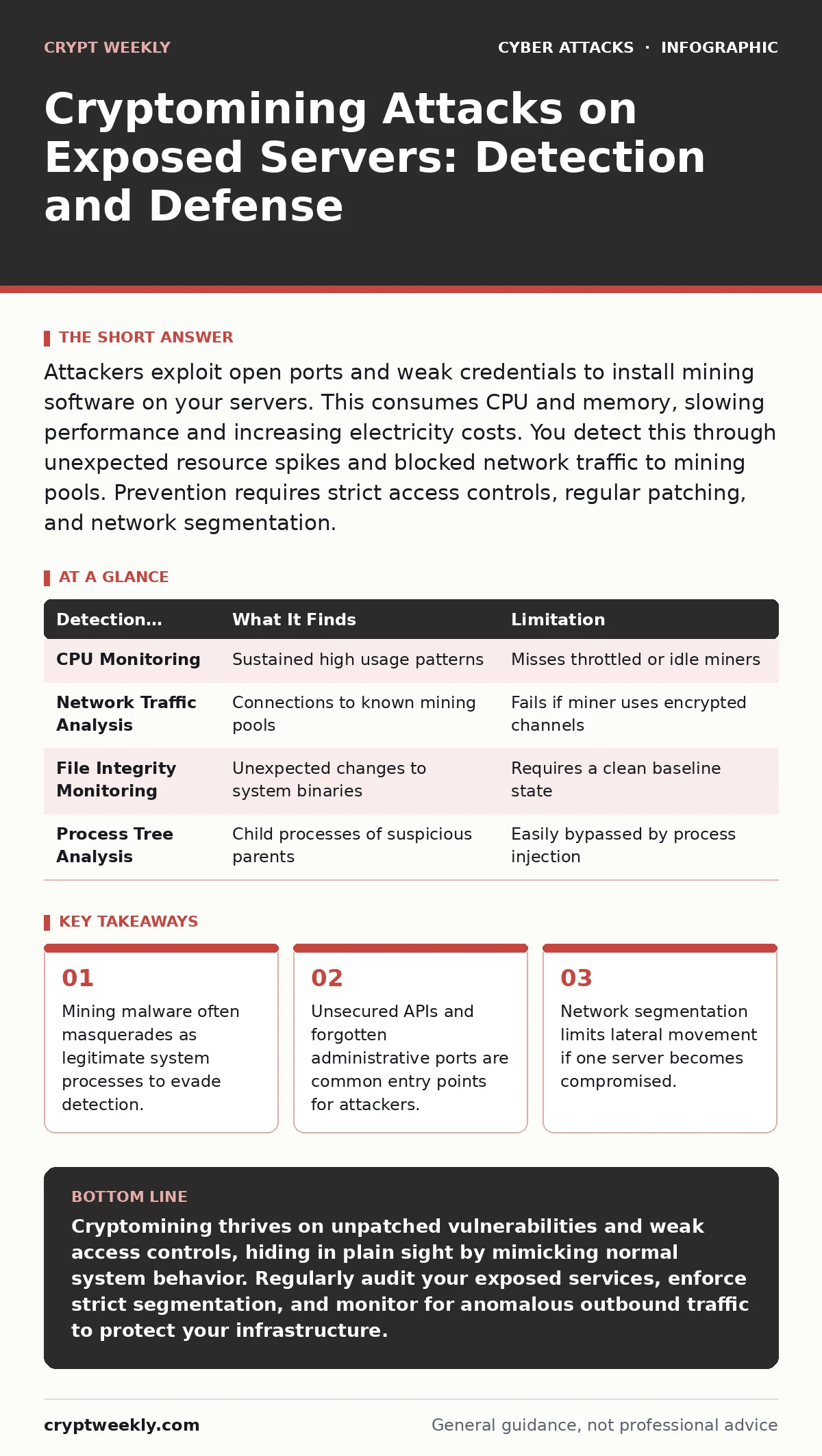
Attackers exploit open ports and weak credentials to install mining software on your servers. This consumes CPU and memory, slowing performance and increasing electricity costs. You detect this through unexpected resource spikes and blocked network traffic to mining pools. Prevention requires strict access controls, regular patching, and network segmentation.
What is a cryptomining attack?
A cryptomining attack, also known as cryptojacking, involves an unauthorized actor installing software on your server to solve cryptographic puzzles for digital currency. The attacker does not steal data or encrypt files for ransom. Instead, they hijack your computational resources to generate profit. Your server performs the heavy lifting, consuming electricity and degrading performance. The attacker receives the mined coins, while you pay the power bill and suffer from reduced system responsiveness.
How do attackers gain initial access?
Attackers enter through exposed services that lack proper authentication or have known vulnerabilities. Common entry points include unpatched web applications, open database ports, and misconfigured cloud storage buckets. Weak passwords remain a primary vector, allowing brute-force attempts to succeed against SSH or RDP services. Attackers also exploit API abuse by sending malformed requests to endpoints that were not designed for public access. If an API lacks rate limiting or input validation, it becomes a backdoor for executing remote commands that install the mining payload.
Why is cryptomining hard to detect?
Mining software is designed to be stealthy, often throttling its activity to stay below detection thresholds. It mimics the resource usage patterns of legitimate applications, making it difficult to distinguish from normal operational loads. Many miners use rootkits to hide their processes from standard system monitoring tools. They may also rename their executables to match system files, such as naming a miner "svchost.exe" or "systemd". This camouflage allows the infection to persist for weeks or months before an administrator notices the gradual decline in server performance.
| Detection Method | What It Finds | Limitation |
|---|---|---|
| CPU Monitoring | Sustained high usage patterns | Misses throttled or idle miners |
| Network Traffic Analysis | Connections to known mining pools | Fails if miner uses encrypted channels |
| File Integrity Monitoring | Unexpected changes to system binaries | Requires a clean baseline state |
| Process Tree Analysis | Child processes of suspicious parents | Easily bypassed by process injection |
What are the financial and operational costs?
The direct cost is increased electricity consumption, which scales with the number of infected cores. Indirect costs arise from degraded application performance, leading to slower response times for users and potential loss of business. In cloud environments, you pay for the compute resources the attacker uses, effectively subsidizing their operation. Repairing the system requires downtime, forensic investigation, and the labor of security teams. The cumulative effect includes hardware wear from sustained high temperatures and the opportunity cost of diverted IT resources.
How do you detect active mining on a server?
You detect active mining by correlating resource usage with network traffic. Start by checking for processes that consume significant CPU or GPU resources but do not correspond to known application tasks. Use tools that display process trees to see if a suspicious process is spawned by a web server or database engine. Next, inspect outbound network connections. Look for persistent connections to IP addresses or domains associated with mining protocols. Firewalls can help identify these connections if they log denied traffic to known malicious destinations. Regular baseline comparisons reveal deviations from normal operational behavior.
See also: DNS Amplification Attacks: Risks and Protection for Small Businesses · OAuth Consent Phishing: How Attackers Bypass Login Screens
What immediate steps stop an active infection?
Isolate the infected server from the network to prevent lateral movement and stop data exfiltration to mining pools. Identify the malicious process and terminate it, but do not delete the binary immediately. Preserve the file for forensic analysis to understand the entry vector. Revoke any new user accounts or SSH keys created by the attacker. Check for persistence mechanisms, such as cron jobs, scheduled tasks, or modified startup scripts. After removal, restore the system from a known good backup or rebuild it from scratch. Reusing a compromised image risks retaining hidden backdoors.
How do you prevent future cryptomining incidents?
Prevention requires reducing the attack surface and enforcing strict access controls. Close all unnecessary ports and disable unused services. Implement multi-factor authentication for all administrative access to prevent credential theft. Regularly patch operating systems and applications to close known vulnerabilities. Use network segmentation to limit the ability of an attacker to move between servers. Monitor for social engineering attempts that might trick staff into revealing credentials. Educate developers about secure coding practices to reduce the risk of vulnerabilities that allow remote code execution.
Why do miners target specific server configurations?
Attackers use automated scanners to identify servers with specific characteristics that make them easy targets. They look for outdated software versions with publicly available exploits. They also target servers with high computational power, such as those used for video rendering or scientific calculations, because these provide higher mining returns. Misconfigured cloud instances with public-facing administrative interfaces are particularly attractive. Attackers prioritize targets that lack intrusion detection systems, as these offer a higher chance of long-term undetected access.
What role do APIs play in modern attacks?
Modern applications rely heavily on APIs, which often expose functionality directly to the internet. If an API endpoint allows file uploads or command execution without proper validation, it becomes a direct path for malware installation. Attackers can bypass traditional perimeter defenses by interacting directly with the application logic. This is why securing API gateways and implementing strict input validation is critical. Without proper controls, an attacker can inject mining scripts through a seemingly harmless data submission, bypassing network-level security measures entirely.
Key takeaways
- Mining malware often masquerades as legitimate system processes to evade detection.
- Unsecured APIs and forgotten administrative ports are common entry points for attackers.
- Network segmentation limits lateral movement if one server becomes compromised.
Cryptomining thrives on unpatched vulnerabilities and weak access controls, hiding in plain sight by mimicking normal system behavior. Regularly audit your exposed services, enforce strict segmentation, and monitor for anomalous outbound traffic to protect your infrastructure.
Frequently asked questions
Can a firewall stop cryptomining attacks?
A firewall can block connections to known mining pools, but it cannot prevent the initial infection if the attacker exploits an open port or a vulnerable application.
Is cryptomining illegal?
Yes, unauthorized use of computing resources is considered theft of service and computer fraud in most jurisdictions.
How do I know if my cloud bill is inflated by miners?
Compare your current resource usage against historical baselines. A sudden, unexplained increase in compute hours or data transfer often indicates unauthorized activity.
Should I use a dedicated antivirus for cryptojacking?
General endpoint detection and response tools are sufficient if configured to monitor behavior. Specialized tools offer marginal benefits over well-tuned standard security solutions.
How this guide was produced: written by the Crypt Weekly editorial team with AI assistance, checked against the public references listed below, and reviewed when the facts change. See our editorial policy or report an error.