IP spoofing detection relies on identifying traffic that violates routing expectations and connection state rules rather than just blocking unknown addresses.
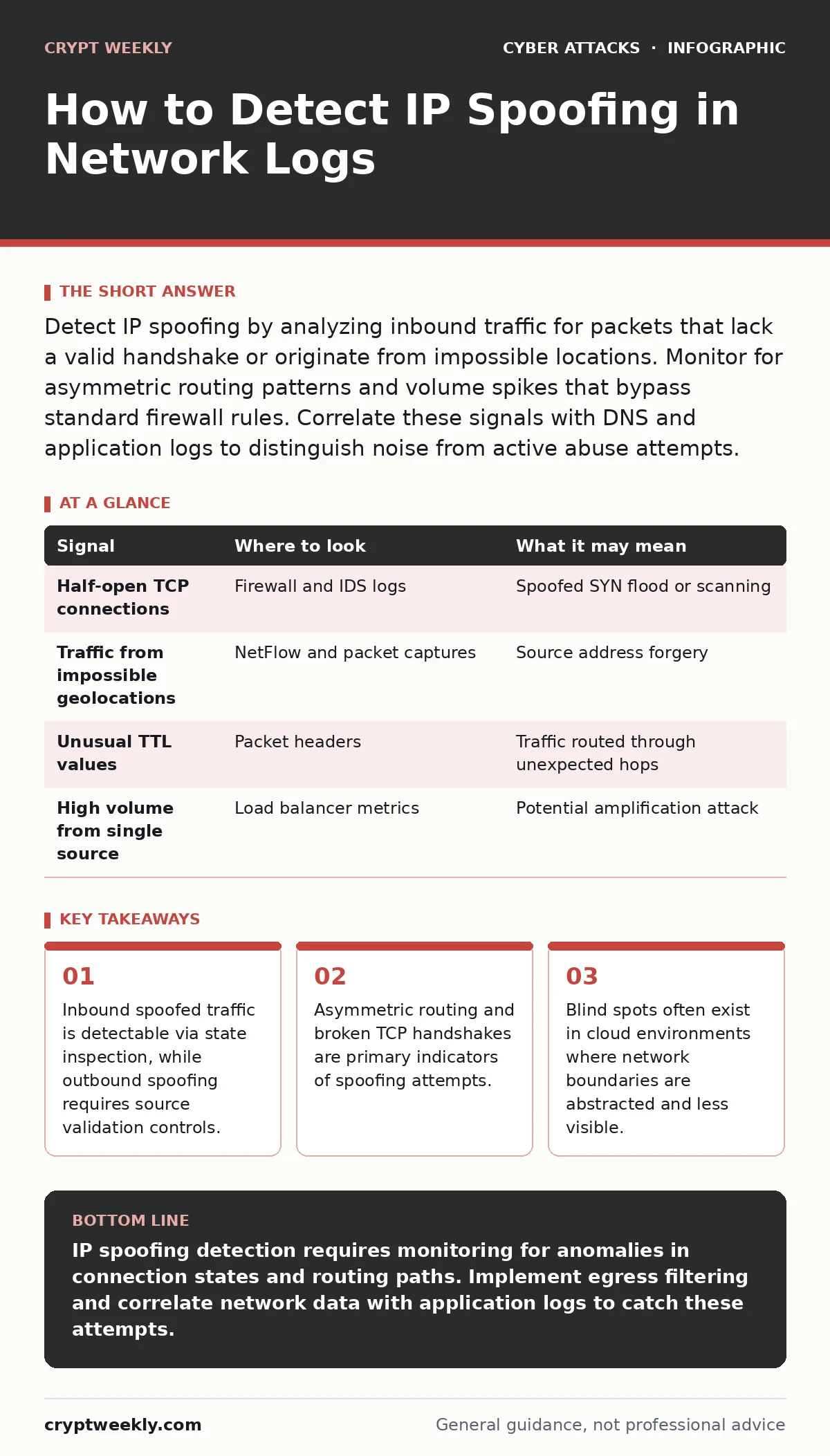
Detect IP spoofing by analyzing inbound traffic for packets that lack a valid handshake or originate from impossible locations. Monitor for asymmetric routing patterns and volume spikes that bypass standard firewall rules. Correlate these signals with DNS and application logs to distinguish noise from active abuse attempts.
Understanding the Spoofing Mechanism
IP spoofing occurs when an attacker alters the source address in an IP packet header. The goal is to hide the true origin or impersonate a trusted system. This technique exploits the fact that many network devices trust the source address without verification. It is the foundation for reflection attacks and evasion tactics. You cannot stop the creation of these packets, but you can detect their presence. Understanding the difference between inbound and outbound spoofing is necessary for detection. Inbound spoofing targets your network, while outbound spoofing uses your infrastructure to attack others.
Signs in Inbound Traffic Logs
When spoofed packets arrive at your perimeter, they often fail to establish a proper connection. Look for TCP SYN packets that do not receive corresponding ACK responses. This happens because the spoofed source address does not expect or receive the reply. Your firewall logs will show a high volume of half-open connections. These connections consume resources and may trigger rate-limiting alerts. If you see traffic from an IP address that should be behind a specific ISP but arrives via a different path, investigate further. This mismatch indicates the source address has been forged.
| Signal | Where to look | What it may mean |
|---|---|---|
| Half-open TCP connections | Firewall and IDS logs | Spoofed SYN flood or scanning |
| Traffic from impossible geolocations | NetFlow and packet captures | Source address forgery |
| Unusual TTL values | Packet headers | Traffic routed through unexpected hops |
| High volume from single source | Load balancer metrics | Potential amplification attack |
Detecting Outbound Spoofing
Your network might be the source of spoofed traffic without your knowledge. This often happens when an internal host is compromised. The attacker configures the compromised machine to send packets with fake source addresses. You can detect this by enabling outbound filtering. This practice, known as egress filtering, drops packets that claim to originate from your network but arrive on an external interface. If your ISP sends you a abuse complaint, check your logs for outbound traffic with internal source addresses. This is a strong indicator that your infrastructure is being used for spoofing.
The Role of Asymmetric Routing
Asymmetric routing occurs when packets travel different paths in each direction. While common in complex networks, it can signal spoofing. Attackers may route spoofed packets through a path that avoids certain security controls. Look for traffic that enters one interface and leaves another unexpectedly. This behavior disrupts stateful inspection mechanisms. Stateful firewalls track the state of active connections. If a packet arrives that does not match an existing state entry, the firewall may drop it or flag it. Analyze your routing tables and netflow data for inconsistencies. Sudden changes in routing paths for specific IP ranges warrant closer inspection.
Correlating with DNS and Application Data
IP spoofing rarely occurs in isolation. It is often part of a broader attack chain. Correlate network logs with DNS queries and application logs. For example, a spike in DNS queries for a non-existent domain might accompany spoofed traffic. This could indicate a DNS amplification attack. These attacks use spoofed IP addresses to reflect amplified traffic toward a victim. Check your DNS server logs for responses sent to addresses outside your network. Also, look for application errors that suggest unexpected traffic patterns. Web servers may log requests from IP addresses that do not match known users.
See also: tls handshake failed: why it happens and how to fix it
Common Blind Spots in Detection
Many organizations fail to detect spoofing due to architectural blind spots. Cloud environments abstract the underlying network, making visibility difficult. You may not have direct access to packet-level data in shared cloud infrastructure. This limits your ability to perform deep packet inspection. Another blind spot is the assumption that internal traffic is trustworthy. Lateral movement within a network can involve spoofing internal addresses. This bypasses perimeter defenses and relies on internal trust. Ensure your monitoring covers internal segments as well as the edge.
Practical Tools for Verification
Several tools help in detecting and analyzing spoofed traffic. Intrusion Detection Systems can be configured to alert on known spoofing patterns. NetFlow analyzers provide visibility into traffic flows and routing anomalies. Packet capture tools allow for deep inspection of individual packets. Use these tools to validate alerts and investigate false positives. Regularly review and update your detection rules. Attackers evolve their techniques to evade standard signatures. Combine automated detection with manual analysis for best results. Consider the trade-offs between visibility and performance. Deep inspection can impact network latency.
Integrating with Broader Security Practices
Detecting IP spoofing is part of a larger security strategy. It intersects with other areas like supply chain attacks and API abuse. Spoofed IP addresses can be used to bypass API rate limits or impersonate trusted partners. Ensure your API security measures include source validation. Similarly, understanding how firewalls handle spoofed traffic is necessary for effective configuration. Review your firewall rules to ensure they drop invalid source addresses. This reduces the attack surface and simplifies detection. Keep your security tools updated and your policies clear.
Key takeaways
- Inbound spoofed traffic is detectable via state inspection, while outbound spoofing requires source validation controls.
- Asymmetric routing and broken TCP handshakes are primary indicators of spoofing attempts.
- Blind spots often exist in cloud environments where network boundaries are abstracted and less visible.
IP spoofing detection requires monitoring for anomalies in connection states and routing paths. Implement egress filtering and correlate network data with application logs to catch these attempts.
Frequently asked questions
Can IP spoofing be completely prevented?
No, because IP is a connectionless protocol at the network layer. However, you can mitigate its impact through validation and monitoring.
What is the difference between IP spoofing and DNS spoofing?
IP spoofing fakes the source address in network packets. DNS spoofing poisons the DNS cache to redirect traffic to malicious servers.
How do I distinguish spoofing from legitimate load balancing?
Legitimate load balancing follows predictable patterns and maintains connection state. Spoofing often results in stateless, high-volume traffic from inconsistent sources.
Should I block all traffic from unknown IP ranges?
Blocking all unknown traffic is impractical and may disrupt legitimate services. Instead, focus on validating traffic patterns and implementing strict egress filtering.
How this guide was produced: written by the Crypt Weekly editorial team with AI assistance, checked against the public references listed below, and reviewed when the facts change. See our editorial policy or report an error.