
Strict authentication rules often force predictable user behavior that weakest overall digital defense systems across modern networks.
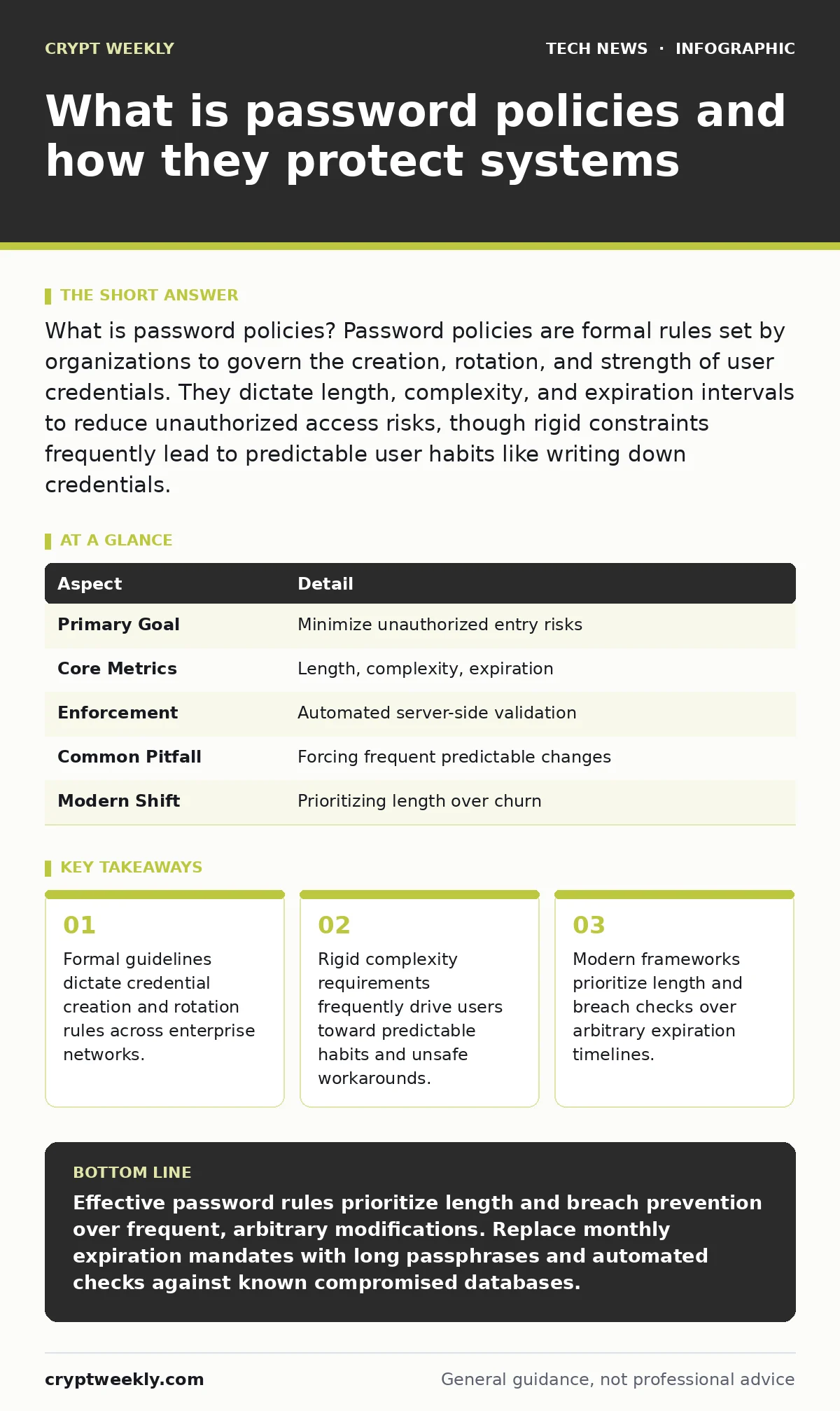
What is password policies? Password policies are formal rules set by organizations to govern the creation, rotation, and strength of user credentials. They dictate length, complexity, and expiration intervals to reduce unauthorized access risks, though rigid constraints frequently lead to predictable user habits like writing down credentials.
The Locksmith Analogy
Building security relies on structured rules much like a master key system in a large physical office building. Security administrators establish baseline requirements for every door lock and physical key issued to employees. These structural controls dictate how frequently keys must change and how complex the bitting pattern must be. Physical access management mirrors digital credential management because both systems attempt to balance user convenience against forced complexity.
Digital authentication systems enforce these boundaries through programmatic constraints coded into central servers. Authentication servers evaluate incoming strings of characters against a predefined matrix before granting entry to sensitive network resources. 3 core parameters typically govern these programmatic checks: minimum character length, mandatory character variety, and maximum operational lifespan. Enforcing these parameters stops basic automated guessing attacks but introduces friction for legitimate users.
| Aspect | Detail |
|---|---|
| Primary Goal | Minimize unauthorized entry risks |
| Core Metrics | Length, complexity, expiration |
| Enforcement | Automated server-side validation |
| Common Pitfall | Forcing frequent predictable changes |
| Modern Shift | Prioritizing length over churn |
What is password policies
What is password policies? Password policies are formally documented security guidelines that dictate how users create, update, and manage their authentication credentials. Organizations implement these governance frameworks to minimize the probability of credential theft and subsequent unauthorized system access. 3 primary goals drive these rules: preventing brute-force guesses, limiting the window of exposure for compromised secrets, and ensuring uniform standards across large user populations.
Governance frameworks operate continuously in the background of enterprise networks, silently evaluating user input against stored requirements. Security teams adjust these parameters based on emerging threat intelligence and industry standards. Failing to update these internal standards leaves gaps that attackers exploit through credential stuffing tools. Balancing strict governance with practical usability remains a constant operational challenge for administrators.
How Authentication Rules Operate
Programmatic enforcement mechanisms inspect every attempted credential creation against a blacklist of common dictionary words and leaked strings. Validation algorithms parse inputs instantly during registration events, rejecting submissions that fail mathematical entropy thresholds. High entropy ensures that strings contain enough randomness to resist rapid decryption attempts by modern computational hardware. Modern systems often integrate public key cryptography principles to secure these credentials in transit.
Rotation schedules dictate the frequency with which users must abandon old secrets and generate new ones. Automated timers trigger warning notifications weeks before expiration dates arrive, prompting user compliance. Administrative policies also govern account lockout thresholds, temporarily disabling access after a specific count of failed login attempts. Temporary lockouts disrupt automated enumeration scripts while causing minimal disruption to human users experiencing brief memory lapses.
Who Bears the Burden of Compliance
End users carry the primary operational burden of navigating restrictive credential rules across multiple daily platforms. Remembering dozens of distinct strings with high character complexity forces individuals to adopt dangerous external memory aids. Employees often resort to writing secrets on sticky notes or reusing identical credentials across both personal and professional accounts. Administrative directives intended to improve security frequently degrade human behavior by demanding impossible cognitive loads.
Security administrators also face heavy workloads when managing support tickets generated by locked accounts and expired credentials. Help desk staff spend countless hours manually verifying user identities to reset forgotten secrets, creating secondary operational vulnerabilities. Social engineering attacks frequently target these support channels, exploiting human helpfulness to bypass technical controls entirely. Organizations must weigh the administrative overhead of frequent resets against the actual risk reduction achieved.
What People Usually Get Wrong
Administrators frequently assume that requiring frequent credential changes improves overall network safety against persistent intruders. Requiring monthly rotations actually pushes users toward predictable patterns, such as incrementing a trailing number sequence over time. Attackers understand this human adaptation and specifically target predictable sequential variations during credential stuffing campaigns. True security relies on length and randomness rather than arbitrary expiration timelines that encourage lazy habits.
Another common misconception involves treating all credential parameters as equally critical for every application context. Low-risk internal applications do not require the same stringent complexity rules as administrative portals managing core infrastructure. Applying identical strict constraints everywhere breeds user resentment and encourages circumvention through unofficial shadow tools. Administrators must tailor governance frameworks to match the actual risk profile of each specific target system.
See also: How API Key Security Works: The Hidden Lifecycle of Tokens · Passkeys vs Passwords: The Practical Difference for Secure Access
Hidden Costs and Edge Cases
Rigid complexity rules often inadvertently introduce new vulnerabilities by forcing users into predictable substitution patterns. Users frequently substitute standard symbols for letters, substituting exclamation points for the letter i, which automated cracking tools anticipate. Attackers maintain massive precomputed dictionaries that map these exact human substitutions, rendering complex-looking secrets surprisingly fragile. Complex rules create a false sense of security while failing against targeted human ingenuity.
Integration challenges arise when connecting legacy internal systems with modern identity providers governed by strict credential policies. Older applications might truncate inputs silently or fail to support required special characters, causing frustrating authentication failures. Managing these technical discrepancies requires careful certificate management practices and thorough compatibility testing across all connected software endpoints. Overlooking these edge cases results in frequent system lockouts and degraded user trust in security programs.
Practical Steps for Better Design
Organizations should replace frequent expiration mandates with long-form passphrases that prioritize length over arbitrary character churn. Allowing users to combine multiple random dictionary words creates memorable secrets that offer massive resistance against computational guessing. Security teams must also prohibit known breached strings by checking user submissions against public databases of compromised credentials during creation. These modern practices eliminate the cognitive burden that drives unsafe user behaviors.
Implementing adaptive authentication controls provides a safer alternative to static complexity rules applied uniformly to all users. Systems can evaluate contextual risk factors, such as login location and device posture, before demanding additional verification steps. Integrating robust session handling protocols ensures that authenticated users remain secure throughout their active browser windows. Thoughtful system design acknowledges human limitations while maintaining strong defensive boundaries against unauthorized access.
Key takeaways
- Formal guidelines dictate credential creation and rotation rules across enterprise networks.
- Rigid complexity requirements frequently drive users toward predictable habits and unsafe workarounds.
- Modern frameworks prioritize length and breach checks over arbitrary expiration timelines.
Effective password rules prioritize length and breach prevention over frequent, arbitrary modifications. Replace monthly expiration mandates with long passphrases and automated checks against known compromised databases.
Frequently asked questions
Why do systems force users to include symbols and numbers?
Character variety increases mathematical entropy, expanding the search space for automated brute-force guessing tools.
How often should users change their authentication credentials?
Modern guidance advises changing credentials only when evidence suggests a compromise occurs, rather than on rigid calendar schedules.
What happens when an account exceeds failed login thresholds?
Systems temporarily lock the account to halt automated enumeration attempts while protecting the targeted user from ongoing attacks.
Why do complex rules encourage poor user habits?
Unrealistic memory demands force individuals to adopt predictable patterns or write down secrets externally.
How this guide was produced: written by the Crypt Weekly editorial team with AI assistance, checked against the public references listed below, and reviewed when the facts change. See our editorial policy or report an error.