
Most healthcare data losses stem from unmanaged legacy systems and insider errors, not targeted external hackers stealing records for profit.
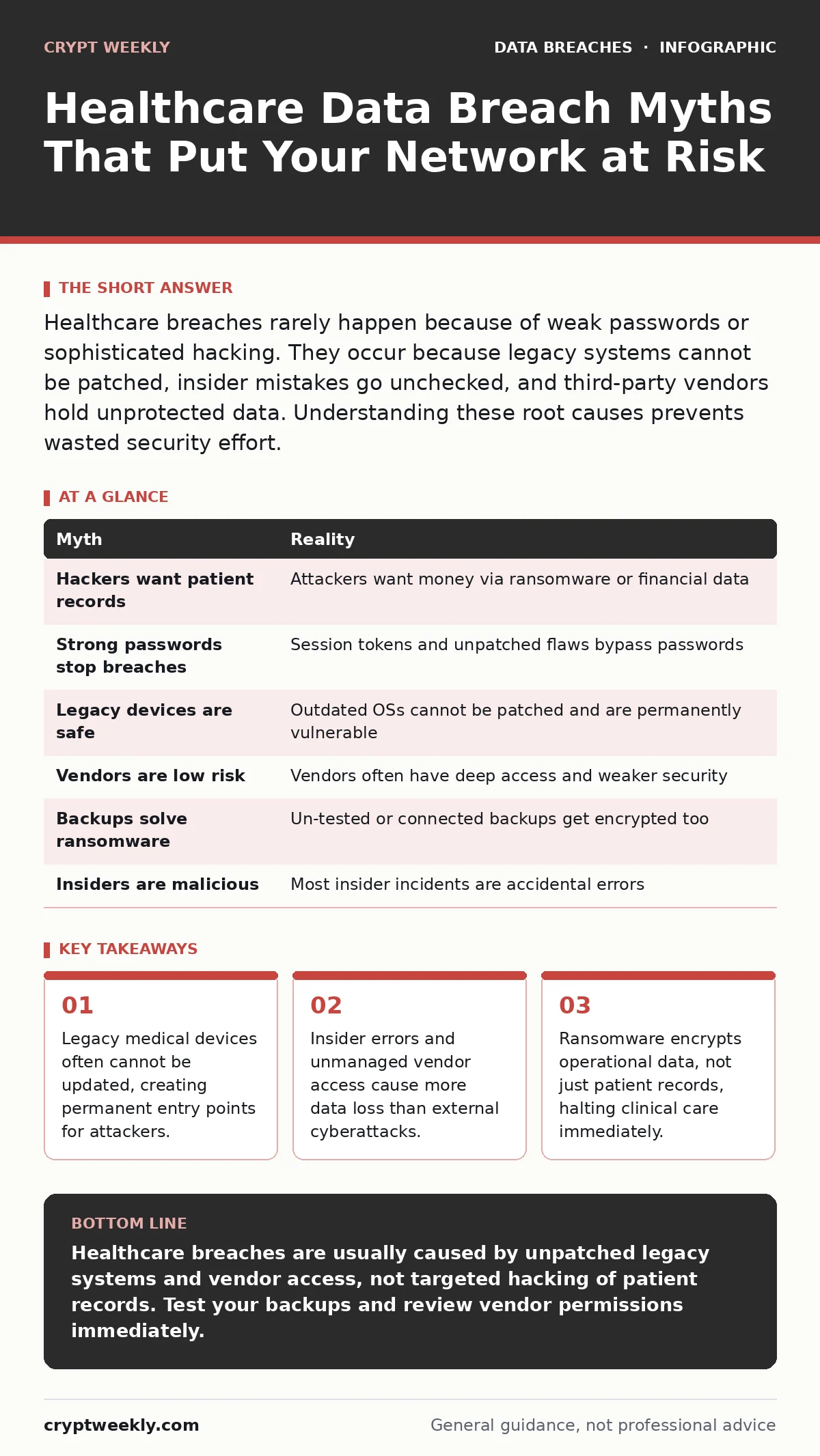
Healthcare breaches rarely happen because of weak passwords or sophisticated hacking. They occur because legacy systems cannot be patched, insider mistakes go unchecked, and third-party vendors hold unprotected data. Understanding these root causes prevents wasted security effort.
Myth: Hackers Target Healthcare for Patient Records
Reality: Most attackers do not want your patient health records. They want the money in the accounts linked to those records, or they want to shut down your operations. Medical data has a long shelf life, but financial data expires quickly if the card is frozen. Attackers prefer credit card numbers or bank details that can be monetized immediately.
Imagine a hospital network being locked by ransomware. The attackers do not care about the medical history of the patients. They care that the hospital must pay to restore access to its scheduling systems and electronic health records. This is extortion, not espionage. The medical data is collateral damage in a financial crime.
You must treat your financial systems and operational networks as the primary targets. If you focus only on protecting patient data at rest, you ignore the systems that keep the lights on. Those systems are often less protected because they are considered "internal" or "non-sensitive." This misconception leaves the door open for disruption.
Myth: Strong Passwords Prevent Breaches
Reality: Password rotation and complex passwords do not stop modern attacks. Attackers bypass passwords by stealing session tokens or exploiting unpatched software vulnerabilities. A session token is a digital key that proves you have already logged in. Once an attacker has this token, the password is irrelevant.
Suppose you force all staff to change passwords every thirty days. This creates fatigue. Users write passwords down or reuse them across personal accounts. When one personal account is breached, the attacker tries that password on your systems. This is credential stuffing. It works because humans are bad at generating unique entropy.
Instead of relying on password complexity, you should implement multi-factor authentication. This requires a second form of verification, such as a hardware key or a mobile push notification. Even if the password is stolen, the attacker cannot log in without the second factor. This stops the majority of automated attacks.
Myth: Legacy Medical Devices Are Safe Because They Are Isolated
Reality: Many medical devices run on outdated operating systems that cannot be patched. Manufacturers often support devices for ten years or more. During that time, security vulnerabilities are discovered and published. The device cannot be updated because the patch might break its medical function.
Imagine an MRI machine connected to the hospital network for image transfer. It runs an operating system from a decade ago. It has known flaws that allow remote code execution. Even if it is "isolated," network segmentation often fails due to misconfiguration. Attackers move laterally from a compromised workstation to the device.
You must treat these devices as inherently compromised. Assume they will be breached. Use strict network segmentation to limit what they can communicate with. Monitor traffic to and from these devices for anomalies. If a device sends data to an unknown external IP, that is a sign of an active breach.
Myth: Third-Party Vendors Are Low-Risk Partners
Reality: Vendors often have deeper access to your systems than your own staff. They manage billing, cloud storage, and IT infrastructure. Their security posture is rarely as strong as yours. A breach at a small vendor can expose your entire patient database.
Suppose a billing vendor stores patient data in an unencrypted cloud bucket. An attacker finds this bucket through a simple search. They download thousands of records. The breach is attributed to you, but the failure was the vendor's. You are responsible for the data, even when it is in someone else's hands.
You must conduct regular access reviews for all third-party accounts. Verify that vendors only have the permissions they need. Remove access when contracts end or roles change. Do not assume their security team is doing this for you. They often do not.
Myth: Backups Solve Ransomware Problems
Reality: Backups only work if they are tested and isolated. Many organizations have backups that are corrupted, incomplete, or connected to the same network as the production systems. If the ransomware encrypts the live data, it often encrypts the backups too.
Imagine a ransomware attack that locks your servers. You try to restore from backup. The backup files are also encrypted. You have no copy of your data. You are forced to pay the ransom or lose everything. This happens because the backup system was not air-gapped or immutable.
You must follow the 3-2-1 backup rule. Keep three copies of your data, on two different media types, with one copy offsite. More importantly, you must perform backup testing regularly. Verify that you can restore data from the backup in a controlled environment. If you cannot restore, you do not have a backup.
See also: Medical Identity Theft: How Stolen Health Records Cost You · Mistakes That Trigger Tax Identity Theft and How to Stop Them
Myth: Insider Threats Are Only Malicious Employees
Reality: Most insider incidents are accidental. A staff member sends an email to the wrong recipient. A configuration error leaves a database open to the internet. These mistakes are far more common than malicious insiders stealing data.
Suppose a nurse accidentally emails a patient’s test results to a wrong address. The data is now in the hands of an unauthorized person. This is a breach. It requires notification and remediation. The intent does not matter, only the exposure.
You must train staff on data handling procedures. Implement data loss prevention tools to block sensitive data from leaving the network via email. Review logs for unusual data access patterns. This helps identify both accidental errors and potential malicious activity.
| Myth | Reality |
|---|---|
| Hackers want patient records | Attackers want money via ransomware or financial data |
| Strong passwords stop breaches | Session tokens and unpatched flaws bypass passwords |
| Legacy devices are safe | Outdated OSs cannot be patched and are permanently vulnerable |
| Vendors are low risk | Vendors often have deep access and weaker security |
| Backups solve ransomware | Un-tested or connected backups get encrypted too |
| Insiders are malicious | Most insider incidents are accidental errors |
Key takeaways
- Legacy medical devices often cannot be updated, creating permanent entry points for attackers.
- Insider errors and unmanaged vendor access cause more data loss than external cyberattacks.
- Ransomware encrypts operational data, not just patient records, halting clinical care immediately.
Healthcare breaches are usually caused by unpatched legacy systems and vendor access, not targeted hacking of patient records. Test your backups and review vendor permissions immediately.
Frequently asked questions
How do I protect medical devices that cannot be updated?
Segment them from the main network and monitor their traffic for anomalies. Assume they are compromised.
What is the biggest risk from third-party vendors?
Excessive access rights. Vendors often have more access than they need, increasing the attack surface.
Why is backup testing more important than having backups?
Untested backups may be corrupted or incomplete. You cannot restore data if you have never verified the process.
How do I stop accidental data leaks by staff?
Use data loss prevention tools to block sensitive data from leaving the network via email or other channels.
How this guide was produced: written by the Crypt Weekly editorial team with AI assistance, checked against the public references listed below, and reviewed when the facts change. See our editorial policy or report an error.