
Your medical identity is more valuable than your credit card because it cannot be frozen, making early detection of data leakage your only real defense.
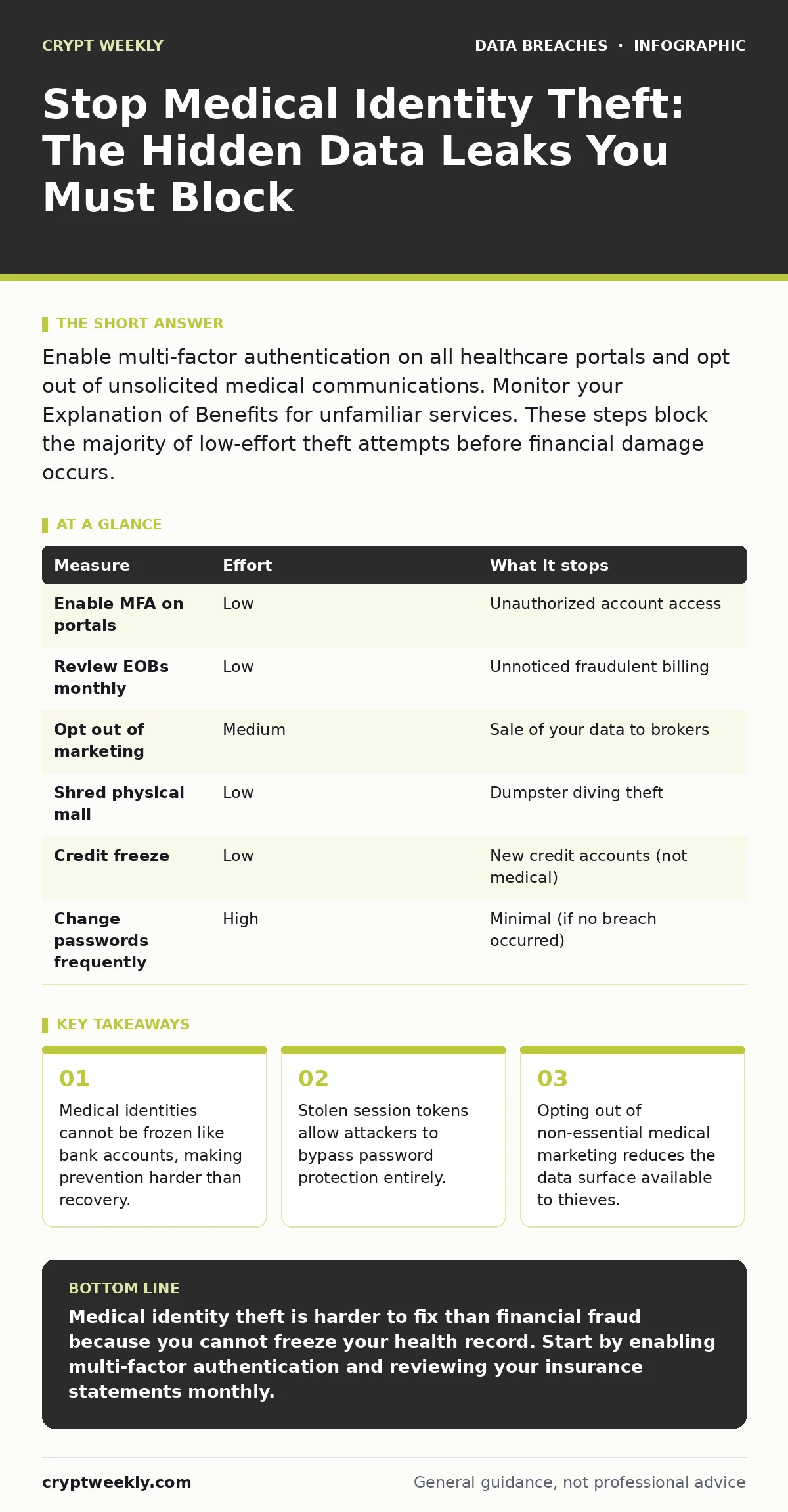
Enable multi-factor authentication on all healthcare portals and opt out of unsolicited medical communications. Monitor your Explanation of Benefits for unfamiliar services. These steps block the majority of low-effort theft attempts before financial damage occurs.
The Silent Value of Your Health Record
Your medical identity carries more weight than your financial identity. A thief can use your name and date of birth to obtain prescription drugs, bill for fake procedures, or build a false medical history. This false history can later deny you life insurance or loan approvals. Unlike a credit card, you cannot simply cancel a medical record. You must live with the erroneous data until a provider corrects it, a process that often takes months.
The damage is often invisible at first. By then, the thief has already moved on. You need to assume your personal health information is already in circulation. The goal is not to keep it secret, but to control who can use it.
Blocking the Digital Door with Authentication
The first line of defense is strong access control on any portal that holds your health data. This includes hospital patient portals, pharmacy apps, and insurance member sites. You must enable multi-factor authentication on every one of them. This requires two forms of verification, such as a password and a code from an authenticator app.
Many people rely on SMS codes for this second factor. This is a weak choice. Attackers can intercept text messages through SIM swapping or social engineering of customer service agents. Use an authenticator app or a hardware security key instead. These methods tie the login to a physical device you possess, not a phone number that can be transferred.
Understanding Session Hijacking Risks
Even with a strong password, you can lose access if an attacker steals your session token. A session token is a digital ticket that proves you have already logged in. If you log into a hospital portal on a public computer or a shared device, that ticket might remain active. An attacker who accesses that browser can use the ticket to enter your account without needing your password.
This is why you must log out explicitly after every use on shared or public devices. Do not just close the browser tab. Click the logout button. This destroys the session token on the server side. You should also review active sessions if the portal offers that feature. Look for logins from unfamiliar locations or devices and terminate them immediately.
For deeper context on how attackers exploit these digital tickets, see our guide on stolen session tokens. Understanding this mechanism helps you realize that password rotation is not enough if the session remains valid.
Cleaning Your Public Data Footprint
Thieves often start with data they can buy or scrape. Medical marketing lists are a common source. Companies that sell health products or services often purchase lists of names and addresses to mail brochures. If your name is on these lists, it signals that you are a real patient with a valid insurance number.
You can opt out of many of these lists. In the United States, the National Do Not Call Registry applies to telemarketing, but you can also request removal from specific medical marketing databases. Check your insurance provider’s privacy settings. Many insurers allow you to block the sharing of your data for marketing purposes. This does not stop clinical care communication, but it reduces the noise that thieves scan for targets.
Monitoring the Paper Trail
The most reliable indicator of medical identity theft is the Explanation of Benefits. This document is sent by your insurance company after a claim is processed. It lists what service was provided, where, and how much was paid. You should review this document every time you receive it.
Look for services you did not receive. Did you go to a lab in a different city? Did you pick up a prescription you do not take? Small errors are common, but patterns of unfamiliar care are not. Do not rely on annual credit reports to catch this. Medical debts appear on credit reports only after they have been sent to collections. By then, the damage is done.
See also: What Does Data Minimization Mean and How to Apply It · Anonymization vs De-identification: How to Choose the Right Data Strategy
Securing Physical Documents
Physical records are still a major leak point. When you receive medical bills or insurance cards in the mail, do not throw them in the regular trash. These documents contain your full name, date of birth, and often your insurance member ID. Thieves who sort through trash can reconstruct your identity from these scraps.
Shred any document that contains your name and a partial or full insurance number. Use a cross-cut shredder, not a strip-cut one. Strip-cut documents can sometimes be reassembled. Treat your medical mail with the same care as your bank statements. If you receive a new insurance card, destroy the old one immediately.
The Limits of Prevention
No single measure stops all theft. Healthcare systems are fragmented. A clinic may have weak security, while your insurer has strong security. If the clinic leaks your data, your strong password at the insurer does not matter. The data is already out.
This is why you must accept that some leakage is inevitable. Your strategy must shift from prevention to detection. You cannot stop every breach, but you can stop the thief from using the data effectively. This requires constant vigilance over your accounts and your physical documents.
Related to this, you should understand how healthcare data breaches occur. Knowing the common entry points helps you anticipate where your data might be exposed. It also helps you understand why providers may share data in ways you did not explicitly consent to.
Prioritizing Your Efforts
Not all security measures are equal. Some remove significant risk with little effort. Others consume time but offer minimal protection. You should focus on the high-impact actions first. The table below ranks common measures by the amount of risk they remove.
| Measure | Effort | What it stops |
|---|---|---|
| Enable MFA on portals | Low | Unauthorized account access |
| Review EOBs monthly | Low | Unnoticed fraudulent billing |
| Opt out of marketing | Medium | Sale of your data to brokers |
| Shred physical mail | Low | Dumpster diving theft |
| Credit freeze | Low | New credit accounts (not medical) |
| Change passwords frequently | High | Minimal (if no breach occurred) |
Notice that changing passwords frequently is low value. If an attacker has your password, they likely have it from a breach that already happened. Changing it now does not remove the old password from their database. Instead, focus on MFA and monitoring.
What Does Not Work
Many people believe that being "careful online" is enough. It is not. You cannot control the security of the hospital that treats you. You cannot control the pharmacy that fills your prescription. You must assume these entities will fail.
Another common mistake is relying on identity theft insurance. This covers financial loss, but it does not fix your medical record. You still have to spend hours disputing false diagnoses and correcting insurance claims. Insurance pays for the money, not the time.
For a broader view of data protection, see our guide on the 3-2-1 backup rule. While this applies to files, the principle of having redundant copies helps you recover if your digital health records are corrupted or locked by ransomware.
Your Daily Defense Checklist
You do not need to overhaul your life today. Start with three concrete actions. These steps address the most common entry points for medical identity theft.
- Enable multi-factor authentication on your primary insurance portal and pharmacy app. Use an authenticator app, not SMS.
- Review your last three Explanations of Benefits. Look for any service you do not recognize.
- Shred any medical bills or insurance notices currently in your trash bin.
Key takeaways
- Medical identities cannot be frozen like bank accounts, making prevention harder than recovery.
- Stolen session tokens allow attackers to bypass password protection entirely.
- Opting out of non-essential medical marketing reduces the data surface available to thieves.
Medical identity theft is harder to fix than financial fraud because you cannot freeze your health record. Start by enabling multi-factor authentication and reviewing your insurance statements monthly.
Frequently asked questions
Can I freeze my medical records like my credit?
No, there is no national system to freeze medical records. You can restrict access by placing a lock on your file with specific providers, but this does not stop all leakage.
How long does it take to fix medical identity theft?
It often takes months or years. You must dispute each false claim with the provider and the insurer. Correcting a false medical history is particularly difficult.
Do I need to monitor my credit report for medical theft?
You should, but it is not enough. Medical debt appears on credit reports only after it goes to collections. Monitor your insurance statements for earlier detection.
Is my health data safe in the cloud?
No data is completely safe. Cloud storage reduces some physical risks, but it introduces new digital risks. Focus on access controls and monitoring rather than assuming the cloud is secure.
How this guide was produced: written by the Crypt Weekly editorial team with AI assistance, checked against the public references listed below, and reviewed when the facts change. See our editorial policy or report an error.