
FortiGate flaws often stem from complex code interactions that turn security gateways into entry points for unauthorized access.
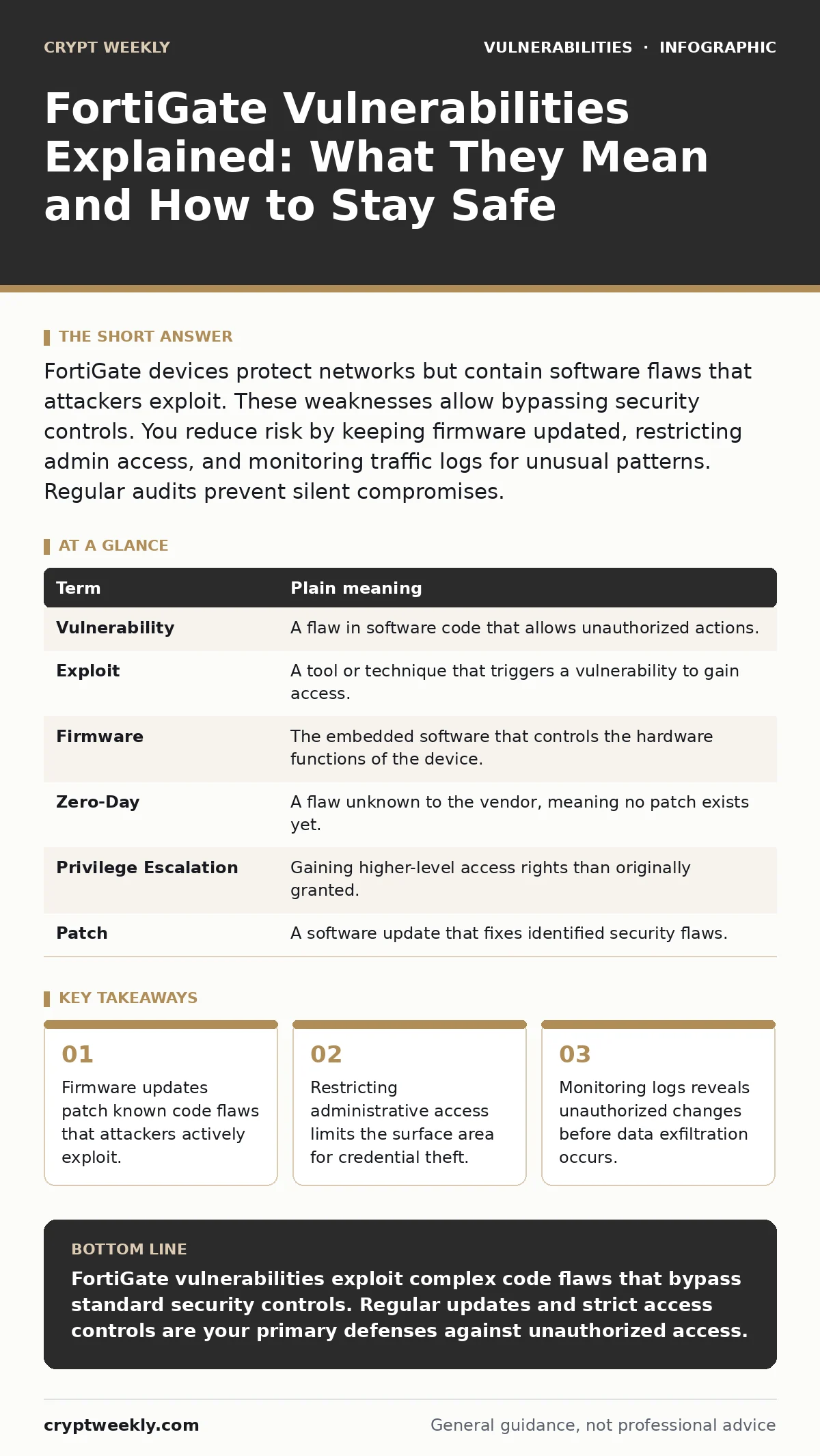
FortiGate devices protect networks but contain software flaws that attackers exploit. These weaknesses allow bypassing security controls. You reduce risk by keeping firmware updated, restricting admin access, and monitoring traffic logs for unusual patterns. Regular audits prevent silent compromises.
The Locked Gate Analogy
Imagine a fortress with a single guarded gate. The guard checks every visitor’s ID before allowing entry. This gate represents your FortiGate firewall. It sits between the public internet and your private network. Its job is to inspect traffic and block malicious data. When a vulnerability exists, it is like finding a loose stone in the gate’s foundation. Attackers do not need to trick the guard. They simply push through the weak spot in the structure itself. This bypasses the intended security checks entirely. The gate remains locked, but the wall around it is compromised.
Key Terms Defined
Understanding the mechanics requires clear definitions. These terms describe how flaws manifest in network devices. Precision matters when discussing security architecture and failure modes.
| Term | Plain meaning |
|---|---|
| Vulnerability | A flaw in software code that allows unauthorized actions. |
| Exploit | A tool or technique that triggers a vulnerability to gain access. |
| Firmware | The embedded software that controls the hardware functions of the device. |
| Zero-Day | A flaw unknown to the vendor, meaning no patch exists yet. |
| Privilege Escalation | Gaining higher-level access rights than originally granted. |
| Patch | A software update that fixes identified security flaws. |
Why Firewalls Have Flaws
Firewalls run complex operating systems. They must process millions of data packets per second. This complexity creates opportunities for coding errors. A null pointer dereference bug might cause the system to crash when processing a malformed packet. Attackers craft specific traffic to trigger these crashes. This can stop the firewall from functioning or open a backdoor. The device is designed to protect, yet its own code can become the weakest link. Complexity is the enemy of security in embedded systems.
The Hidden Cost of Convenience
Many users configure firewalls for ease of use. They enable remote administration from any IP address. This convenience creates a massive attack surface. Attackers scan the internet for devices with open admin ports. If you leave default credentials or weak passwords, they gain entry. This is not a theoretical risk. It is a daily occurrence. The trade-off is clear: easy access for you means easy access for them. Restricting administrative access to specific internal networks reduces this risk significantly. You must balance usability with security constraints.
What This Means for Users
An ordinary user does not manage the firewall directly. However, you are affected by its failures. If a FortiGate device is compromised, attackers can intercept your traffic. They can steal login credentials or inject malicious content into web pages. You might see no signs of intrusion. The device continues to route traffic normally. This stealth makes detection difficult. Your data privacy depends on the integrity of that gateway. Trusting a single device without verification is dangerous. Assume the perimeter can be breached.
See also: Medical Device Security Myths: 6 False Beliefs That Leave Patients Exposed
Simple Safety Habits
You can influence security even if you do not administer the device. Advocate for regular firmware updates. These patches close known vulnerabilities. Push for strict access controls on management interfaces. Ensure that only authorized personnel can change settings. Monitor for unusual network behavior. If your connection slows or websites redirect unexpectedly, report it. These could be signs of a compromised gateway. Awareness drives better security practices across the organization.
Try This Now
- Check if your organization has a patch management policy for network devices.
- Verify that remote administrative access is disabled or restricted to VPN connections.
- Review recent network logs for unauthorized configuration changes or failed login attempts.
Beyond Basic Prevention
Security is not just about fixing known bugs. You must consider how components interact. Dependency scanning helps identify vulnerable libraries within the firmware. This proactive approach finds flaws before they are exploited. Consider threat modeling for applications to understand potential attack paths. This shifts focus from reactive patching to proactive design. Understanding business logic flaws reveals how attackers misuse legitimate features. A firewall can be configured correctly but still fail due to logic errors. Depth of understanding prevents oversights.
The Role of Verification
Regular testing ensures your defenses work. Penetration testing simulates real-world attacks to find weaknesses. This process identifies gaps that automated scans miss. It validates the effectiveness of your security controls. However, testing must be done responsibly. Coordinate with your security team to avoid disrupting services. Responsible disclosure ensures that vendors are notified of flaws before public exposure. This allows them to develop patches. Collaboration between users, testers, and vendors strengthens the ecosystem. Silence helps attackers, not defenders.
Staying Ahead of Threats
Attackers constantly evolve their techniques. Side-channel attacks exploit information leakage from physical implementation. These are hard to detect and require specialized defenses. You cannot patch against every theoretical attack. Focus on reducing the attack surface. Limit unnecessary services and ports. Keep software updated. Monitor for anomalies. Security is a continuous process, not a one-time fix. Stay informed about new vulnerabilities. Adapt your defenses as threats change. Vigilance and adaptation are your best tools.
Key takeaways
- Firmware updates patch known code flaws that attackers actively exploit.
- Restricting administrative access limits the surface area for credential theft.
- Monitoring logs reveals unauthorized changes before data exfiltration occurs.
FortiGate vulnerabilities exploit complex code flaws that bypass standard security controls. Regular updates and strict access controls are your primary defenses against unauthorized access.
Frequently asked questions
How do I know if my FortiGate is vulnerable?
Check the vendor’s security advisory page for known flaws matching your firmware version.
Can a firewall vulnerability steal my passwords?
Yes, if the attacker intercepts traffic or gains administrative access to the device.
Is updating firmware enough to stay secure?
No, you must also restrict access and monitor logs for unusual activity.
What is a zero-day attack on a firewall?
It exploits a flaw the vendor does not yet know about, leaving no immediate patch.
How this guide was produced: written by the Crypt Weekly editorial team with AI assistance, checked against the public references listed below, and reviewed when the facts change. See our editorial policy or report an error.